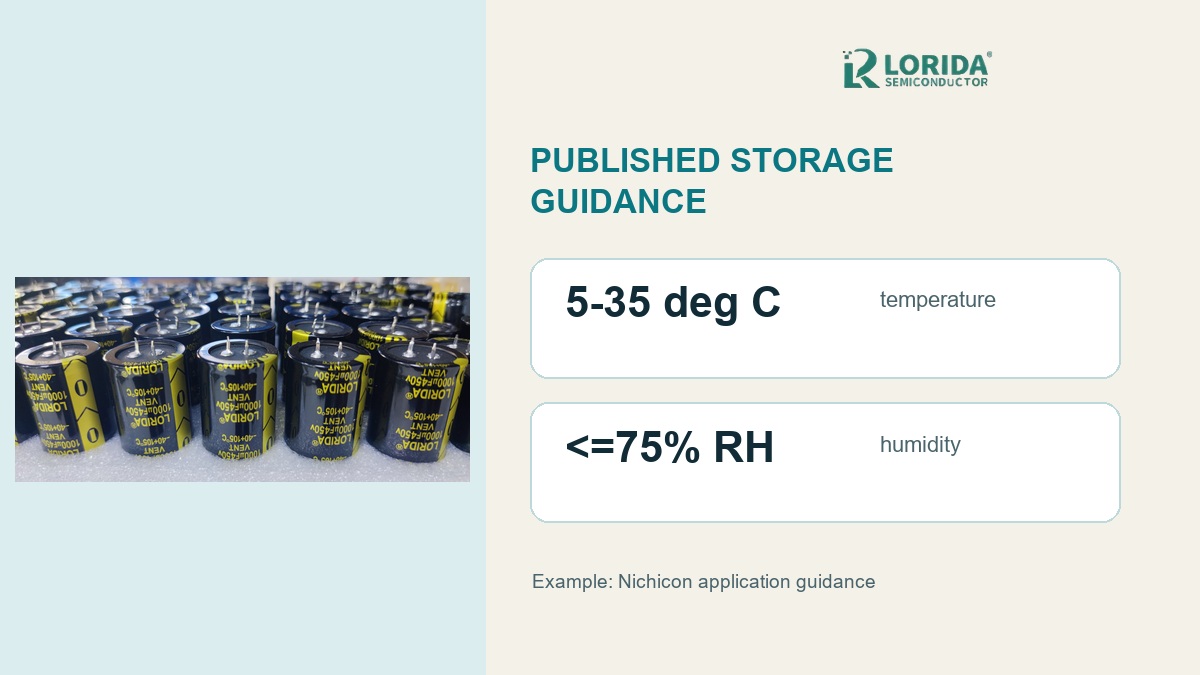
Aluminum electrolytic capacitors should be released from storage only after the buyer verifies the date code, storage environment, package condition, series-specific shelf-life rule, and any required voltage treatment. Nichicon recommends 5 to 35 deg C and 75% RH or less, while Nippon Chemi-Con notes that storage limits are commonly 2 to 3 years depending on the product. These figures are manufacturer guidance, not universal LORIDA specifications. The correct acceptance plan must follow the exact offered series and the equipment owner's safety procedure.
Last Updated: September 19, 2026
Key Takeaways
What an OEM buyer should control
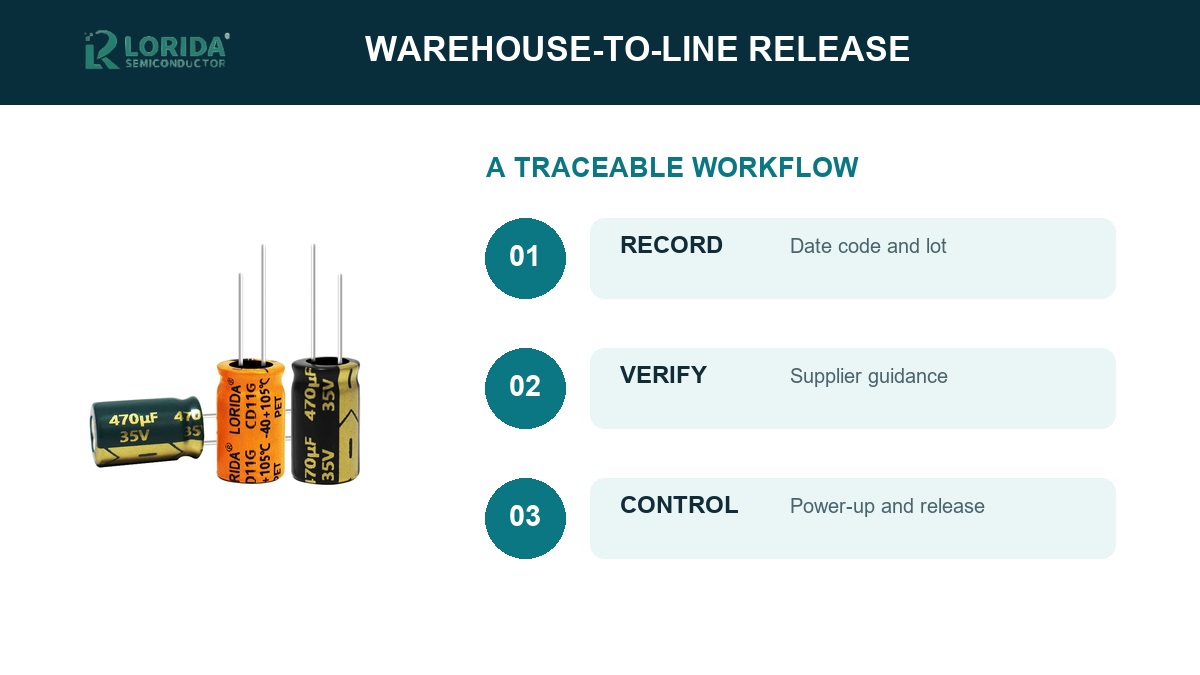
Record the manufacturer, series, lot or date code, receipt date, packaging status, and storage history.
Do not turn a general two- or three-year guideline into a universal expiry date; use the exact supplier document.
Inspect for swelling, leakage, corrosion, damaged seals, and contaminated terminals before electrical testing.
Use a controlled, current-limited voltage treatment only when the relevant manufacturer or equipment procedure requires it.
Release the lot only after leakage current, capacitance, dissipation factor or ESR, solderability, and first-article behavior meet approved limits.
Why Storage Changes the First Power-Up Risk
The oxide dielectric is maintained electrochemically
An aluminum electrolytic capacitor uses an aluminum oxide dielectric on the anode foil. During long storage without voltage, the oxide layer can lose part of its insulating performance. When power is first applied, leakage current may therefore be higher until the oxide is restored by the electrochemical action of the electrolyte. TDK states that leakage current after voltage-free storage may reach up to 100 times its normal level during the first few minutes, depending on storage time and temperature.
This does not mean every stored capacitor is defective. It means the first energization must be treated as a controlled engineering event. High leakage current produces heat. In a severely degraded part, applying full voltage without current limitation can create enough internal pressure to operate the safety vent. A warehouse release decision therefore needs storage evidence and electrical acceptance limits, not only a capacitance reading.
Six Checks Before Releasing Stored Capacitors
1. Verify identity and traceability
Match the physical label to the purchase order, approved specification, and controlled drawing. Record manufacturer, series, capacitance, rated voltage, temperature category, termination, date or lot code, and quantity. Photograph the unopened package and representative labels. If the date-code format is unclear, ask the supplier to decode it in writing rather than inferring the manufacturing date.
2. Reconstruct the storage environment
Ask for temperature and humidity records, packaging type, sunlight exposure, chemical atmosphere, and whether the lot experienced condensation. Nichicon recommends storage from 5 to 35 deg C at 75% RH or less. Nippon Chemi-Con also recommends normal temperature and humidity without direct sunlight and warns that high humidity can reduce solderability through terminal oxidation.
3. Inspect the package and capacitor
Check bags, cartons, trays, desiccant, and labels for water marks or damage. Inspect representative parts for a raised pressure vent, electrolyte residue, sleeve shrinkage, seal distortion, corrosion, bent terminals, and foreign material. Do not attempt voltage treatment on a visibly leaking, swollen, mechanically damaged, or badly corroded capacitor. Quarantine it and obtain a disposition from qualified engineering and the supplier.
4. Read the exact shelf-life rule
Nippon Chemi-Con states that storage limits are generally 2 to 3 years depending on the product, while its detailed table lists up to 3 years for packaged aluminum electrolytic capacitors and different limits for some polymer types. Nichicon says a conventional aluminum electrolytic capacitor stored for less than 2 years at 5 to 35 deg C can generally be used without voltage treatment. The difference is the lesson: series and construction matter.
5. Define voltage treatment from the approved source
Do not copy one reforming recipe into every work instruction. Nippon Chemi-Con gives an example of approximately 1 kohm in series at rated voltage for 30 to 60 minutes. Nichicon gives approximately 1 kohm at rated voltage for about 30 minutes for an individual capacitor. TDK describes an IEC acceptance-test preconditioning method using approximately 100 ohm at 100 VDC or below, or 1000 ohm above 100 VDC, for one hour, followed by 12 to 48 hours without voltage before leakage measurement. These procedures serve different documents and must not be mixed.
6. Approve the lot with measurable evidence
After the approved conditioning process, measure the parameters specified for the exact series. TDK notes that IEC leakage-current acceptance measurement is referenced at 20 deg C after rated voltage has been applied for 5 minutes. Record the test temperature, supply, current limit, dwell time, measured leakage, capacitance, dissipation factor or ESR, and final discharge. For soldered types, include solderability when storage or humidity history warrants it. Then validate a representative first article in the actual equipment.
Compare the Published Guidance Before Writing a Procedure
Different documents answer different questions
| Official source | Published figure | How an OEM buyer should use it |
|---|---|---|
| Nichicon application guideline | 5 to 35 deg C; 75% RH or less; generally less than 2 years without voltage treatment | Use as manufacturer guidance, then confirm the exact series and storage history. |
| Nippon Chemi-Con storage FAQ | Common storage limit 2 to 3 years; about 1 kohm for 30 to 60 minutes in its voltage-treatment note | Use the product-category table and current series document; do not convert it into a universal rule. |
| TDK general technical information | Leakage may be up to 100 times normal initially; IEC preconditioning uses one hour plus a 12 to 48 hour rest | Distinguish acceptance-test preconditioning from a factory or equipment field procedure. |
| Exact offered series | Series-specific leakage, capacitance, ESR or dissipation factor, temperature, and test method | This is the controlling evidence for lot release and first-article approval. |
Safety boundary: aluminum electrolytic capacitors can retain hazardous energy after the supply is removed. Only qualified personnel using rated equipment, current limitation, guarding, discharge controls, and an approved procedure should perform voltage treatment or powered testing.
Build a Traceable Warehouse-to-Line Workflow
Separate inventory status from electrical acceptance
A warehouse status such as "within storage period" is not an electrical test result. Link each lot to its receipt date, manufacturer date code, storage records, package-opening status, and any exposure event. Define the trigger for engineering review, the sampling plan, test limits, disposition authority, and label applied after approval. FIFO helps inventory rotation, but it does not replace a controlled acceptance process.
For a supplier RFQ, request the current data sheet, shelf-life statement, voltage-treatment instruction, leakage-current limit and measurement condition, packaging requirements, date-code explanation, and change-control commitment. Buyers can review the LORIDA capacitor product center, the 1500 uF 450 V screw-terminal capacitor page, and the related VFD DC-bus capacitor selection guide. Final approval still requires the exact offered model and application duty.
Frequently Asked Questions
How long can aluminum electrolytic capacitors be stored?
There is no single universal storage period for every aluminum electrolytic capacitor. Nippon Chemi-Con says limits commonly depend on the product and are often 2 to 3 years, while Nichicon says conventional parts stored for less than 2 years at 5 to 35 deg C can generally be used without voltage treatment. Polymer, hybrid, snap-in, screw-terminal, radial, and SMD constructions can have different packaging and storage rules. Use the exact series document, manufacturing date, packaging status, temperature and humidity history, and supplier confirmation. Treat an unknown or interrupted storage history as an engineering-review condition rather than assuming the lot is acceptable or expired.
Do electrolytic capacitors always need reforming after storage?
No, voltage treatment is not automatically required for every stored capacitor. The decision depends on the manufacturer, series, storage duration, environment, package condition, and intended equipment. Some manufacturer guidance allows use without treatment inside a defined storage period and environment. A part that already meets the specified leakage-current requirement may also not need preconditioning for a particular acceptance test. Conversely, visibly damaged or leaking parts should not be treated as recoverable inventory. The approved work instruction should state who makes the decision, what document controls it, how the current is limited, what values are measured, and what conditions require rejection.
What resistor should be used to reform an electrolytic capacitor?
Use the resistance and procedure specified for the exact capacitor or equipment; do not choose a generic resistor value from the internet. Nichicon and Nippon Chemi-Con publish examples around 1 kohm, while TDK documents approximately 100 ohm for rated voltage at or below 100 VDC and 1000 ohm above 100 VDC in an IEC preconditioning context. These are not interchangeable universal recipes. The resistor must also have adequate voltage, pulse-energy, and power ratings. Qualified personnel should define supply limits, guarding, dwell time, stop criteria, measurement points, discharge method, and acceptance limits before energizing the part.
What evidence should accompany an aged-capacitor RFQ?
Send traceability, storage history, exact electrical requirements, and the proposed acceptance plan. Include manufacturer and series, photographs, date or lot codes, quantity, storage temperature and humidity records, package-opening date, environmental excursions, visible condition, rated voltage and capacitance, termination, dimensions, leakage-current limit, ESR or dissipation-factor requirement, and equipment duty. Ask the supplier to return the current data sheet, controlled drawing, shelf-life and voltage-treatment statement, date-code explanation, sample-test report, and change-control terms. For replacement projects, also provide bus voltage, ripple spectrum, ambient temperature, cooling, mounting, and expected life.
Send your electrolytic capacitor storage and RFQ data
Include the exact series, lot or date code, storage history, package condition, voltage duty, ripple spectrum, temperature, dimensions, quantity, and required acceptance tests.