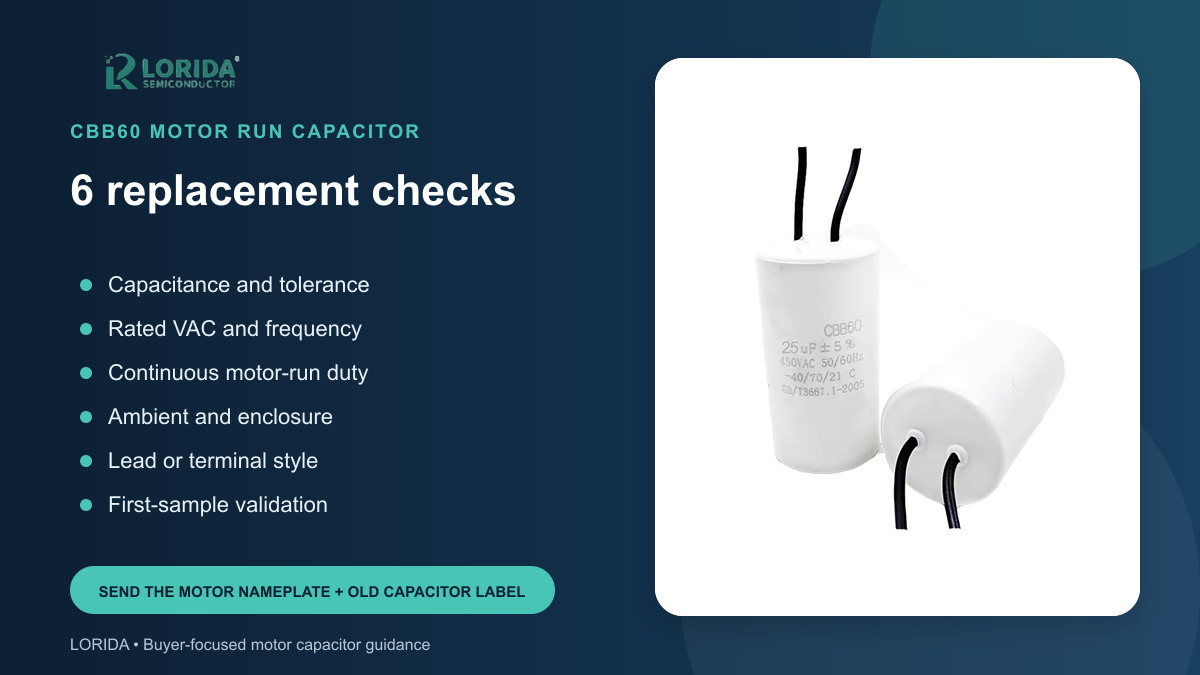
A CBB60 motor run capacitor replacement should match capacitance, tolerance, voltage, frequency, continuous-duty requirements and mechanical connection—not capacitance alone. Start with the motor nameplate and the complete old-capacitor label, then confirm the voltage measured across the capacitor under real operating conditions. LORIDA's public CBB60 page describes a dry polypropylene-film construction for motor-run applications and lists a 25 µF, 450 V example. This guide turns those facts into a six-check replacement and RFQ process while keeping third-party series data clearly separated from LORIDA specifications.
Last Updated: 2026-09-08
Need a replacement shortlist? Send the motor nameplate, old-capacitor label, wiring photo, dimensions, supply frequency and measured capacitor voltage.
Key Takeaways
What buyers should confirm before ordering
Use the original capacitance and tolerance as the starting point, but verify the motor manufacturer's requirement.
Do not reduce the rated AC voltage below the required operating duty.
Confirm 50/60 Hz marking, continuous motor-run duty, temperature environment and enclosure conditions.
Match lead or terminal style, body dimensions and mounting method.
Validate the first sample on the real motor before freezing the production construction.
Why a CBB60 replacement is more than a µF match
Motor-run duty is continuous
A motor run capacitor remains connected while the motor operates, so its dielectric, self-heating, voltage stress and enclosure environment matter throughout the duty cycle. IEC 60252-1:2010 covers AC motor capacitors intended for asynchronous motors at frequencies up to 100 Hz and rated voltages up to and including 660 V. The IEC page also notes that operating a capacitor above rated voltage can reduce life. Those limits describe the scope of the standard, not a rating for every CBB60 product.
Third-party examples show why exact-series data matters
KEMET's C28 motor-run series is one engineering example: its official data sheet lists polypropylene construction, 470 VAC, ±5% capacitance tolerance, 50–60 Hz use and an operating temperature range of −25 to +85 °C. It also lists maximum permissible voltage of 1.10 times rated voltage and current of 1.30 times rated current. These values belong to that KEMET series; they are not LORIDA specifications. Their value here is to show which fields a buyer should request for the exact quoted part.
Six checks for a CBB60 motor run capacitor replacement
Normalize every quotation to one operating point
| Check | Evidence to send | What to confirm |
|---|---|---|
| 1. Capacitance | Original µF and motor requirement | Exact nominal value and tolerance |
| 2. Rated voltage | Old label and measured capacitor voltage | Required VAC rating and margin method |
| 3. Frequency | Motor supply frequency | 50 Hz, 60 Hz or both as applicable |
| 4. Duty and safety | Continuous run duty, enclosure and applicable market | Declared standard, safety class and protection device |
| 5. Environment | Ambient temperature, airflow and moisture exposure | Temperature category and enclosure suitability |
| 6. Mechanical fit | Diameter, height, mounting and wiring photo | Body size, leads or terminals and mounting method |
Read public catalogue information carefully
LORIDA's CBB60 product page describes polypropylene film dielectric, dry construction, flame-retardant plastic or metal-aluminum shells, epoxy sealing and optional P2/P0 configurations. It lists applications including water pumps, washing machines and shredders, and the visible catalogue includes a CBB60 450 V 25 µF example. These are useful screening facts. The supplier quotation still needs to identify the exact series, construction, drawing and verified electrical limits for the requested motor.
How to collect the right replacement data
Photograph both the motor and capacitor labels
A complete label photograph reduces transcription errors. Capture capacitance, tolerance, rated voltage, frequency, temperature category, safety marking, manufacturer and part code. Photograph the lead exit or terminal arrangement and measure the body diameter and height. Record whether the capacitor is held by a clamp, stud or molded feature. If the old component is swollen, leaking or unreadable, do not infer the missing rating from body size; obtain the motor documentation or have a qualified technician identify the circuit.
Measure the operating condition safely
The voltage across a run capacitor can differ from the motor's supply voltage because of the auxiliary winding and phase-shift circuit. A qualified technician should measure the capacitor voltage with correctly rated equipment and appropriate electrical safety practices. Include steady-state motor current, ambient temperature, run time, cycling pattern and any start or overheating symptom. If the application is a pump or appliance, note the load condition used during measurement because a lightly loaded bench test may not represent the production duty.
How to validate the first sample
Test electrical behavior and temperature together
Install the sample using the intended production wiring and mounting. Confirm starting behavior, running current, speed stability, noise and vibration. After the system reaches thermal stability, record ambient temperature and capacitor surface temperature at a consistent point. Inspect the connections for looseness, discoloration or heating. If the replacement changes lead length or terminal style, verify that the routing does not contact hot, moving or sharp components. Compare all results with the approved baseline rather than accepting a sample because the motor merely starts.
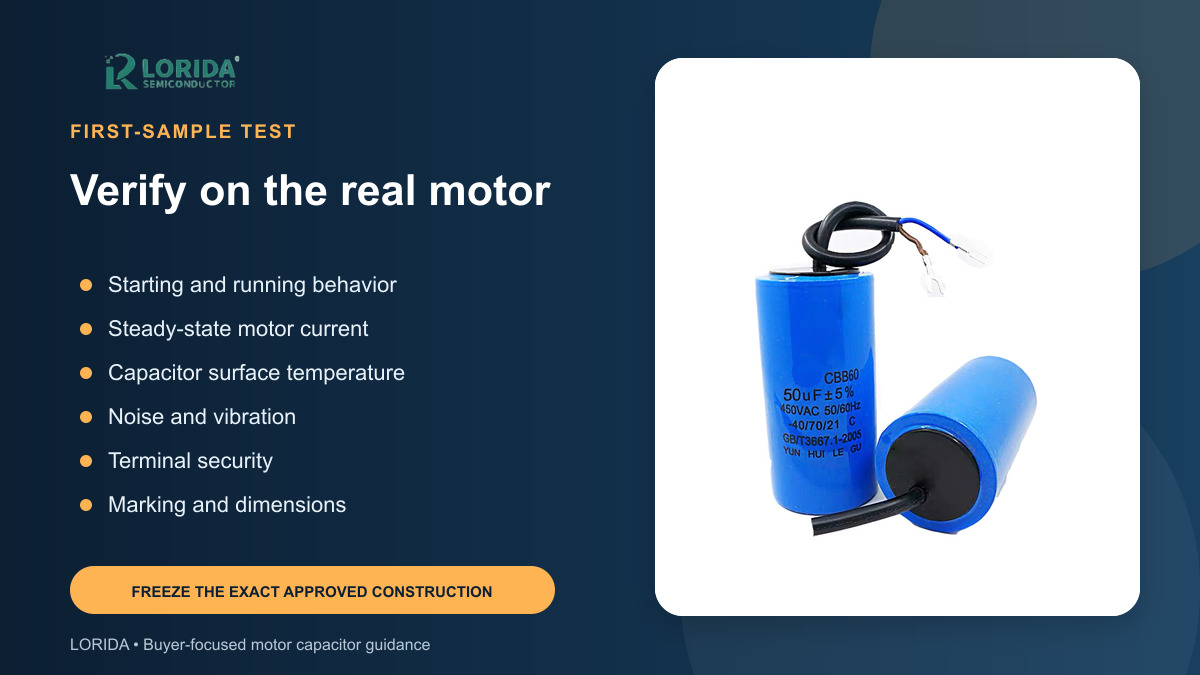
Freeze the exact approved construction
The approval record should identify manufacturer, series, part number, capacitance, tolerance, rated voltage, frequency, temperature category, safety class, case material, dimensions, lead or terminal drawing and marking. Keep photographs of the tested sample and the test conditions. If a later shipment changes the case, terminals, marking, dielectric construction or supplier part number, route it through change review. This helps ensure that the evidence collected during sample validation still applies to the delivered item.
Frequently Asked Questions
Can I replace a CBB60 capacitor with the same µF but a higher VAC rating?
A higher VAC rating may be acceptable, but the voltage label alone does not prove a correct replacement. Keep the required capacitance and tolerance, then confirm continuous motor-run duty, frequency, temperature category, safety construction, body size and connection style. A higher-voltage part may be physically larger or may use a different terminal arrangement. Ask the supplier for the exact data sheet and drawing, and validate the sample on the real motor. Do not substitute a lower voltage rating, and do not use a start-only capacitor where a continuous-duty run capacitor is required.
Is a CBB60 a start capacitor or a run capacitor?
CBB60 is commonly used as a motor run capacitor, but the exact product label and data sheet must confirm its duty. Run capacitors are intended to remain in the circuit during operation, while start capacitors are normally switched out after startup. Similar-looking cylindrical parts can have different constructions and duty limits, so appearance is not enough. Check the application diagram, old component marking and motor documentation. For an RFQ, explicitly state continuous motor-run duty and provide the operating voltage, frequency, ambient temperature and run cycle so the quoted part can be checked against the actual service.
What if the proposed capacitance tolerance is different?
Do not approve a different tolerance until the motor designer or responsible engineer confirms the acceptable range. Capacitance affects auxiliary-winding current, phase shift, running torque, efficiency, noise and temperature. A wider tolerance can allow units farther from the nominal value even when the printed µF number is unchanged. Compare the full tolerance band of the original requirement with the proposed part, then test samples at relevant limits when the design is sensitive. Record the accepted nominal value and tolerance in the drawing or approved-parts list so future quotations use the same requirement.
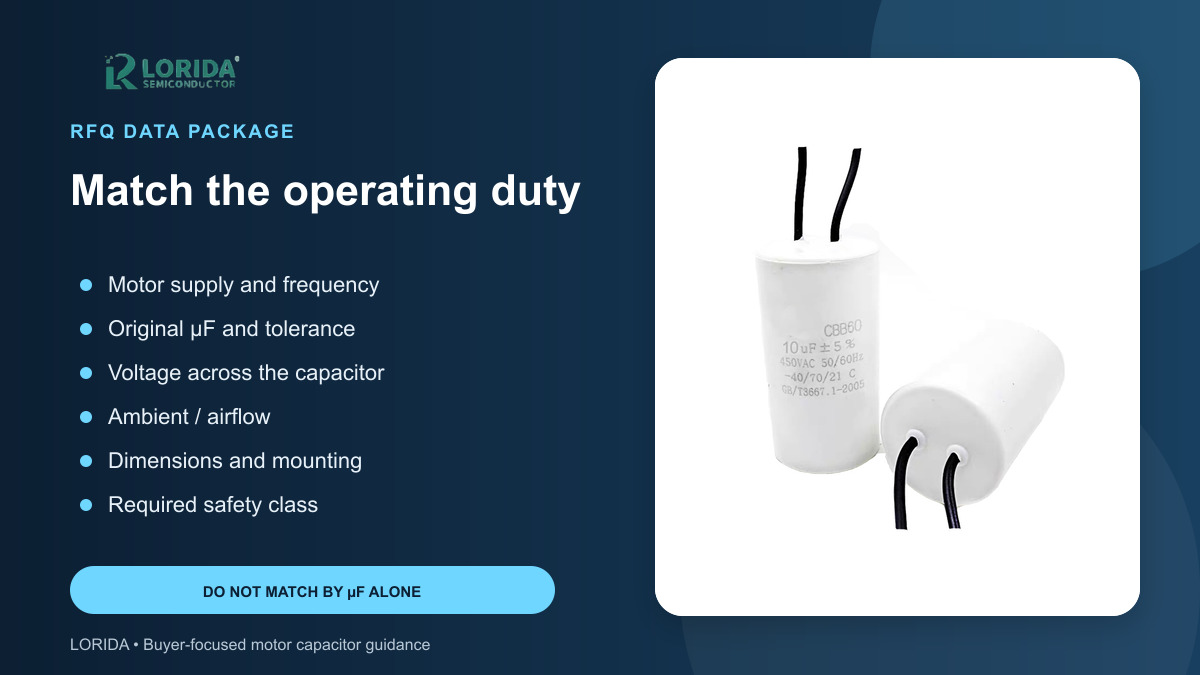
What information should I send in a CBB60 replacement RFQ?
Send the motor nameplate, complete old-capacitor label, supply frequency, measured capacitor voltage, dimensions, mounting and wiring photos. Add the ambient temperature, enclosure condition, run cycle, annual quantity and destination market. State whether you need plastic or metal housing, leads or terminals, and any required declared standard or safety class. If a failure triggered the replacement, describe the symptom and provide photos, but avoid assuming the capacitor caused the problem. A complete data package lets suppliers compare the same operating duty and answer with an exact part number, drawing and sample-validation plan.
Build a conversion-ready RFQ package
Use the same evidence for every supplier
Keep the RFQ compact: one motor nameplate photo, one readable capacitor-label photo, one wiring and mounting photo, a dimension sketch and a short operating-data table. Ask each supplier to fill missing fields rather than returning a generic catalogue. For related options, review LORIDA's CBB60 capacitor page, capacitor range and product center. Then use the same first-sample checklist for the shortlisted construction.
Ready for a technical quotation? Attach the label photos and six replacement checks. LORIDA can use that package to identify candidate CBB60 constructions for sample review.
Sources
Verified references used for exact data
LORIDA CBB60 Capacitor: https://www.loridacapacitor.com/cbb60-capacitor/
IEC 60252-1:2010 official publication page: https://webstore.iec.ch/en/publication/1153
KEMET C28 Motor Run Capacitors data sheet: https://content.kemet.com/datasheets/KEM_F3115_C28.pdf
TDK Motor Run Capacitor product search: https://www.tdk-electronics.tdk.com/en/3192234/products/product-catalog/film-capacitors/motor-run-and-motor-start-capacitors/search-results-deltacap-capacitors