

Film capacitor humidity resistance should be selected from a named temperature-humidity-bias test, not from a generic claim such as “moisture proof.” The useful evidence states temperature, relative humidity, applied voltage, duration, recovery method, and electrical acceptance limits for the exact series. This guide gives OEM buyers six checks for comparing metallized film capacitors used in industrial power, filtering, and suppression circuits without turning another manufacturer’s test into a LORIDA product rating.
Request the complete THB condition: temperature, humidity, voltage, duration, and acceptance criteria.
Match the test to the exact dielectric, metallization, enclosure, terminals, and safety class.
Separate initial values from post-test changes in capacitance, loss, and insulation resistance.
Validate the assembled equipment because condensation, contamination, heat, and electric field distribution differ from a component test.
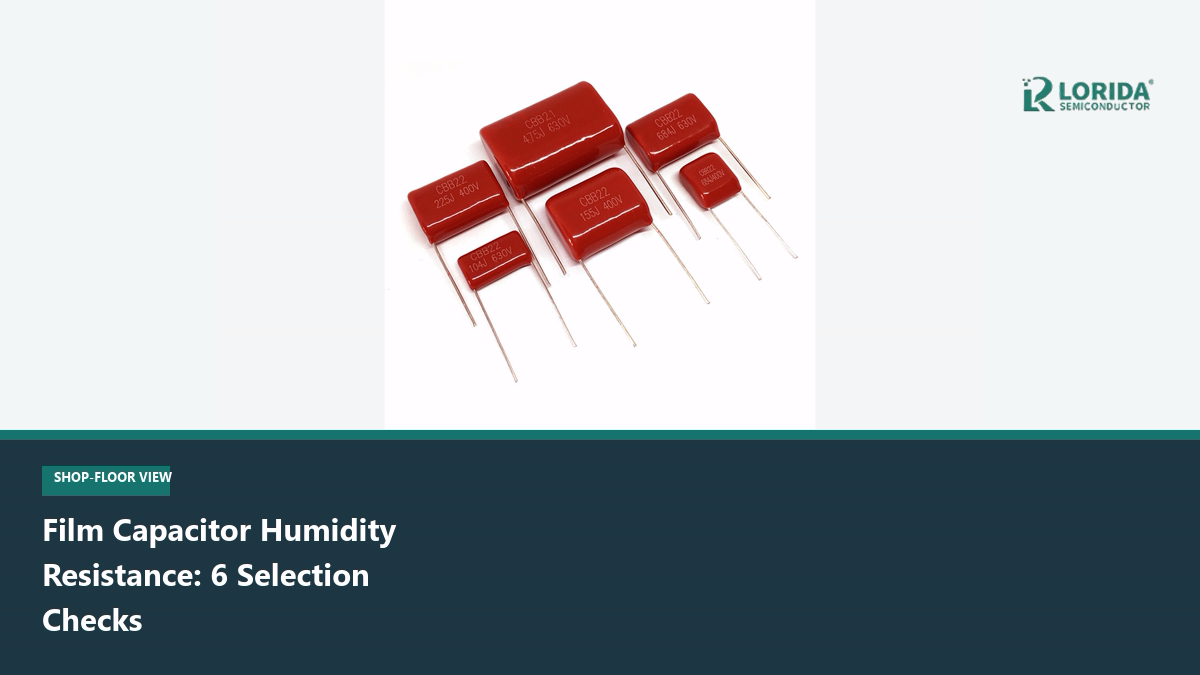
Why humidity changes the selection decision
Moisture acts on insulation and metallization
Humidity can lower insulation resistance, promote corrosion at electrode edges or contacts, and change the conditions around weak dielectric areas. Self-healing does not make the package immune to sustained moisture and bias. Sealing, film treatment, metallization, terminals, and enclosure all influence the result, so compare controlled series evidence.
A published test is meaningful only with its conditions
TDK’s B3291xH/J4 X1 example is specified for 480 V AC and 1000 V DC operation, and the manufacturer reports a THB test at 85 °C, 85% relative humidity, for 1000 hours at 380 V AC and 1000 V DC. The same announcement gives a capacitance range of 15 nF to 10.0 µF and a maximum operating temperature of 110 °C. These numbers demonstrate how a complete evidence set is structured; they apply to that named TDK family, not automatically to another capacitor.
Six checks before approving a humid-environment capacitor
1. Define the real environment
State the continuous and cyclic temperature, maximum relative humidity, condensation risk, altitude, contamination, enclosure protection, airflow, and storage conditions. “Indoor” is not a sufficient environment definition. Record where the capacitor sits relative to vents, cold surfaces, heat sinks, and possible conductive deposits.
2. Match circuit position and safety class
Identify whether the part is used for DC link, pulse, coupling, motor run, across-line suppression, or another function. A general DC film capacitor cannot be converted into an X- or Y-class safety capacitor by choosing a higher voltage label. For direct mains connection, specify the required suppression class, equipment standard, approval markets, rated frequency, impulse requirement, and discharge provisions. KEMET likewise ties self-healing safety film capacitors to across-line filtering.
3. Request the exact THB protocol
Ask for temperature, relative humidity, applied AC or DC voltage, test duration, sample count, preconditioning, recovery time, and measurement method. Do not treat “85/85 tested” as complete because the voltage and duration can differ. TDK’s older rugged DC-link example used 60 °C, 95% relative humidity, rated voltage, and 1000 hours, while special versions were described at 85 °C, 85% relative humidity, rated voltage, and 1000 hours. Those different profiles are not interchangeable.
4. Read the acceptance limits
Qualification evidence should state what changed after exposure. Require the initial and final capacitance, dissipation factor, insulation resistance or leakage current, dielectric strength where applicable, and visual or mechanical acceptance criteria. A test condition without a pass/fail limit cannot support a sourcing decision. Conversely, a limit without the exact measurement frequency, voltage, temperature, and recovery period cannot be reproduced during supplier approval or incoming inspection.
5. Check voltage, ripple, and self-heating together
Humidity qualification does not replace electrical and thermal selection. TDK’s general film-capacitor information lists example maximum self-heating values of 10 °C for polypropylene and 15 °C for PET or PEN. Those are general material examples, not universal LORIDA limits. Use the exact series curves for AC voltage, RMS current, frequency, and temperature. Measure capacitor surface temperature after stabilization and include startup, regenerative, and abnormal operating modes.
6. Validate the assembled equipment
Test the proposed capacitor in the real enclosure or a representative fixture. Monitor voltage and current at the capacitor terminals, case temperature, capacitance, dissipation factor, insulation behavior, and visible changes before and after environmental exposure. Include condensation or contamination when credible, but do not create unsafe conditions outside the equipment test plan. A component certificate cannot predict every field pattern, PCB residue, or enclosure cycle.
| RFQ field | Buyer input | Evidence to approve |
|---|---|---|
| Environment | Temperature, RH, condensation, pollution, enclosure | Named qualification condition and result |
| Electrical duty | DC/AC voltage, ripple, frequency, transients | Series curves and selection comparison |
| Post-test limits | Required capacitance, loss, insulation behavior | Initial/final values and measurement method |
| Mechanical fit | Body, pitch, clearance, coating, terminals | Drawing and approved physical sample |
How to compare candidate constructions
Use one operating envelope for every candidate
Compare candidates against the same environment, waveform, temperature, cooling, life target, and failure preference. A part with a stronger THB claim may still be unsuitable if its voltage or ripple-current curve does not cover the application. A larger case may offer thermal margin but fail the approved footprint. Start with the LORIDA film-capacitor category and a relevant controlled product record such as the CBB22 4.7 µF 630 V record, then confirm the ordered construction, drawing, and evidence.
Keep self-healing and humidity claims in context
For metallized film capacitors, self-healing can isolate a localized dielectric breakdown by clearing thin metallization around the fault. TDK describes metallization thickness of 20–50 nm, local plasma temperature up to 6000 K, and quenching after a few microseconds in its general technical guide. These figures explain the mechanism but do not define humidity life. Repeated clearing, corrosion, heating, or loss of insulation can still accumulate. Review the related film-capacitor self-healing checks without substituting them for the selected series test.
Frequently asked questions
What does 85/85 mean for a film capacitor?
It usually means exposure at 85 °C and 85% relative humidity, but those two numbers alone do not define the test. You still need the applied voltage, duration, sample count, conditioning, recovery period, measurement method, and acceptance limits. One TDK X1 family is described at 85/85 for 1000 hours with 380 V AC and 1000 V DC applied, but another series can use different stress. Ask for the exact report or controlled datasheet and keep the part number linked to the result.
Does a THB test guarantee outdoor life?
No, a THB test is qualification evidence under defined laboratory conditions, not a universal outdoor-life guarantee. Field exposure can add condensation, salt, dust, chemical contamination, ultraviolet radiation, vibration, thermal cycling, and enclosure leaks. Electrical stress and self-heating can also differ from the qualification fixture. Use the component test to screen candidates, then validate the selected part in the actual enclosure and mission profile. Define inspection intervals and end-of-life criteria when the equipment’s consequence of failure is significant.
Is polypropylene always better than polyester in humidity?
No, dielectric material alone does not determine humidity resistance. Polypropylene generally offers low dielectric loss, but the finished capacitor also depends on film treatment, metallization, edge design, winding, end spray, encapsulation, terminals, sealing, and manufacturing control. Polyester can be appropriate for other size, temperature, or circuit requirements. Compare exact series evidence under the same humidity, voltage, and temperature conditions. Do not approve a substitute from the material name or package color alone.
What should I send with a humid-environment film-capacitor RFQ?
Send the circuit position, complete voltage and current waveform, temperature-humidity profile, condensation risk, enclosure details, life target, dimensions, and required standards. Include DC and AC stress, frequency spectrum, ripple current, transient peaks, ambient and measured hotspot temperature, ventilation, altitude, contamination, duty cycle, safety class, approvals, lead pitch, body envelope, and acceptance tests. Photographs, drawings, and terminal waveform captures reduce ambiguity. Use the LORIDA contact page to submit the controlled requirement set.
Sources
Primary technical references
Send the operating environment, waveform, thermal profile, mechanical limits, standards, and validation criteria so candidates can be compared under one controlled envelope.
Request a technical quotationLast Updated: November 5, 2026


