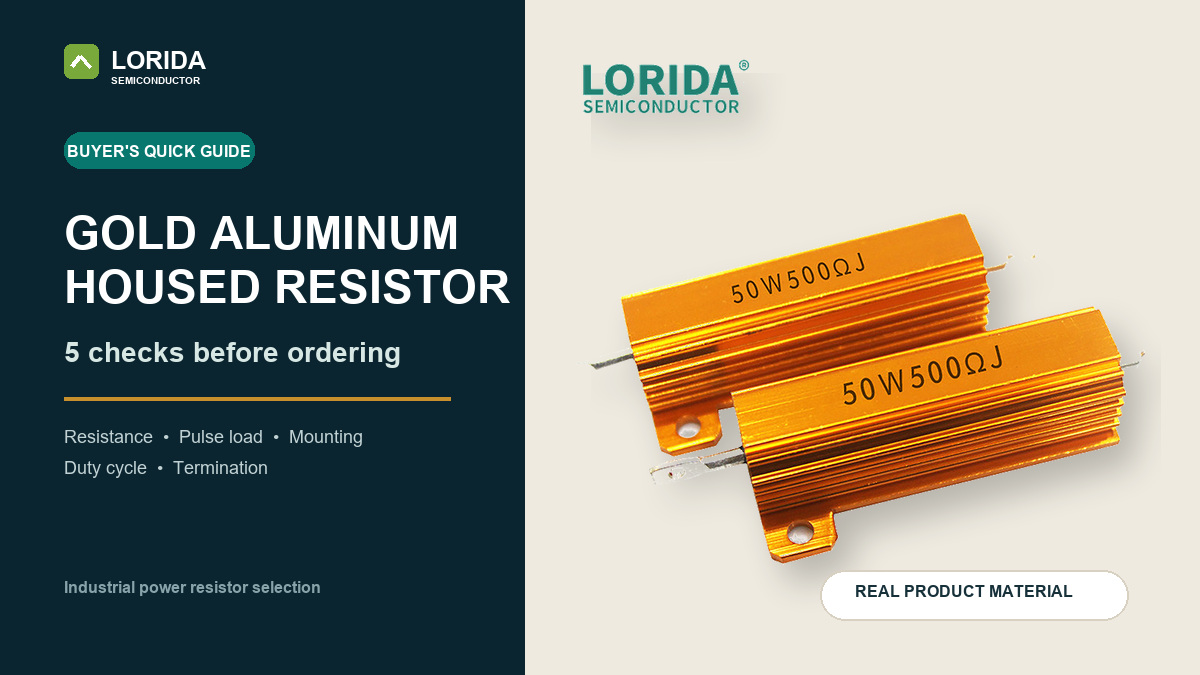
Choosing a gold aluminum housed resistor is not simply a matter of matching resistance and wattage. In braking, pre-charge, discharge and industrial power-control circuits, pulse energy, mounting and duty cycle often determine whether the resistor operates reliably.
Start with the application, not the catalogue
First confirm the resistance specified by the drive, controller or circuit designer. A value that is too low may increase current beyond the switching device limit; a value that is too high may reduce the energy-dissipation effect. The required resistance range should therefore come from the system design—not from enclosure size alone.
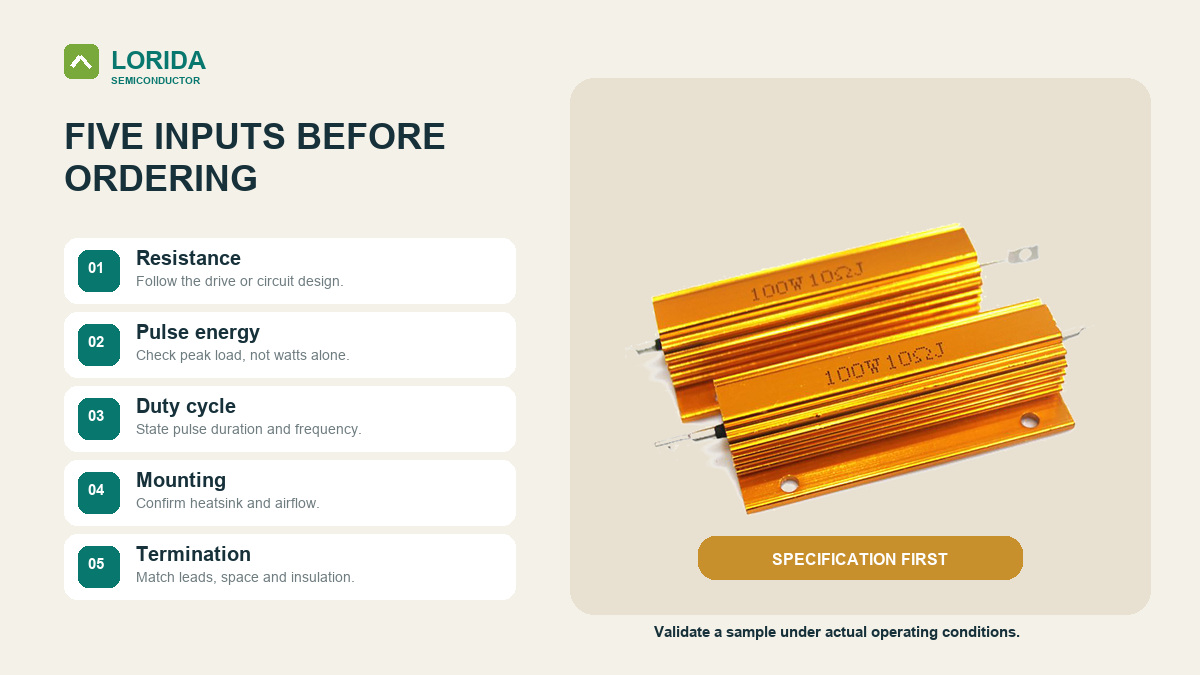
Five details to send before requesting a quote
| Resistance | Target value, allowable range and tolerance |
| Load profile | Peak power or pulse energy, pulse duration and repetition rate |
| Thermal conditions | Ambient temperature, airflow and mounting surface |
| Mechanical limits | Available space, fixing method and lead direction |
| Order context | Application, sample quantity and estimated demand |
Why mounting changes the real power capability
The aluminum housing transfers heat to the mounting surface. Rated power may depend on a defined heatsink and installation condition, so the catalogue wattage should not be treated as the guaranteed dissipation in every cabinet. Flat contact, suitable thermal interface material, airflow and clearance from heat-sensitive parts all matter.

A practical purchasing rule
Compare suppliers using the same operating profile, then validate a sample in the real system before bulk ordering. This is more useful than comparing wattage labels alone and helps reduce redesign, overheating and mismatched lead or mounting issues.
Send LORIDA your target resistance, load or braking cycle, mounting space, lead requirement, application and quantity. Our team can review the specification and prepare a suitable sample proposal.
Quick FAQ
Can wattage alone determine the correct resistor?
No. Pulse energy, duty cycle, ambient temperature and heatsink conditions must be considered together.
Should the final selection be tested?
Yes. Sample validation under actual operating and mounting conditions is recommended before volume purchase.