Quick Answer
A DC-link film capacitor for a solar, energy storage or industrial inverter should not be selected by capacitance and voltage alone. Buyers should also confirm RMS ripple current, ESR, ESL, hot-spot temperature, terminal design and expected lifetime.
The best RFQ includes measured operating conditions. This helps the supplier match the electrical rating and mechanical construction without repeated sample revisions.
What Does the DC-Link Capacitor Do?
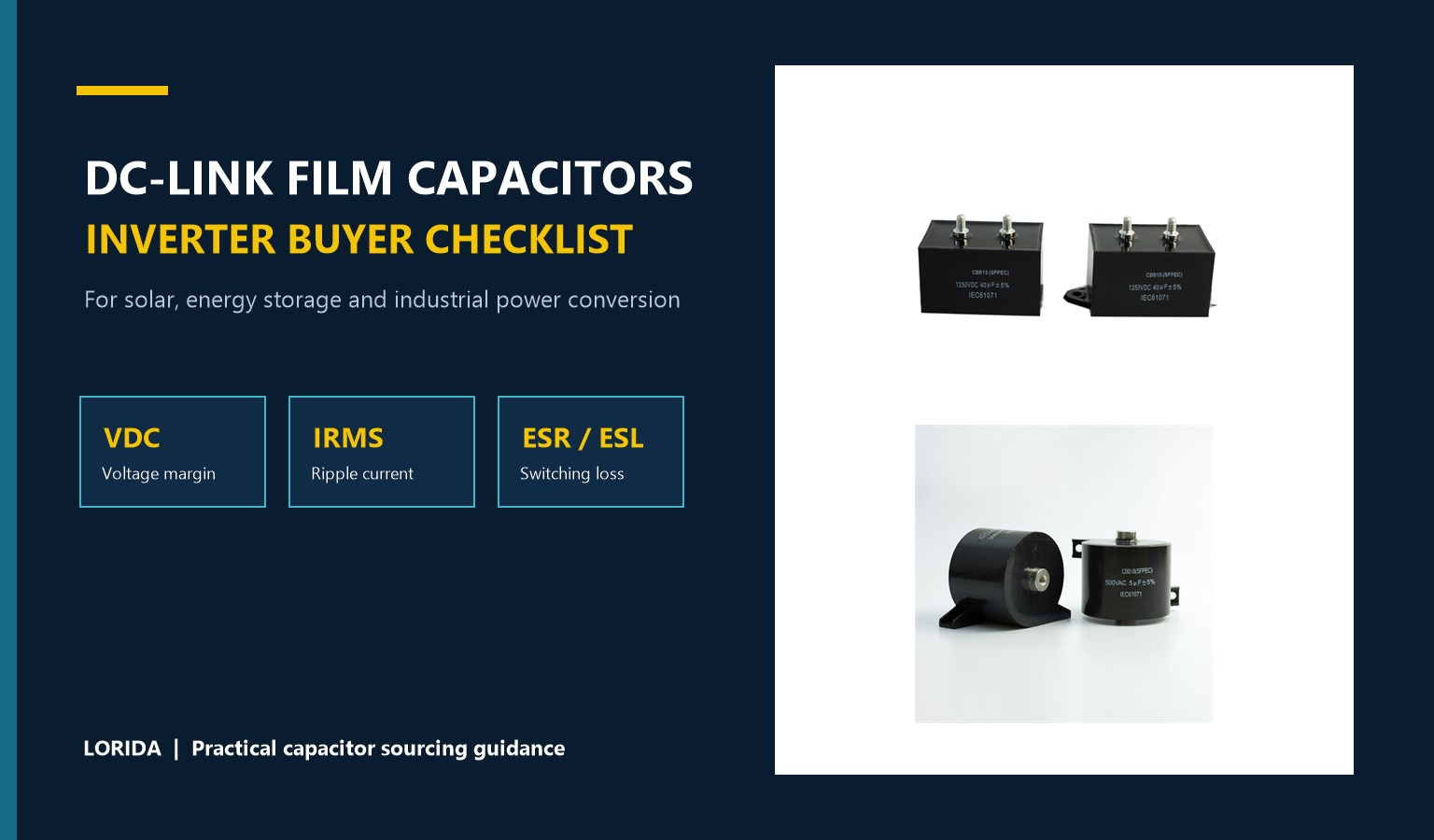
The DC-link capacitor stabilizes the DC bus, stores short-term energy and supplies pulsating current to the inverter stage. Metallized polypropylene film capacitors are commonly considered where low loss, high ripple capability and self-healing behavior are required.
The final choice still depends on the inverter topology, switching frequency, cooling method and service environment.
Four Electrical Checks Before Sampling
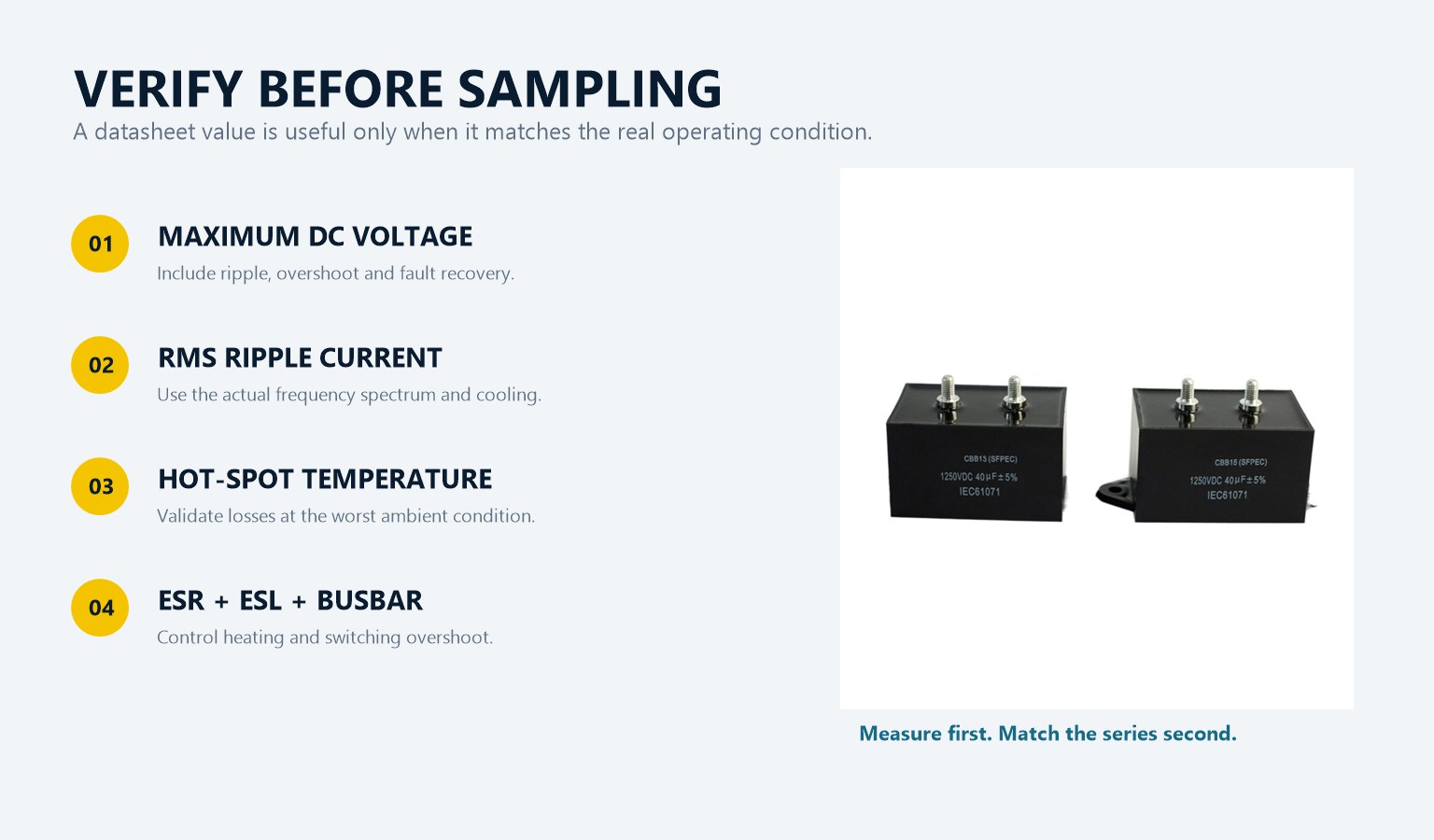
1. Maximum DC voltage
Start with the highest continuous bus voltage. Add ripple, startup overshoot, regenerative events and fault-recovery conditions. Apply the derating rules specified for the selected capacitor series.
2. RMS ripple current
Ripple current produces heat inside the capacitor. Provide the RMS current and relevant frequency spectrum, not only inverter power. Confirm the rating at the expected ambient and cooling condition.
3. ESR, ESL and switching behavior
Low ESR reduces power loss. Low ESL and a short busbar path help control voltage overshoot in fast-switching SiC or IGBT designs. A suitable capacitor can still perform poorly if the connection adds excessive inductance.
4. Hot-spot temperature
Lifetime depends on the internal hot-spot temperature, not only room temperature. Ask the supplier to estimate losses and life using series-specific data, then confirm the result during prototype testing.
Match the Mechanical Design
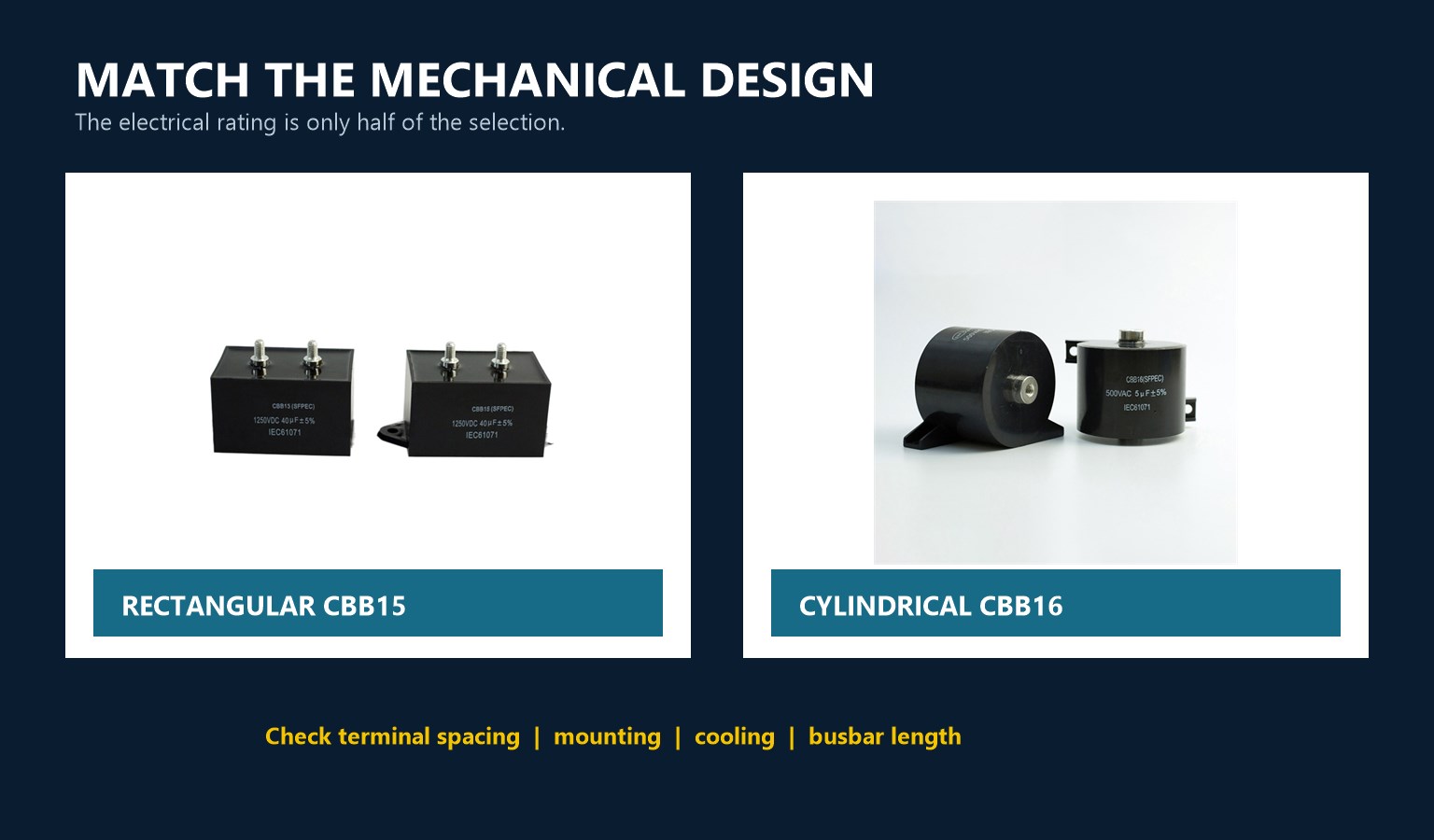
Check case dimensions, terminal spacing, mounting holes, creepage distance, busbar position and airflow. A rectangular CBB15-style package and a cylindrical CBB16-style package can require very different installation layouts even when their electrical purpose is similar.
What Should Buyers Include in the RFQ?
nominal and maximum DC bus voltage;
required capacitance and tolerance;
RMS ripple current and frequency spectrum;
ambient temperature, cooling and lifetime target;
maximum dimensions, terminal spacing and mounting method;
sample quantity and estimated annual demand.
How Should Samples Be Validated?
Run the inverter at maximum continuous load and the worst expected cooling condition. Record bus voltage, ripple current and capacitor temperature. Check startup, shutdown and fault recovery for overshoot. Inspect terminal heating and mounting stability before approving volume production.
Frequently Asked Questions
Can a higher voltage rating always replace the original capacitor?
No. The new part may have different capacitance, size, ESR, ESL or terminal geometry.
Why does busbar design matter?
Extra connection inductance can increase switching overshoot and reduce the benefit of a low-ESL capacitor.
What information speeds up model selection?
Measured voltage, RMS ripple, temperature, space limits and a clear lifetime target.
Need a DC-Link Capacitor Recommendation?
Send LORIDA your electrical conditions, mechanical drawing, cooling method and expected quantity. Our team can review the application and recommend a practical CBB15, CBB16 or customized DC-link film capacitor option for prototype evaluation.