400 0345 800

How to Select Aluminum Electrolytic Capacitors for 48V AI Server Power Systems

July. 23, 2026

Short Answer: What Should Buyers Specify?

For a nominal 48V server power rail, do not select an aluminum electrolytic capacitor by capacitance alone. The correct part must tolerate the highest continuous bus voltage and switching transients, carry the measured RMS ripple current at the actual operating frequency, stay within its core-temperature limit, and fit the mechanical and airflow constraints of the power supply.

A 63V capacitor can be a starting point for some regulated 48V rails, but it is not automatically the right choice. If startup overshoot, hot-plug events or abnormal conditions reduce the voltage margin, an 80V or 100V design may be more appropriate. The final decision should be based on measured waveforms and the capacitor supplier's application data.

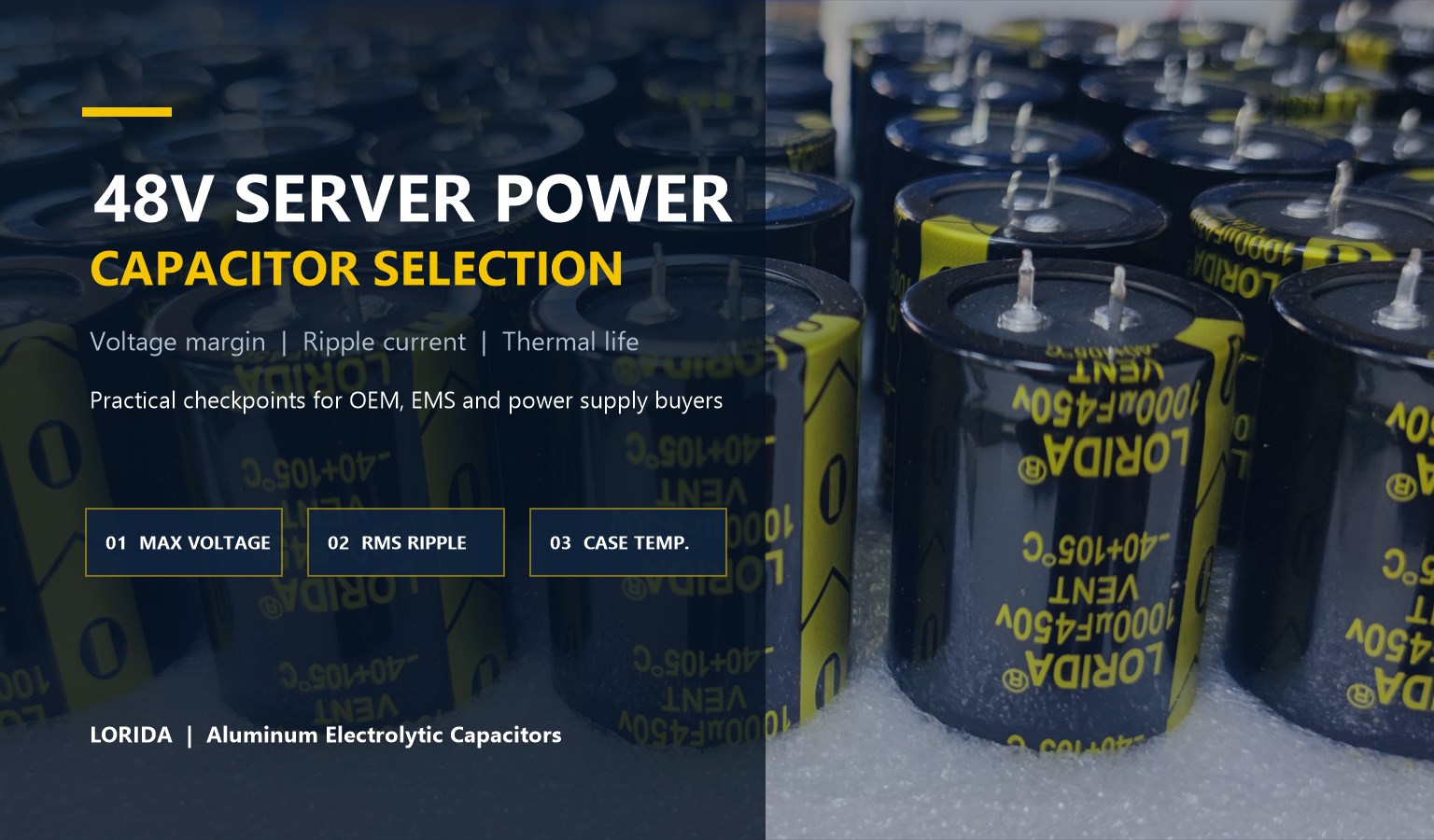
Aluminum electrolytic capacitors on a 48V AI server power conversion board
A 48V server power stage combines bulk energy storage, low-ESR filtering and careful thermal design.

Why 48V Server Power Designs Put More Pressure on Capacitors

Modern AI and high-density server systems move large amounts of power through compact conversion stages. Loads can change quickly, airflow is shared with other heat-producing components, and board space is limited. In this environment, the bulk capacitor bank has to support transient energy, limit low-frequency voltage movement and handle ripple without excessive self-heating.

Aluminum electrolytic capacitors are commonly used for bulk energy storage and low-frequency filtering. Polymer capacitors and MLCCs may be placed closer to converters and processors for higher-frequency decoupling. These technologies are complementary; one capacitor type rarely solves every frequency range and transient requirement.

1. How Much Voltage Margin Is Needed on a 48V Rail?

Start with the highest voltage the capacitor will see, not the nominal label on the power bus. Include charger or rectifier tolerance, startup overshoot, load-dump behavior, hot-plug events and test limits. The capacitor's rated voltage must remain above that worst-case value with a practical engineering margin.

  • 63V rating: may be suitable when the rail is tightly controlled and verified transients remain safely below the rating.

  • 80V or 100V rating: can provide more headroom where overshoot, field conditions or future design revisions are uncertain.

  • Important trade-off: a higher voltage rating often increases case size, cost or ESR, so over-specifying every position is not always efficient.

Send the supplier an oscilloscope capture of the maximum bus voltage, including startup and fault-recovery conditions. That is more useful than stating only “48V application.”

2. How Should Capacitance Be Estimated?

For an initial transient estimate, engineers often use:

C ≥ I × Δt / ΔV

Here, I is the load step, Δt is the time before the converter responds, and ΔV is the allowed voltage drop. This gives a useful starting value, but it does not include ESR-related voltage step, component tolerance, aging or temperature behavior.

Increasing capacitance can reduce droop, but a large nominal value with poor ESR or insufficient ripple-current capability may still run hot. Review capacitance, impedance and ripple together rather than treating microfarads as the only purchasing parameter.

3. Why Do ESR and Ripple Current Matter?

Ripple current creates internal heat. A simplified relationship is:

Power loss ≈ IRMS2 × ESR

This is why a small increase in RMS current can create a much larger thermal penalty. Buyers should compare ripple-current ratings at the relevant frequency and temperature, not just the largest number printed on a datasheet. Frequency correction factors and ambient-temperature derating may apply.

Low ESR is generally helpful for efficiency and temperature, but “the lowest ESR available” is not a universal rule. Some converter control loops depend on a certain output-capacitor impedance range. When replacing an existing capacitor, confirm stability requirements with the power-supply designer before making a major ESR change.

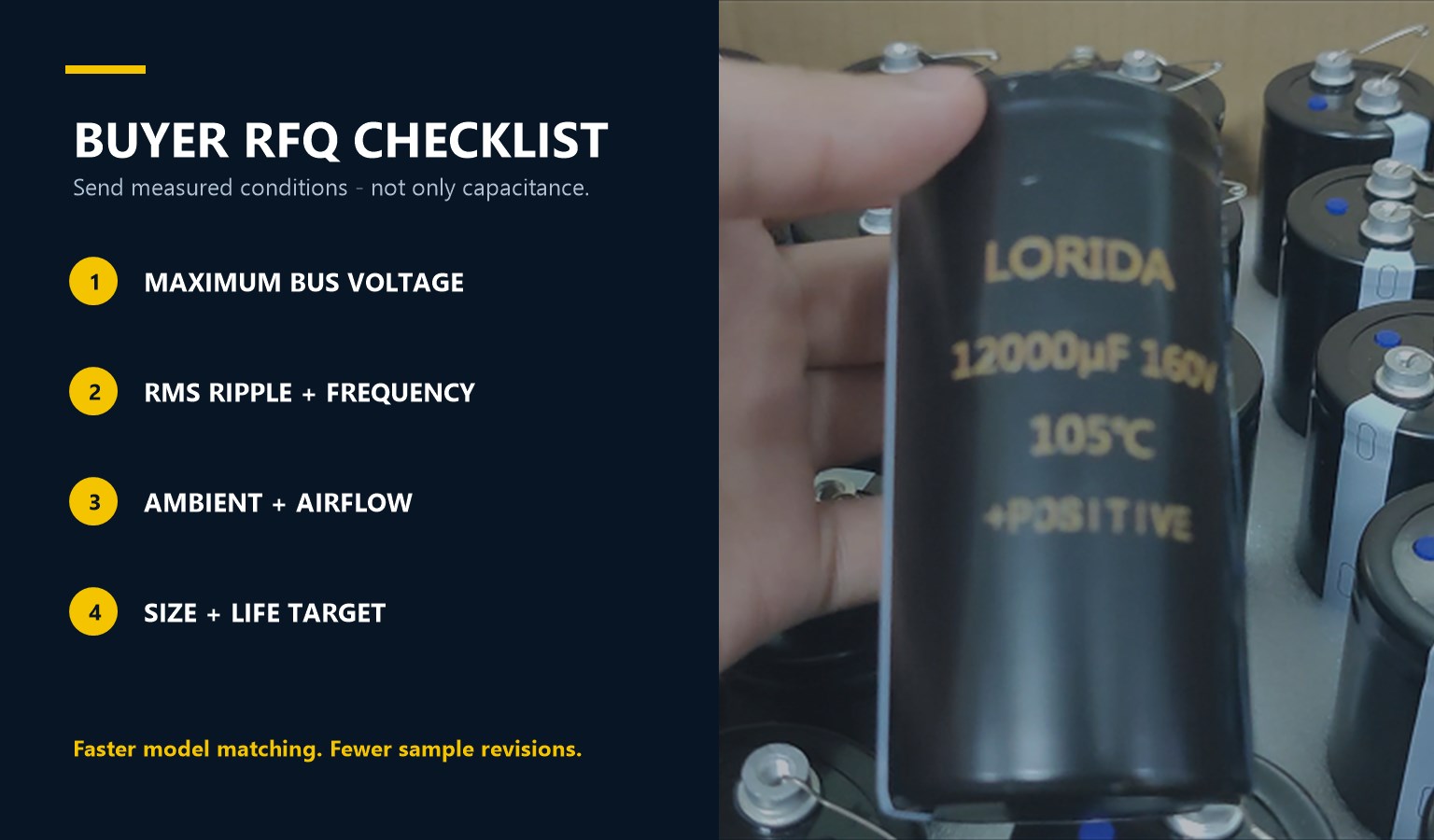
Ripple current and thermal validation of aluminum electrolytic capacitors on a 48V power board
Prototype validation should combine voltage waveform, RMS ripple current and capacitor temperature measurements.

4. What Determines Capacitor Life in a Server Power Supply?

The endurance value in a datasheet is a qualification condition, not a promise that every installed capacitor will operate for exactly that number of hours. Actual life depends on ambient temperature, ripple-generated core heating, applied voltage, airflow, mounting position and the manufacturer's life model.

A capacitor placed beside a heatsink can operate much hotter than the server inlet temperature suggests. For prototype validation, measure temperature at the capacitor case under steady high load and during the worst airflow condition. Ask the supplier to calculate expected life using its own series-specific model rather than applying a generic rule of thumb.

5. Which Package and Terminal Style Should Be Used?

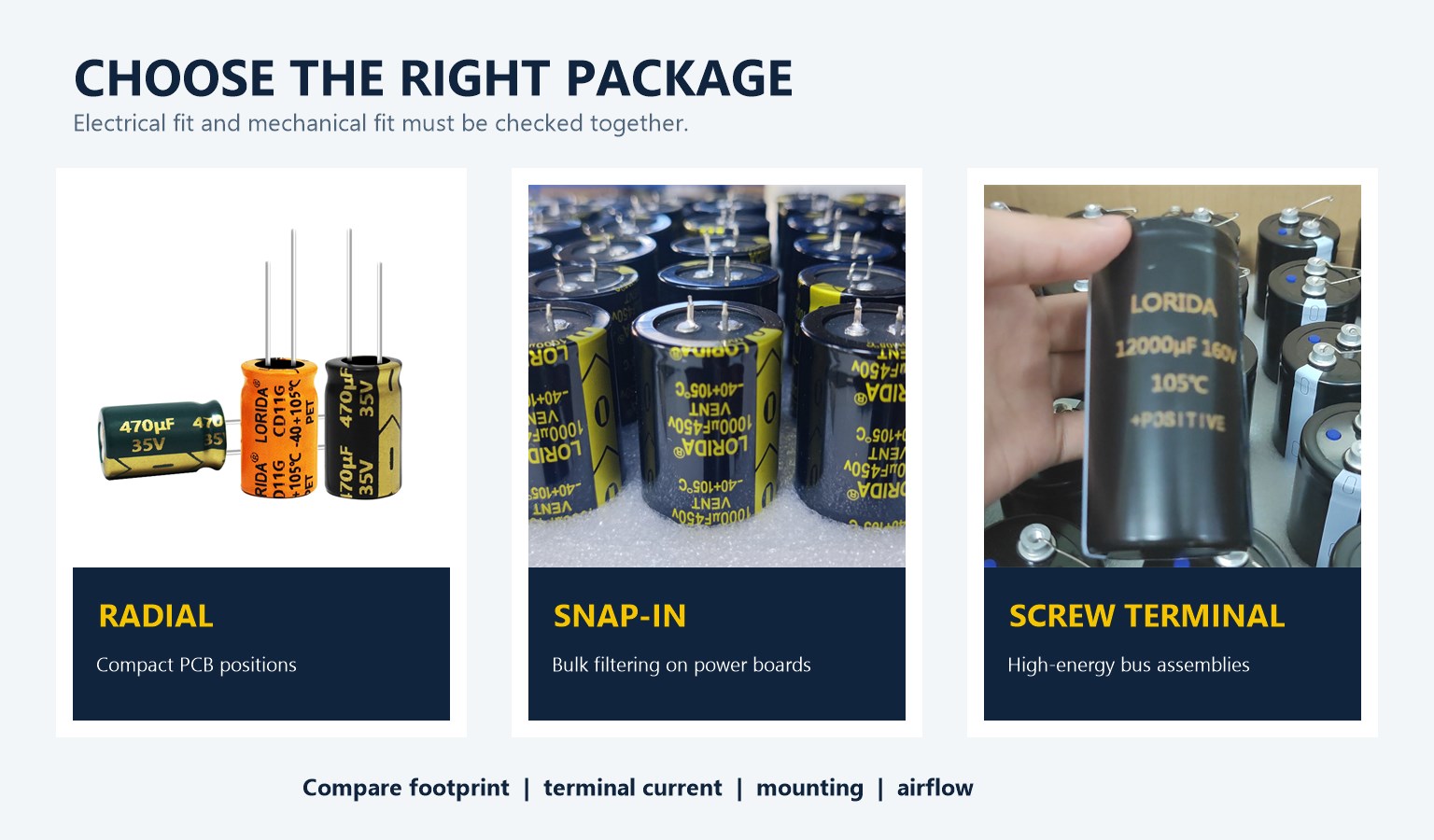
  • Radial capacitors: useful where PCB space and moderate energy storage are the main constraints.

  • Snap-in capacitors: suitable for higher-capacitance power boards that need secure PCB mounting and efficient assembly.

  • Screw-terminal capacitors: often considered for large energy-storage banks, serviceable modules and high-current bus structures.

Check diameter, height, lead spacing, terminal current, mounting clearance and vibration requirements. A technically correct electrical replacement can still fail a project if it changes the PCB footprint or blocks the designed airflow path.

Radial, snap-in and screw-terminal aluminum electrolytic capacitor package comparison
Package choice affects PCB footprint, terminal current, mechanical mounting and airflow.

6. What Information Should Be Included in an RFQ?

A precise request helps a manufacturer recommend a realistic series and speeds up sample approval. Include:

  • nominal and maximum continuous voltage;

  • measured transient peak and duration;

  • required capacitance and tolerance;

  • RMS ripple current, waveform and frequency range;

  • maximum ambient temperature and available airflow;

  • target operating life and duty cycle;

  • case diameter, height, lead spacing and terminal style;

  • annual quantity, sample quantity and production schedule;

  • required compliance, inspection and traceability documents.

7. How Should Samples Be Validated Before Volume Production?

Run samples in the real converter rather than relying only on a capacitance meter. Record startup overshoot, load-step response, ripple current and capacitor temperature. Repeat the test at high line, low line, maximum load and reduced-airflow conditions. If capacitors are used in parallel, check current sharing and mechanical spacing.

For replacement projects, compare the candidate with the original part's voltage rating, capacitance tolerance, ESR or impedance curve, ripple-current rating, endurance class and dimensions. A cross-reference based only on capacitance and voltage is incomplete.

Frequently Asked Questions

Is a 63V capacitor always enough for a 48V server rail?

No. It depends on the real maximum voltage, overshoot and fault behavior. Measure the waveform first, then select a rating with adequate margin.

Can one large capacitor replace several smaller capacitors in parallel?

Sometimes, but the bank may lose ripple-current capability, gain inductance or create a different thermal pattern. Compare the complete bank performance, not only total capacitance.

Can a lower-ESR capacitor directly replace the original part?

Not in every circuit. Lower ESR can reduce heating, but a large impedance change may affect converter stability or current sharing. Confirm the acceptable ESR range with the design engineer.

What should a buyer send for fast model selection?

Send the voltage waveform, ripple-current data, ambient temperature, target life, dimensions and expected quantity. If an existing part is being replaced, include its datasheet or clear label and footprint photos.

Need a 48V Power Capacitor Recommendation?

LORIDA supplies radial, snap-in and screw-terminal aluminum electrolytic capacitors for power conversion and energy-storage applications. Share your maximum voltage, ripple current, temperature, size limit and target life with our team. We can review the application, suggest candidate specifications and arrange samples for circuit validation.

RECENT NEWS & BLOG

Request product information

Please leave your request for any product you wish. We will be happy to search it for you in our databases.

400 0345 800