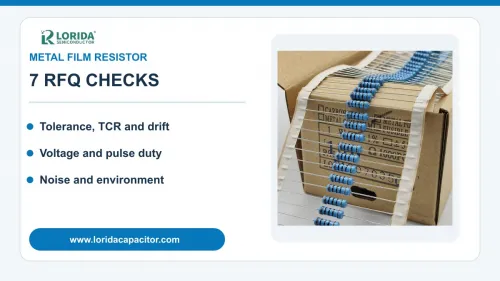
Select a metal film resistor by resistance, tolerance, temperature coefficient, long-term drift, voltage, pulse duty, noise, environment and mechanical fit—not by color bands alone. A useful RFQ states the circuit error budget, real voltage and power, ambient and board temperature, surge waveform, lead spacing and required qualification. The supplier can then compare an exact series and order code under matching conditions.
Tolerance is only the initial part of the accuracy budget.
TCR and load-life drift must be separated and combined correctly.
Operating voltage can limit a high-value resistor before power does.
Pulse curves, noise, dimensions and qualification are series-specific.
1. Build the complete resistance error budget
Start with circuit accuracy, not a preferred tolerance label
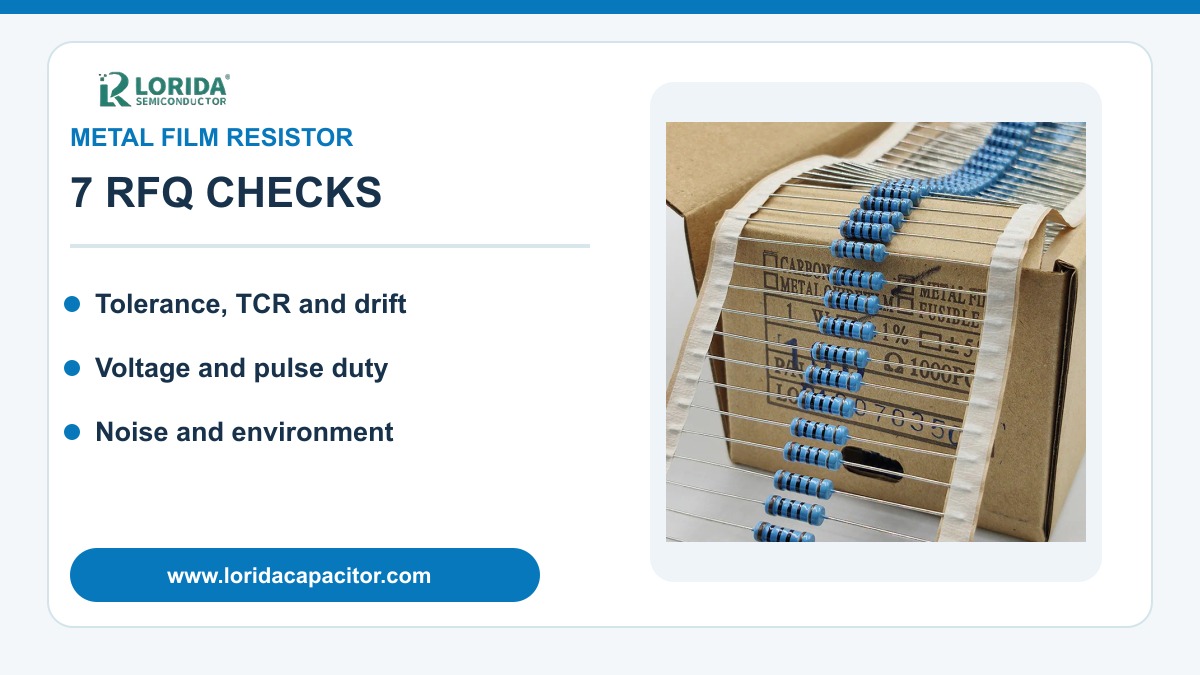
State nominal resistance and the maximum acceptable circuit error at minimum and maximum operating temperature. Include initial tolerance, TCR, expected load-life drift and the measurement contribution of nearby components. A ±1% resistor does not remain within ±1% under every condition. Tolerance describes the initial value at specified conditions; TCR describes reversible temperature movement; stability specifications describe change after time, load and environmental exposure.
Vishay’s professional MBA/SMA, MBB/SMA and MBE/SMA family provides an external comparison example: the official datasheet lists ±5%, ±1% and ±0.5% tolerances, with ±50 ppm/K and ±25 ppm/K TCR options. These values belong only to the cited series. They demonstrate why an RFQ must request a complete order code and resistance-specific table rather than ask for a generic “one-percent blue resistor.”
2. Check resistance range and package together
Not every value is offered in every size or grade
Specify resistance, body length and diameter, lead diameter, lead spacing after forming, mounting orientation and maximum component height. Different body sizes can cover different resistance ranges and power levels. Changing package may alter voltage rating, insulation, pulse capability and assembly process even when the nominal value is unchanged.
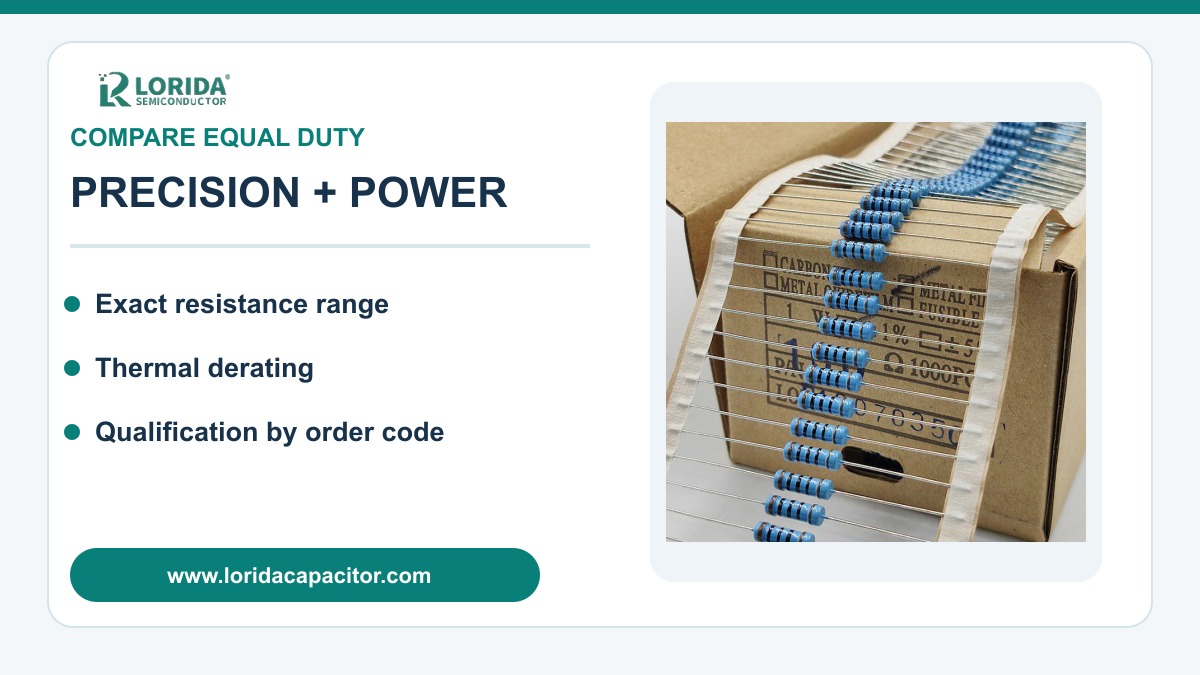
In the same Vishay professional family, the official datasheet lists 0.22 Ω to 10 MΩ for MBA/SMA 0204 and 0.22 Ω to 22 MΩ for MBB/SMA 0207 and MBE/SMA 0414. It lists rated dissipation at 70 °C of 0.4 W, 0.6 W and 1.0 W respectively. These are exact external-series examples, not LORIDA specifications. Use the proposed product’s own table to verify the chosen resistance, tolerance and TCR combination.
3. Calculate real power and apply thermal derating
Nominal wattage assumes stated ambient conditions
Calculate continuous dissipation using P=I²R or P=V²/R at worst-case supply and resistance. Then use the series derating curve at the resistor’s local ambient temperature. Include enclosure temperature, airflow, spacing, PCB heating and lead length. Heat generated in a leaded resistor flows through its body, surface and terminals; a cramped enclosure can produce a higher film temperature than a bench test at the same electrical power.
The professional Vishay family specifies an operating-temperature range of -55 °C to +155 °C and a peak permissible film temperature of 155 °C. Those limits do not mean full rated power is allowed at 155 °C; the family’s application information and derating curve still control. Ask the supplier to identify reference temperature, permissible film temperature and the exact derating method. Confirm the hottest condition on the final assembly.
4. Compare operating voltage and insulation limits
High resistance can reach voltage limits first
A high-value resistor can dissipate modest power while exceeding its operating-voltage limit. State maximum continuous voltage, transient peak, waveform polarity and whether the body or leads require isolation from chassis or nearby conductors. The same Vishay family lists maximum AC/DC operating voltages of 200 V for MBA/SMA 0204, 350 V for MBB/SMA 0207 and 500 V for MBE/SMA 0414.
Its one-minute insulation-voltage examples are 300 V, 500 V and 800 V for those three sizes. These values apply only to the cited family and test conditions. Do not treat insulation withstand as continuous operating voltage. The RFQ should separately list element voltage, insulation requirement, creepage, clearance and environmental contamination level, then require evidence for the exact order code.
5. Describe pulse and overload conditions
Average power does not protect against a short surge
Provide the pulse amplitude, duration, waveform, repetition period, source impedance and number of events. A startup pulse, capacitor discharge and fault surge can have different energy concentration even when their average power is identical. Ask the supplier to identify the correct single-pulse or repetitive-pulse curve and confirm that it applies at the requested resistance value and ambient temperature.
Do not infer pulse capability from body size or metal-film technology alone. Laser trimming, film thickness and voltage distribution influence localized stress. For repetitive duty, verify both individual pulse stress and average heating. Capture the real waveform during sample testing and measure resistance before and after the defined sequence. If the application includes abnormal operation, coordinate the resistor with the fuse or protection device instead of assuming predictable failure behavior.
6. Match noise, environment and qualification
Use evidence tied to the exact order code
Metal-film resistors are often selected for low noise and stability, but the requirement should still be quantified at circuit level. State signal level, bandwidth, allowable noise, humidity, sulfur or corrosive exposure, cleaning process, vibration and expected service life. If automotive, medical, military or another qualification is required, request the qualification status for the exact part number rather than a similar series.
Vishay’s established-reliability VG06 family cites approval to EN 140101-806 and lists separate professional and precision variants. Its dimensions also differ by size, including maximum body lengths of 3.6 mm, 6.3 mm and 11.9 mm for the 0204, 0207 and 0414 examples. These facts illustrate why certification, dimensions and electrical grade must be verified together. Review the LORIDA metal film resistor category before requesting samples.
7. Normalize candidates and validate samples
Approve a traceable order code, not a visual substitute
| RFQ field | Provide | Decision controlled |
|---|---|---|
| Accuracy | Resistance, tolerance, TCR and drift budget | Total circuit error |
| Continuous duty | Voltage, current, ambient and local temperature | Power and derating |
| Pulse duty | Waveform, peak, width, period and event count | Film overload and heating |
| Voltage | Continuous maximum, transient and isolation | Element and insulation limits |
| Mechanical | Body, leads, forming, spacing and height | Assembly and replacement fit |
| Environment | Humidity, corrosion, vibration and qualification | Construction and evidence |
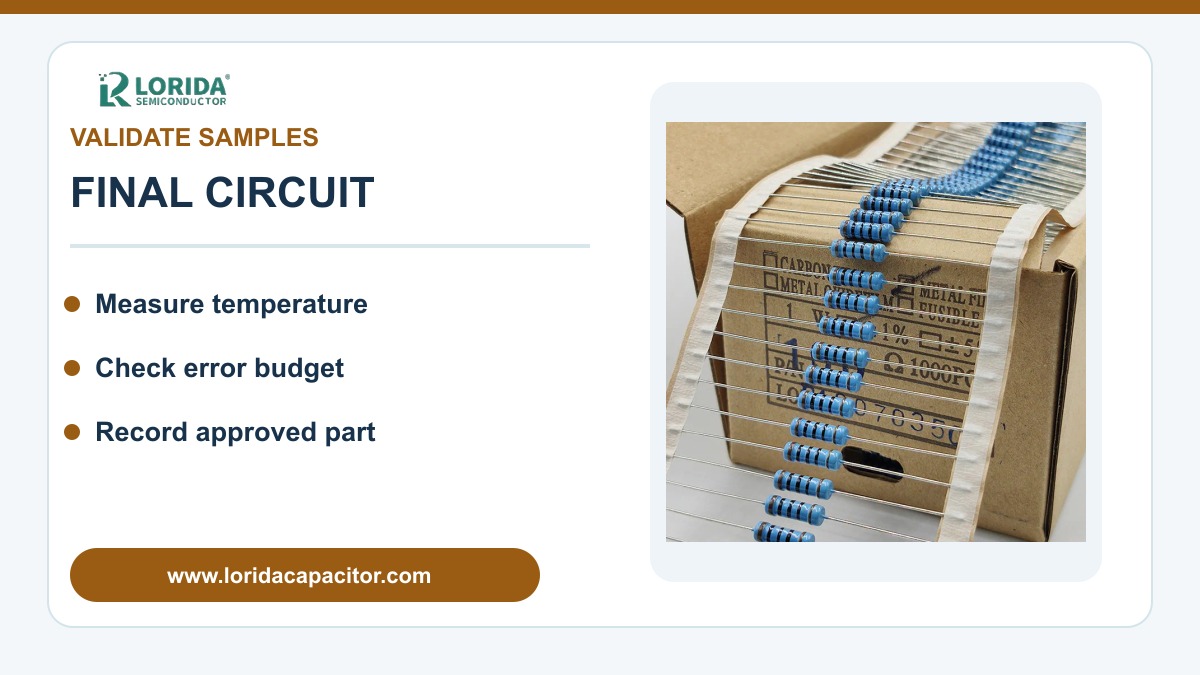
Test samples at supply and temperature extremes. Measure resistance using a suitable method before testing, after thermal stabilization and after the planned load or pulse sequence. Inspect coating, color bands, leads and solder joints. Record manufacturer, full order code, datasheet revision and accepted evidence so purchasing cannot substitute a visually similar part without review.
For alternative technologies, compare the carbon film resistor category and wirewound resistor category. Send the original part number, circuit duty and drawing through the LORIDA contact page for a datasheet-based sample review.
Frequently Asked Questions
Can I replace a metal film resistor using its color bands?
No, color bands normally show resistance, tolerance and sometimes TCR, but not every voltage, pulse, stability or qualification limit. Confirm body size, lead diameter and spacing, exact technology, operating voltage, power derating, pulse curve, noise requirement and environmental rating. Send the original order code and circuit conditions. A visually similar resistor can have a different film, trimming pattern or coating. Validate the proposed sample at the final temperature and voltage, and record resistance before and after the required load or pulse sequence.
Is a tighter initial tolerance always the best choice?
No, a tighter initial tolerance does not automatically control temperature error or long-term drift. Build the total circuit error budget using tolerance, TCR, load-life drift and measurement uncertainty. A ±0.5% part with a higher TCR may move more across temperature than a ±1% part with a lower TCR. Check the exact resistance value because available combinations often change across the range. Select the least restrictive specification that still meets the circuit limit, then verify it at temperature and under real electrical load.
Why can a high-value resistor fail below its wattage rating?
It can exceed operating voltage or pulse stress while average power remains below the nominal wattage. Calculate both power and voltage at tolerance extremes. Add switching overshoot and abnormal supply conditions. Compare the continuous voltage with the exact series limit and compare every transient with the correct pulse curve. If several resistors are placed in series, also consider unequal voltage distribution, board contamination and spacing. Validate the real waveform and temperature on the final assembly rather than relying only on a steady-state calculation.
What should a metal film resistor RFQ contain?
Provide resistance accuracy, electrical duty, temperature, pulse, mechanical and evidence requirements. Include nominal resistance, tolerance, TCR, permitted drift, maximum continuous voltage and current, pulse waveform, repetition, ambient and board temperature, body dimensions, lead spacing and forming, cleaning process, humidity, vibration and qualification. Attach the original order code for replacement work. Ask for the exact datasheet row, derating and pulse curves, order-code qualification status, samples and an agreed validation plan.
Sources: Vishay MBA/SMA 0204, MBB/SMA 0207 and MBE/SMA 0414 professional datasheet, Document 28766; Vishay VG06 established-reliability datasheet, Document 28768; Vishay MRS16/MRS25 official product information.
Prepare a metal film resistor RFQ
Send the error budget, voltage, pulse duty, temperature and mechanical drawing for a datasheet-based sample review.
Send your metal film resistor requirementsLast Updated: September 14, 2026