MOV clamping voltage must be checked at the specified surge current and waveform, not selected from nominal varistor voltage alone. A reliable metal-oxide-varistor review also confirms the maximum continuous AC or DC voltage, the protected circuit's withstand level, surge current, pulse energy, repetition rate, temperature, and end-of-life protection. The six checks below give OEM engineers and buyers a practical way to compare datasheets and prepare a clearer RFQ without treating any catalog example as a LORIDA model specification.
Key Takeaways
Clamping voltage is meaningful only with its test current and waveform.
Maximum continuous operating voltage is not the same as nominal varistor voltage.
Surge-current, energy, pulse-count, temperature, and thermal-disconnect limits must be reviewed together.
An RFQ should identify the actual line condition and surge requirement before requesting a substitute.
What MOV clamping voltage actually means
Check 1: read the test condition beside the voltage
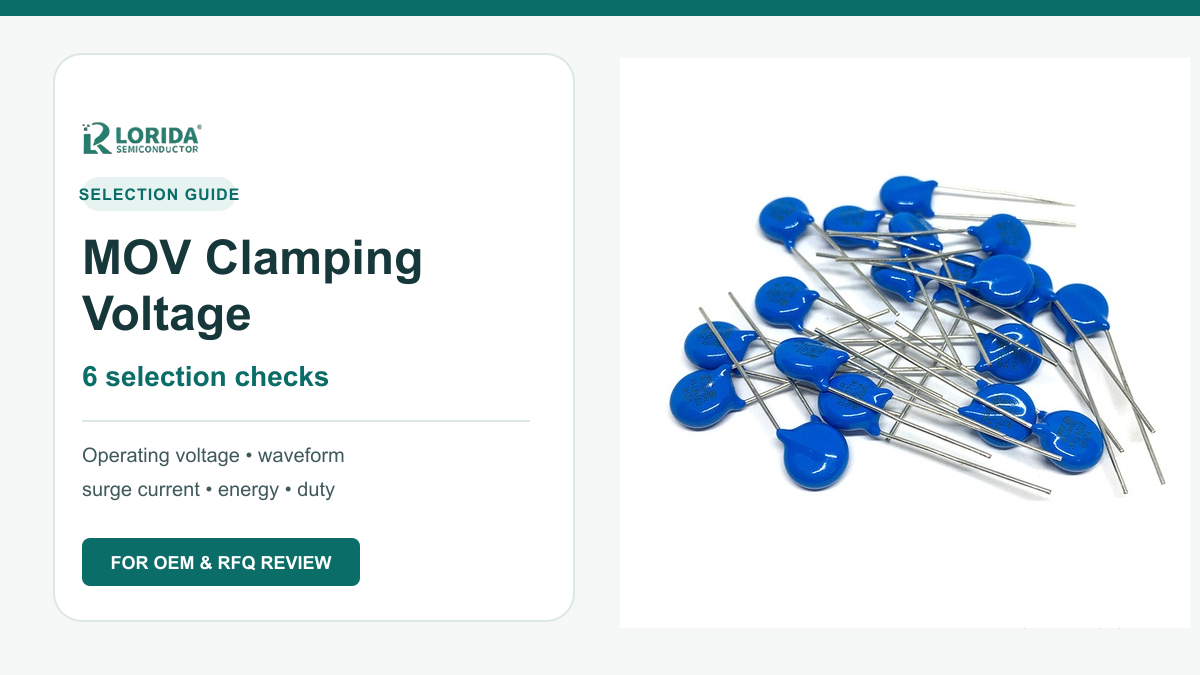
Clamping voltage is the peak voltage across a varistor when a stated peak surge current is applied under a stated waveform. Littelfuse Application Note 9767 defines it this way and separately defines the voltage-clamping ratio as a comparison between clamping voltage and the maximum continuous AC or DC voltage. TDK's SIOV guide likewise states that protection level is shown as a function of surge current using an 8/20 µs waveform. Therefore, a value such as “Vc” without test current and waveform cannot support a like-for-like comparison.
The protected IC, power stage, relay, insulation system, or downstream capacitor sees the residual voltage that remains while the MOV conducts. The selected device must keep that residual level below the circuit's verified withstand limit, including tolerance, wiring inductance, and overshoot. Faster-front pulses can create overshoot above the catalog 8/20 µs clamping value, so placement and loop length also matter.
Check 2: separate operating voltage from nominal varistor voltage
The maximum continuous AC voltage and maximum continuous DC voltage define what may remain applied to the device. Nominal varistor voltage is a reference measured at a specified low current. TDK explains that its varistor-voltage reference uses 1 mA and that the measuring current should be applied for only 0.2 to 2.0 seconds, typically 1 second, to avoid self-heating errors. Those definitions serve different purposes and should not be interchanged.
For AC input protection, verify the highest steady RMS voltage, regulation tolerance, abnormal high-line duration, frequency, and whether the installation is line-to-line, line-to-neutral, or line-to-earth. For DC rails, include charging conditions and regenerative or load-dump events. Do not choose an MOV merely because its nominal marking is numerically above the normal line voltage.
Six checks for an OEM or replacement review
Checks 3 and 4: surge current, energy, and protected withstand
Peak surge-current rating describes a particular impulse and test condition; it is not a promise for every pulse shape or repetition rate. Littelfuse defines the rated peak single-pulse current using an 8/20 µs impulse and separately defines single-pulse transient energy. TDK product data also reports surge current, energy absorption, and clamping voltage as distinct fields. Compare all three with the expected source impedance and applicable equipment test, then add engineering margin.
| RFQ field | What it controls | Evidence to provide |
|---|---|---|
| Max. continuous AC/DC voltage | Standby stress and leakage | Highest steady line and abnormal duration |
| Clamping voltage | Residual voltage at surge | Test current, waveform, and circuit withstand |
| Peak current and energy | Single-pulse loading | Surge standard, source impedance, pulse shape |
| Pulse count and interval | Cumulative heating and aging | Events per test and expected service life |
| Temperature and protection | Derating and safe failure | Ambient, enclosure, fuse or thermal disconnect |
Checks 5 and 6: repetitive pulses, temperature, and safe failure
A single-pulse rating does not describe a repetitive application. TDK notes that average power must be considered when the varistor does not have enough time to cool between pulses. Its reliability example for strap varistors uses 10 unipolar 8/20 µs surges with an interval of at least 60 seconds; that is a test condition, not a universal operating allowance. Use the actual repetition requirement and the manufacturer's derating curves for the selected series.
Temperature affects energy and current capability, while sustained abnormal voltage can overheat an MOV. The assembly should include coordinated overcurrent or thermal protection where required by the product safety design. Physical disk diameter alone is not a sufficient substitute rule because formulation, electrode geometry, lead spacing, approvals, coating, and pulse capability can differ.
How to prepare a clear MOV RFQ
Send the circuit conditions, not only a printed code
Provide the existing part photo and marking, circuit position, continuous voltage, surge waveform, peak current, pulse energy, event count, interval, ambient temperature, disk diameter, lead spacing, coating, approvals, and downstream withstand limit. If the original part failed, include the failure mode and the protective fuse or thermal device. This information lets an engineer determine whether the requirement is a direct replacement, a lower-clamp option, or a higher-energy design.
For related component sourcing, review LORIDA's varistor product area, the Product Center, and our earlier guide on MOV leakage-current selection. Confirm the final specification against the approved series datasheet and applicable safety standard before release.
Frequently asked questions
Is a lower MOV clamping voltage always better?
No, a lower clamping voltage is useful only if the MOV can remain nonconductive during every permitted steady operating condition. Selecting too low a continuous-voltage rating can increase leakage, heating, aging, or premature failure during normal high-line operation. Compare the maximum continuous AC or DC rating first, then confirm the clamping voltage at the required surge current and waveform is below the protected circuit's verified withstand limit. Include component tolerance, wiring overshoot, temperature, surge repetition, and the safety protection used if the MOV overheats.
Can I compare two MOVs using nominal varistor voltage only?
No, nominal varistor voltage alone is not enough for an equivalent-part decision. It is a low-current reference measurement, commonly specified at 1 mA, while clamping voltage is measured at a much higher surge current and stated waveform. Two devices with similar nominal values may have different continuous-voltage limits, maximum clamping levels, surge-current capability, energy absorption, pulse-life curves, dimensions, approvals, or thermal behavior. A valid comparison aligns each test condition and the complete application requirement rather than matching one printed number.
Why must the surge waveform be included in an MOV RFQ?
The waveform is required because peak current and energy do not describe stress duration by themselves. The widely used 8/20 µs current impulse defines a front and tail shape for a specific test, while other disturbances can deliver different energy or overshoot at the same peak current. State the governing equipment standard, generator source impedance, voltage waveform, current waveform, peak values, and pulse count. This prevents a catalog rating from one test condition being mistaken for an allowance under another condition.
What information helps LORIDA review an MOV replacement?
Send the existing part marking plus the real electrical, mechanical, and environmental requirements. The most useful package includes clear photos, continuous AC or DC voltage, normal and abnormal line limits, surge standard and waveform, peak current, energy, repetition interval, ambient temperature, disk diameter, lead spacing, certifications, and the protected circuit's withstand voltage. Also identify any fuse or thermal disconnect and explain the observed failure. LORIDA can then discuss a series-level option without assuming that a visually similar disk has equivalent performance.
Sources
Primary technical references
Littelfuse Application Note 9767: Varistors—Basic Properties, Terminology and Theory.
TDK Electronics: SIOV Metal Oxide Varistors, General Technical Information.
Prepare a verifiable MOV inquiry
Send the circuit voltage, surge test, protected withstand level, dimensions, and existing part photos. We will review the requirement against confirmed product data.
Contact LORIDALast Updated: November 11, 2026. Technical review should use the approved datasheet for the selected series and the applicable equipment standard.