SMD resistor TCR tells you how far resistance may move as temperature changes, so it must be checked separately from room-temperature tolerance. For an OEM RFQ, state the maximum ppm/K, resistance, tolerance, package, operating temperature, power, voltage and qualification requirement. A 1% resistor is not automatically a low-TCR resistor, and the package code alone does not define accuracy.
Convert TCR from ppm/K into an expected resistance shift across the real temperature excursion.
Check the exact resistance range because one series can assign different TCR limits to different values.
Keep initial tolerance, temperature drift, load-life stability and soldering shift as separate error terms.
Request the manufacturer series and full ordering code before approving a substitute.
1. What does SMD resistor TCR mean?
TCR converts temperature change into resistance change
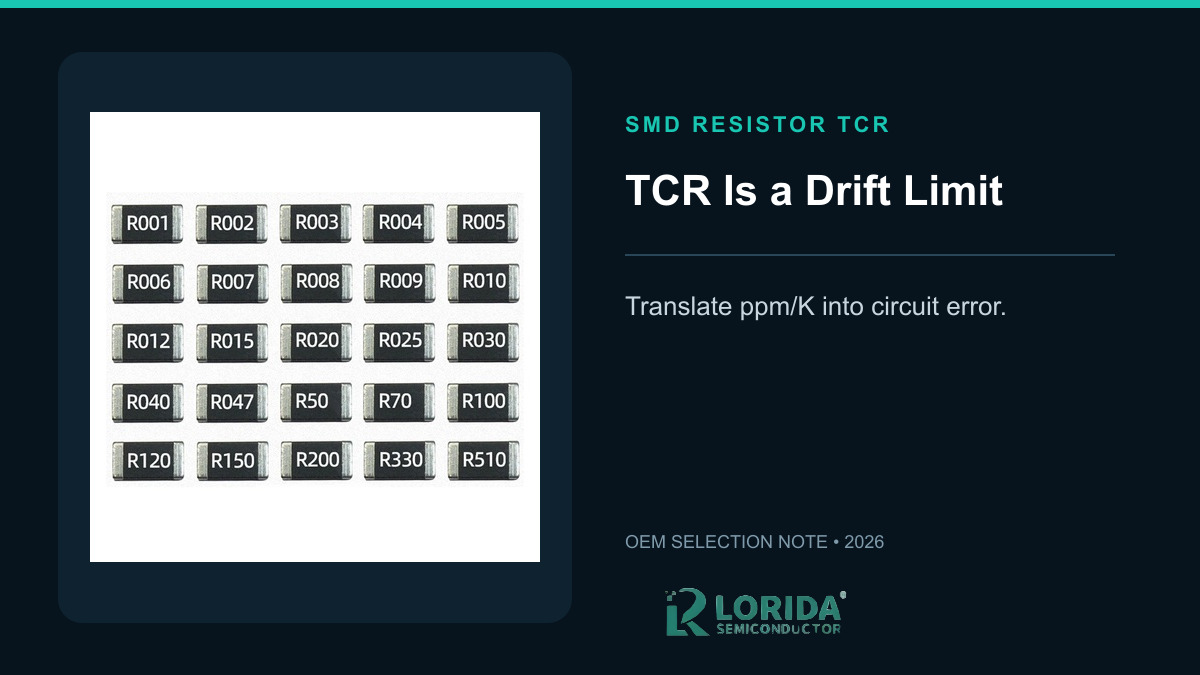
Temperature coefficient of resistance, or TCR, is normally stated in parts per million per kelvin (ppm/K). For a first-order estimate, multiply the absolute TCR limit by the temperature change and divide by one million. A ±100 ppm/K resistor exposed to a 75 K change can therefore contribute up to about ±0.75% resistance change from temperature alone. The calculation is an engineering estimate; the applicable datasheet test method and temperature intervals still control acceptance.
Tolerance and TCR answer different questions
Initial tolerance describes the resistance window at the specified reference condition. TCR describes how resistance may change with temperature. Add load-life drift, soldering effects, humidity and measurement uncertainty separately. This distinction prevents an apparently precise 1% part from being accepted where thermal drift dominates the circuit error budget.
2. Compare standard and lower-TCR chip resistor options
Official series data shows why the exact suffix matters
Vishay's standard D/CRCW e3 datasheet lists ±200 ppm/K and ±100 ppm/K options, while the D/CRCW-P e3 semi-precision family lists ±50 ppm/K with ±1% or ±0.5% tolerance. The semi-precision 0402 option covers 100 Ω to 1 MΩ; the 0603, 0805 and 1206 options cover 100 Ω to 10 MΩ. These are supplier-series examples, not LORIDA-wide specifications.
| RFQ choice | Published example | Buyer check |
|---|---|---|
| Standard thick film | ±100 or ±200 ppm/K; ±1% or ±5% | Confirm value-dependent TCR and tolerance |
| Semi-precision thick film | ±50 ppm/K; ±0.5% or ±1% | Confirm exact -P family and ordering code |
| High-precision example | Panasonic 0603 examples: ±25 ppm/K, 0.1% | Do not generalize one part number to a whole family |
Package size affects power and voltage, not just board area
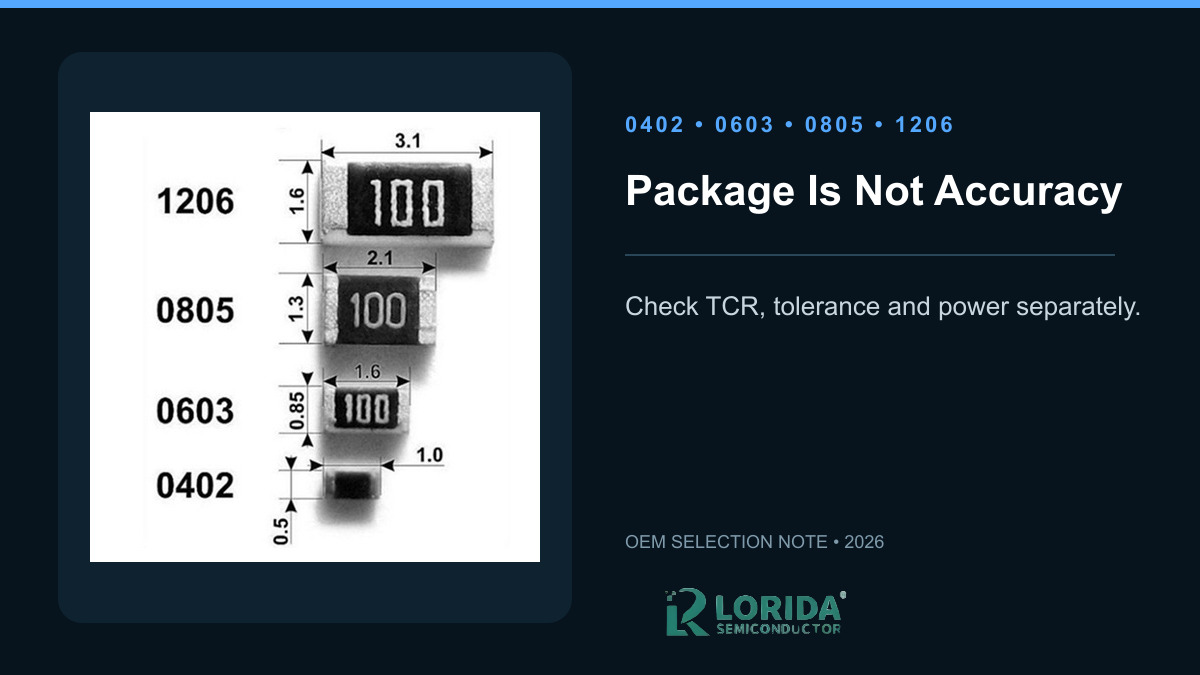
For the Vishay D/CRCW-P e3 example, rated dissipation at 70 °C progresses from 0.063 W for 0402 to 0.10 W for 0603, 0.125 W for 0805 and 0.25 W for 1206. Maximum operating voltage also rises from 50 V to 75 V, 150 V and 200 V. These values show why a thermal or voltage requirement cannot be inferred from TCR alone.
3. Build a thermal error budget before sampling
Use the real resistor temperature, not ambient alone
Estimate board ambient, self-heating, nearby heat sources, airflow and copper area. The resistor body can be hotter than the enclosure air. Vishay publishes an operating range of -55 °C to +155 °C for both cited families, but operation inside that range does not mean full rated power is available at every temperature. Apply the manufacturer's derating curve and the equipment's worst-case thermal profile.
Keep reversible drift separate from permanent stability change
TCR primarily describes reversible temperature-related movement. Load life describes longer-term resistance change under electrical and thermal stress. Vishay's D/CRCW-P e3 table gives a maximum resistance change of 1% after 1,000 hours at rated dissipation and 2% after 8,000 hours for its stated test conditions. Do not add these numbers mechanically without an error-budget method, but do not omit either term.
4. Six OEM checks for an SMD resistor TCR RFQ
1) Define circuit sensitivity and allowed drift
State whether the resistor sets gain, bias, timing, current sense, pull-up or damping. Convert the maximum allowable circuit error into a resistor-level TCR target across the measured temperature excursion.
2) Lock the resistance and tolerance
Provide the nominal value and initial tolerance. Vishay's standard family shows that a single series may pair ±200 ppm/K with low resistance values and ±100 ppm/K with broader 1% ranges. The resistance value must therefore be evaluated together with TCR.
3) Specify package, power and working voltage
Give the EIA/metric size, continuous dissipation at real board temperature, overload or pulse waveform, and maximum continuous or transient voltage. Use the supplier's smaller limit when both power and voltage constrain the design.
4) State temperature and environment
Include minimum and maximum ambient, estimated hotspot, humidity, sulfur exposure, coating, cleaning chemistry and mounting orientation. For harsh environments, request the relevant anti-sulfur or automotive-qualified series rather than assuming a generic thick-film part is equivalent.
5) Request qualification and evidence
Ask for the current datasheet, ordering code, lot traceability, qualification status and test report level required by your quality plan. The standard Vishay D/CRCW e3 family states testing against EN 60115-1, EN 60115-8 and EN 140401-802; the exact procurement requirement still belongs in the drawing or RFQ.
6) Approve substitutions by full error budget
A substitution is acceptable only after comparing resistance range, tolerance, TCR, power derating, voltage, pulse behavior, dimensions, termination, soldering process and qualification. Package and nominal resistance alone are not enough.
5. What should buyers send to LORIDA?
A complete RFQ shortens the technical review
Send nominal resistance, tolerance, maximum TCR, package, power at the actual ambient, working and surge voltage, pulse waveform, operating temperature, PCB land pattern, application, annual demand, qualification needs and any approved manufacturer references. Review the broader SMD resistor RFQ checklist, browse the LORIDA SMD resistor range, or contact LORIDA with a drawing and operating profile.
Sources used for the numerical examples
Technical data in this article is drawn from the Vishay D/CRCW e3 datasheet, the Vishay D/CRCW-P e3 datasheet, and official Panasonic high-precision chip resistor listings. Values are examples for those named series, not blanket specifications for every resistor supplied by LORIDA.
FAQ
Is a 1% SMD resistor always ±100 ppm/K?
No. Initial tolerance and TCR are separate specifications. A 1% resistor may be offered with different TCR limits depending on series, resistance value and ordering code. Vishay's standard D/CRCW e3 table, for example, includes both ±200 ppm/K and ±100 ppm/K selections. Buyers should specify both the room-temperature tolerance and the maximum TCR, then verify that the requested resistance sits inside the published range for that combination.
How much can a ±100 ppm/K resistor change over 75 °C?
A first-order worst-case estimate is about ±0.75%. Multiply 100 ppm/K by 75 K to obtain 7,500 ppm, which equals 0.75%. This is only the temperature-coefficient contribution. Initial tolerance, self-heating, load-life stability, soldering shift and measurement uncertainty may add further error. Use the applicable datasheet's TCR method and a circuit-level worst-case or statistical analysis for final validation.
Does a larger chip package guarantee a lower TCR?
No. A larger package does not automatically provide a lower TCR. Package size mainly changes dimensions, heat dissipation, working voltage and pulse capability. Low-TCR performance comes from the specific resistor technology and series. Compare the exact datasheet and ordering code; then check whether the required TCR is available for the selected resistance, tolerance and package.
What is the minimum evidence needed to approve a substitute?
Approve a substitute only after the full part specification and qualification evidence match the application. At minimum, compare nominal resistance, tolerance, TCR, package dimensions, rated power and derating, maximum voltage, pulse limits, operating temperature, termination, soldering compatibility and relevant qualification. Keep the manufacturer's full part number and current datasheet in the approval record so future lots are not accepted only by a shortened description.
Last Updated: October 15, 2026