

Welding equipment can place a capacitor under repeated, short-duration electrical stress. That makes a catalogue match based only on capacitance and nominal voltage incomplete. A useful RFQ should describe what the capacitor will experience in the circuit, how often the pulse repeats, and how the component will be installed and cooled.
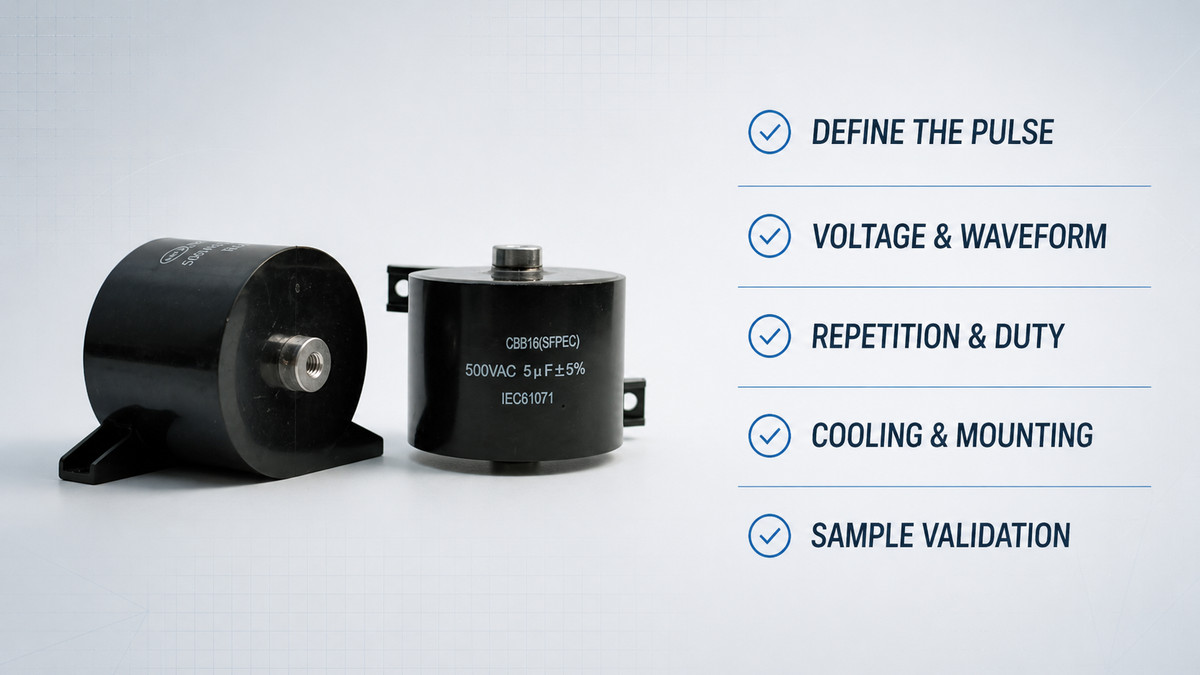
Start with the actual pulse profile
Send the normal operating voltage, maximum voltage, waveform or circuit diagram, pulse duration, repetition rate and expected duty cycle. If measured data are available, include a scope capture and explain where it was taken. These details let the supplier review the electrical duty instead of guessing from the welding-machine power rating.
Also state whether the capacitor is used for energy storage, filtering, commutation or another function. Parts that look similar externally may be designed for different jobs. A marking or family name alone does not confirm suitability for a new circuit.
Treat temperature and installation as design inputs
Repeated pulses create internal heating, while cabinet temperature and airflow influence how quickly that heat can leave the component. Include the expected ambient range, ventilation method, nearby heat sources and operating schedule. If the machine runs in batches, describe both the active period and the cooling interval.
Mechanical information matters too. Share the available envelope, terminal style, mounting orientation, busbar or cable connection, vibration conditions and required creepage or clearance constraints. A capacitor that fits electrically but forces long connections or poor mounting can complicate the equipment build.
What to send with your RFQ
Circuit voltage and maximum expected voltage
Pulse waveform, duration, repetition rate and duty cycle
Required capacitance and tolerance
Ambient temperature, airflow and work cycle
Outline drawing, terminal arrangement and mounting space
Annual quantity, sample quantity and target validation schedule
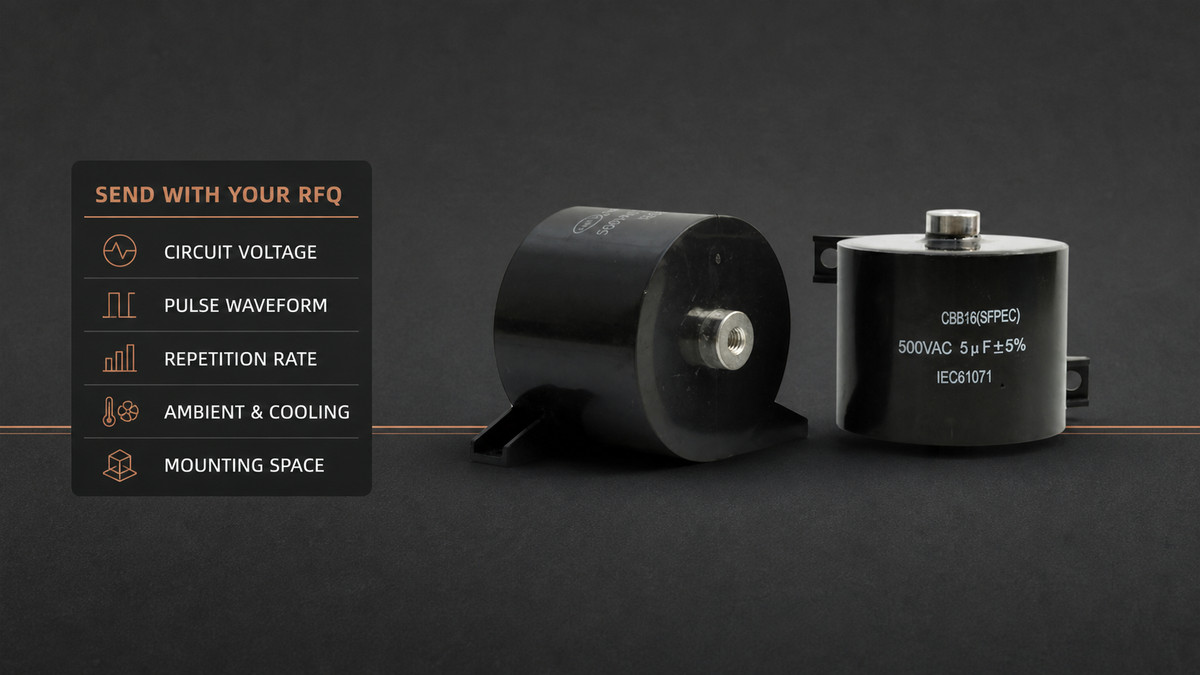
If you are replacing an existing CBB15 or CBB16 capacitor, add clear photos of every marking, the original drawing or datasheet, and the reason for replacement. Do not assume that two parts with the same headline values are interchangeable.
Validate samples in the real duty cycle
Before bulk approval, verify the sample in the intended circuit and installation. Record voltage and temperature during representative operation, inspect the connections after repeated cycles, and compare the result with the agreed acceptance criteria. Any change in waveform, cooling, mounting or repetition rate should trigger a new technical review.
Quick FAQ
Can I request a quote with only capacitance and voltage?
You can request an initial discussion, but the supplier will need the pulse and installation details before confirming a suitable option.
What is the best first document to send?
A circuit diagram or waveform capture plus the mechanical drawing usually removes the most uncertainty.
Need help preparing a welding pulse capacitor RFQ? Send LORIDA your circuit conditions, waveform, cooling method, mounting space and sample plan for a model-matching discussion.


