X1 and X2 safety capacitors are both line-to-line EMI suppression components, but they are qualified for different impulse categories, so the correct choice must follow the circuit position, certified part data, surge environment, voltage, climate and mechanical fit. For an OEM buyer, the label is the start of the decision, not the entire specification.
Key Takeaways
The six decisions that prevent a weak RFQ
Confirm that the component is connected line-to-line before specifying an X-class capacitor.
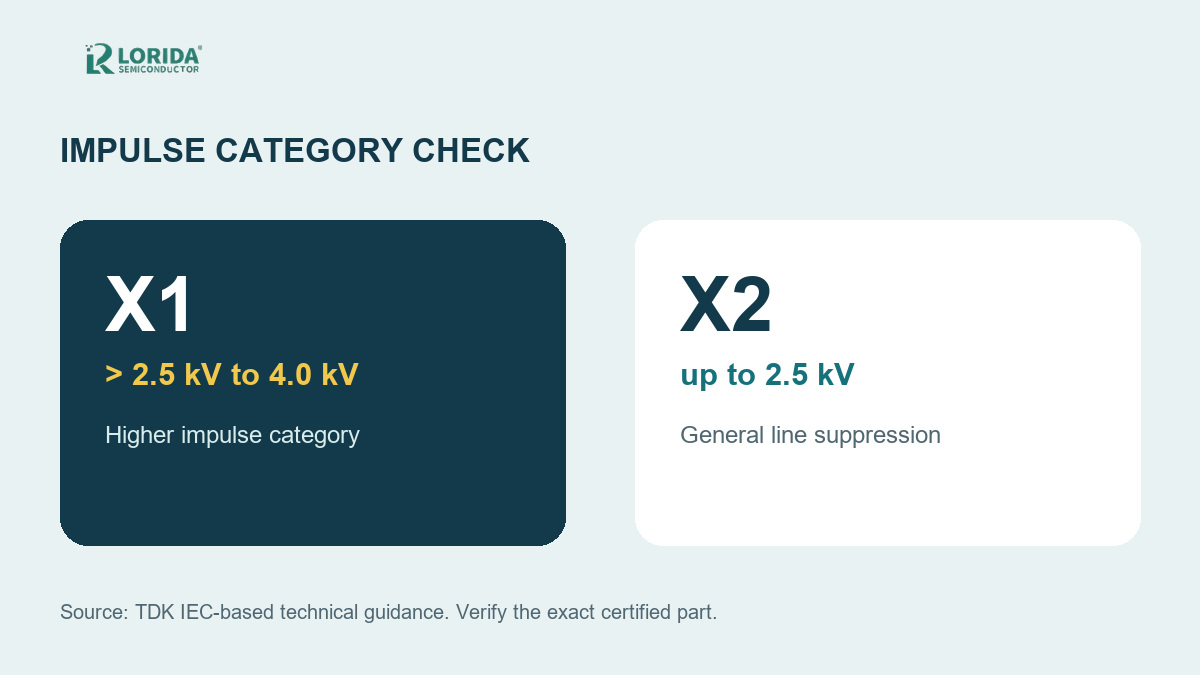
Use the required impulse category: IEC-based guidance places X1 above 2.5 kV through 4.0 kV and X2 at up to 2.5 kV.
Match the exact approval file, rated voltage, capacitance, temperature and humidity conditions.
Check dimensions, lead spacing and clearance instead of treating equal capacitance as physical interchangeability.
Request the current datasheet and certificate for the offered manufacturer and part number.
Document the equipment standard and surge assumptions in the RFQ.
What Is the Practical Difference Between X1 and X2?
The impulse category is the first dividing line
TDK's IEC-based technical guide describes X capacitors as components connected between the supply lines. In that guide, X1 covers peak pulse voltages above 2.5 kV through 4.0 kV, while X2 covers peak pulse voltages up to 2.5 kV. KEMET's current CAS SMD datasheet gives the same practical checkpoints in its impulse table: 4.0 kV for X1 and 2.5 kV for X2. These values describe a safety subclass and test regime; they do not by themselves define capacitance, package, lifetime or the approval status of a particular part.
IEC 60384-14:2023 is the current fifth edition of the international specification for fixed capacitors used in electronic equipment for electromagnetic-interference suppression and connection to the supply mains. The official IEC page states a scope up to 1,000 V AC RMS at frequencies not over 100 Hz and includes DC supplies up to 1,500 V DC. Buyers should still verify the exact equipment standard and national approval requirements that apply to their end product.
| Decision point | X1 | X2 |
|---|---|---|
| Typical line connection | Line-to-line | Line-to-line |
| IEC-based peak pulse category | Above 2.5 kV through 4.0 kV | Up to 2.5 kV |
| Selection emphasis | Higher impulse category plus exact approval | General line suppression plus exact approval |
| Can class alone approve a substitute? | No. Verify voltage, capacitance, certification, environment, dimensions and equipment requirements. | |
Six OEM Checks Before You Approve a Part
Turn the circuit requirement into a verifiable RFQ
1. Circuit position: identify whether the capacitor is genuinely across the line. A line-to-ground position belongs to a Y-class safety analysis and must not be converted into an X-class choice by convenience. 2. Impulse requirement: document the expected overvoltage category and the design standard rather than selecting X1 merely because its number looks higher. 3. Rated conditions: list the working AC or DC voltage, line frequency, capacitance, tolerance and ambient temperature.
4. Approval evidence: request the current certificate and datasheet for the offered manufacturer, series and part number. Check that markings, document identifiers and ratings agree. 5. Environment: state humidity, pollution, altitude, enclosure and expected service profile. As one product-family example, KEMET describes a 1,000-hour endurance test and 10,000 charge/discharge cycles at about 1 Hz; those figures are useful questions, not universal promises for every X2 capacitor. 6. Mechanical fit: confirm body size, lead spacing, terminal diameter, creepage, clearance and assembly process.
Why an X1 Part Is Not Automatically a Drop-In X2 Upgrade
A higher impulse class can still fail the real design review
A proposed X1 part may have a different capacitance range, dissipation behavior, case size, lead pitch, voltage rating, climate category or approval scope. It can also change conducted-EMI results because equivalent series resistance and inductance vary by construction. The substitution decision therefore belongs to the equipment engineer and compliance owner, supported by the offered part's documents and validation results.
Current manufacturer examples illustrate the spread. TDK has described an X1 family rated at 480 V AC and 1,000 V DC with a product-specific 85 C/85% RH/1,000 h THB test and maximum operating temperature of 110 C. Those numbers show how much information exists beyond the word X1; they must not be transferred to another series without evidence.
How to Read Markings Without Overclaiming Approval
Use the body print as a cross-check, not the sole certificate
Read the safety class, capacitance code, tolerance, rated voltage, climate category, manufacturer or trademark and approval symbols. Then match them against the offered datasheet and approval record. Logos on a body can be too small, outdated or series-specific, and a product photograph cannot prove that the shipped lot is covered. The image below is a third-party sourcing reference used only to demonstrate what buyers should inspect; it is not presented as a LORIDA-manufactured part or as proof of certification.
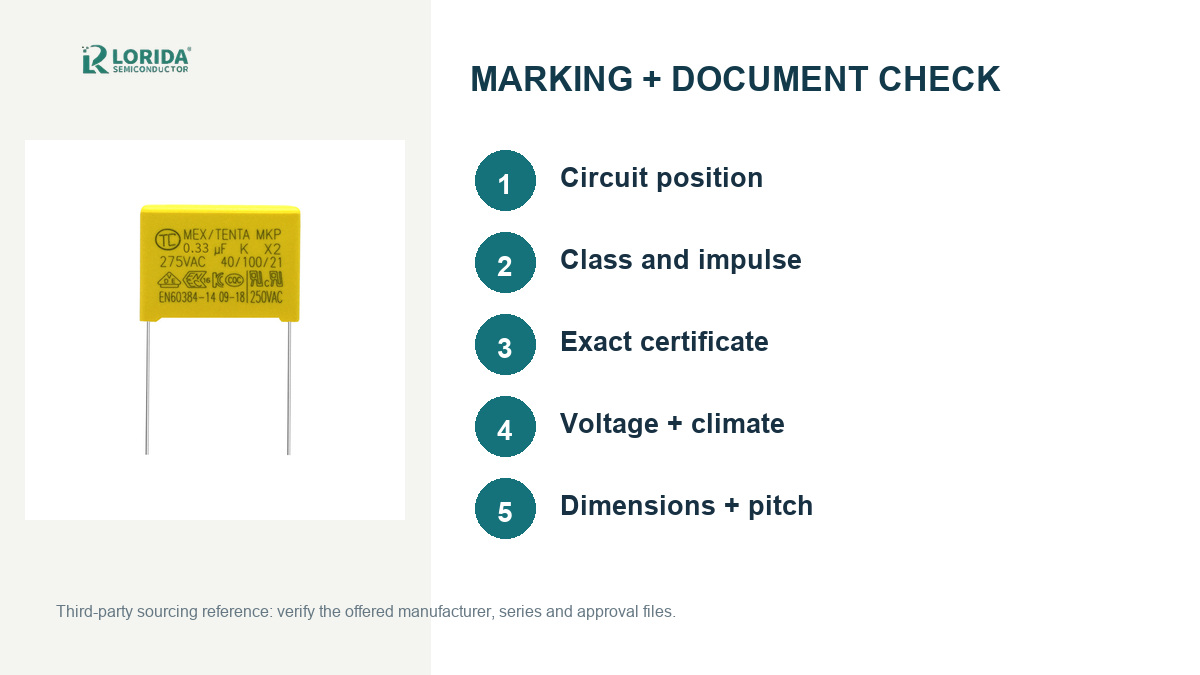
Reference marking example from internal sourcing material. Verify the actual offered manufacturer, series, approvals and ratings.
What Should the RFQ Include?
A short checklist produces a much stronger quotation
Provide a circuit-position description, schematic excerpt when permitted, safety subclass, equipment standard, rated voltage and frequency, capacitance and tolerance, impulse or surge requirement, temperature and humidity profile, body envelope, lead spacing, annual forecast and required approval markets. Ask the supplier to return the exact manufacturer, series, part number, datasheet revision and approval files with the quotation.
For related options, browse the LORIDA product range and review the current X2 capacitor product page. These pages are starting points; the final part and approval package must be matched to your application.
Frequently Asked Questions
Questions buyers ask before approving X-class capacitors
Can I replace an X2 capacitor with an X1 capacitor?
Only after the replacement is approved against the complete electrical, safety and mechanical requirements. X1 represents a higher IEC-based impulse category than X2, but that does not guarantee equal capacitance, rated voltage, loss, dimensions, lead spacing, climate performance or certification coverage. Compare the exact manufacturer and series documents, confirm the approval marks and voltage ratings, and verify the equipment standard. The engineering owner should also assess EMI performance and physical clearances. Treat a class change as a controlled component substitution, not as a purchasing shortcut.
What is the main impulse difference between X1 and X2?
IEC-based manufacturer guidance places X1 above 2.5 kV through 4.0 kV and X2 at up to 2.5 kV. KEMET's current CAS SMD datasheet also lists 4.0 kV for X1 and 2.5 kV for X2 in its impulse table. These values are useful classification checkpoints, but procurement still needs the exact part's rated voltage, approval certificate, environment, construction and dimensions. Do not use the impulse number alone to approve a design or to transfer performance claims between different series.
Are all yellow box capacitors X2 safety capacitors?
No, case color and shape do not establish a safety class or approval. A yellow rectangular package may be used for several film-capacitor constructions, and photographs can be reused or outdated. Read the full body marking, identify the manufacturer and series, and match the print to a current datasheet and certificate. Confirm capacitance, tolerance, rated voltage, climate category and approval symbols. If the supplier cannot provide traceable documents for the offered part, keep the component in pending review rather than inferring compliance from appearance.
What documents should I request with an X1 or X2 quotation?
Request the current datasheet and approval evidence tied to the exact offered manufacturer, series and part number. The quotation should also identify the document revision, capacitance and tolerance, rated voltage, safety class, climate category, dimensions and lead spacing. For demanding environments, ask for the applicable endurance or humidity test information and clarify whether it covers the offered construction. Keep these documents with the approved vendor list and incoming-inspection criteria so that a later series or factory change triggers formal review.
Sources and Review Note
Primary references used for the numerical checkpoints
Last Updated: September 21, 2026. Technical review performed against the sources above. No individual author or reviewer name is displayed because a confirmed public byline identity was not available for this batch.
Send Your X1 or X2 Requirements
Get a document-based component review
Share the circuit position, voltage, capacitance, impulse requirement, approval market and mechanical envelope. Contact LORIDA with your RFQ checklist.