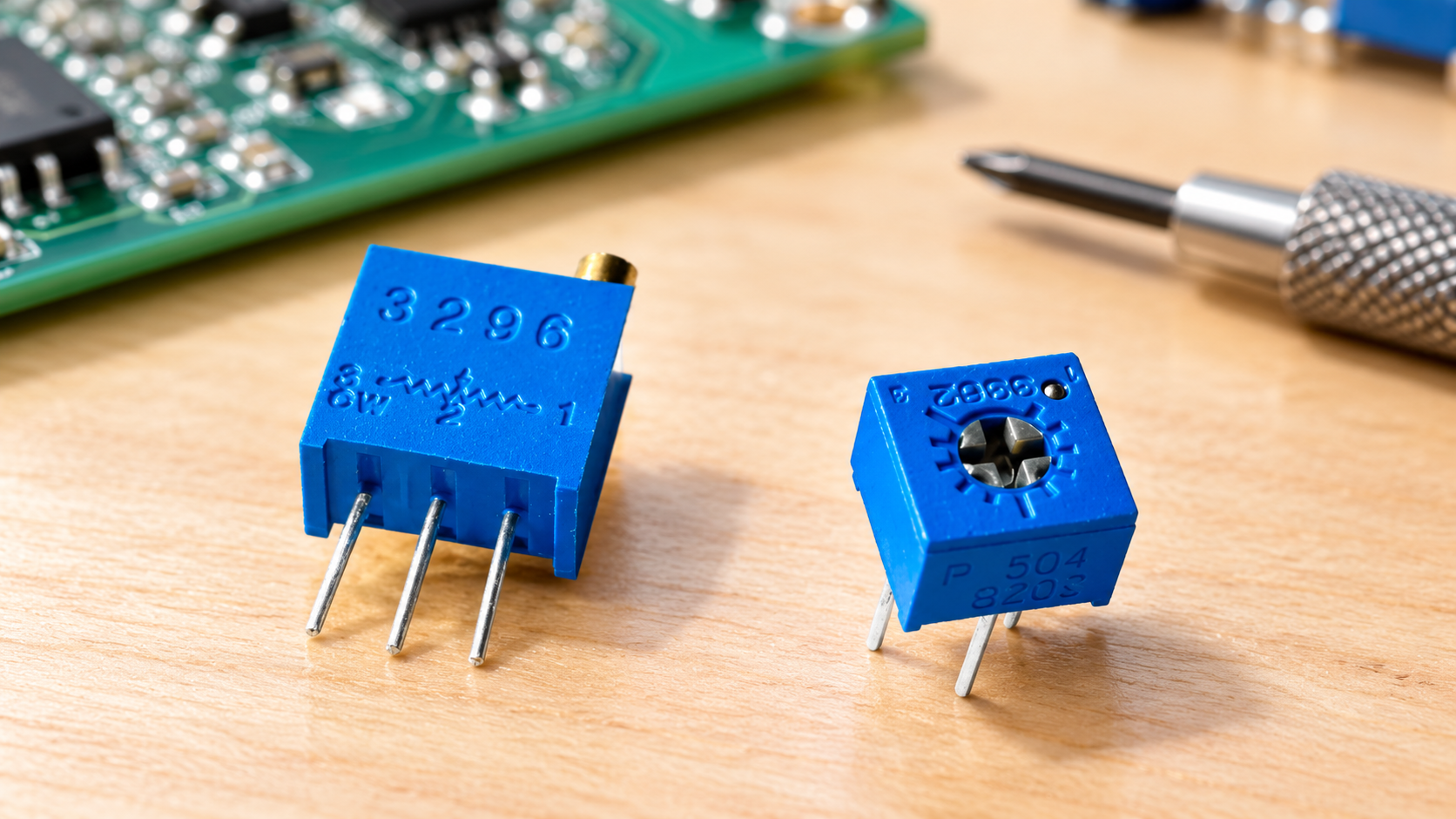
A 3296-style multiturn trimmer should be approved only after the OEM verifies the resistance code, terminal style, adjustment orientation, power derating, temperature range, sealing, and packaging against the exact supplier drawing. The familiar blue 3/8-inch body is not a complete specification. Visually similar parts can differ in pin layout, adjustment direction, resistance range, qualification evidence, and delivery format. This guide turns the RFQ into seven checks that purchasing, engineering, and incoming inspection can use together.
Key Takeaways
What the RFQ must identify
Specify the exact resistance value and code; never approve a trimmer from body color or size alone.
Attach the terminal-style drawing and state the PCB viewing side.
Separate power rating at the reference temperature from the derated limit at higher temperature.
Define adjustment access, packaging, and incoming-inspection evidence before sample approval.
Treat cited manufacturer values as comparison references, not automatic ratings for an unspecified LORIDA part.
What Does “3296” Tell an OEM Buyer?
It identifies a product format, not the complete ordered part
The 3296 format is widely associated with a sealed, through-hole, cermet, multiturn trimming potentiometer in a 3/8-inch square body. Bourns publishes 25 nominal turns for its 3296 family, a resistance range from 10 ohms to 2 megohms, and a 0.5 W rating at 70 degrees C. These numbers belong to that named manufacturer family and are useful as a comparison reference. They do not prove the ratings of a visually similar part from another supplier.
An orderable code normally combines several decisions. In the Bourns example, the letter following 3296 identifies the pin style, the numeric field identifies the resistance code, and an additional suffix can identify termination or packaging. Vishay's T9 and T93 families show the same procurement lesson: products with a similar 3/8-inch multiturn form still have their own drawings, ratings, and ordering structures. The RFQ should therefore name the candidate series, full code, drawing revision, and requested evidence rather than say only “3296 blue trimmer.”
Which Seven Checks Prevent an Incorrect Substitute?
Checks 1–3: resistance, code, and terminal geometry
Lock the electrical value. State nominal resistance in ohms and the permitted tolerance. Bourns' published standard table uses three-digit resistance codes: for example, 103 represents 10,000 ohms, 104 represents 100,000 ohms, and 105 represents 1,000,000 ohms. The purchase record should include both the written value and the code so a misplaced digit is easier to detect.
Verify the full part code. A family number alone does not identify pin style, termination, or packaging. Require the supplier quotation, label, and sample marking to map to one controlled orderable code. If the supplier uses a different coding system, include a cross-reference approved by engineering.
Match the terminal drawing to the PCB. Confirm pin spacing, body orientation, adjustment screw location, and the PCB viewing side. A side-adjust version cannot be assumed interchangeable with a top-adjust version. Incoming inspection should compare the sample to the released drawing, not to a catalog thumbnail.
Checks 4–7: adjustment, thermal limits, environment, and packaging
Confirm adjustment travel and access. Bourns states 25 nominal effective turns for its 3296 family. More turns can support finer setting than a single-turn format, but the actual circuit resolution also depends on resistance value, wiper behavior, instrument resolution, and mechanical technique. Verify that the enclosure provides tool access without side loading or shorting nearby conductors.
Apply the series-specific power curve. The cited Bourns family is rated 0.5 W at 70 degrees C and derates to 0 W at 125 degrees C, with a 300 V maximum stated alongside the power rating. Do not copy these values into a substitute specification. Obtain the exact candidate curve and calculate dissipation under the real circuit voltage, resistance, duty, ambient temperature, and self-heating condition.
Define the environmental evidence. The same Bourns data lists an operating range of -55 degrees C to +125 degrees C, a 1,000-hour load-life test at 0.5 W and 70 degrees C, and 200 rotational cycles under its stated acceptance criteria. These are precise examples of the evidence categories an OEM may request. Approval must use the selected supplier's current data and the equipment's own qualification plan.
Control packaging and inspection. Bourns lists 50 pieces per tube for standard packaging and identifies tape-and-reel or ammo-pack options for selected pin styles. The RFQ should state packaging, quantity per pack, label fields, moisture or storage controls when applicable, and the sampling plan. Packaging differences can change feeder compatibility, bent-pin risk, and traceability even when the electrical part is correct.
How Should Buyers Compare Candidate Parts?
Use one evidence table for engineering and purchasing
| RFQ field | Evidence to request | Release question |
|---|---|---|
| Resistance and tolerance | Full order code, datasheet, label photo | Do written value and resistance code agree? |
| Pin style and adjustment | Dimensioned drawing and PCB footprint | Do pin positions, viewing side, and tool access match? |
| Power and temperature | Power derating curve and application calculation | Is dissipation below the permitted curve in every mode? |
| Environmental life | Supplier qualification report and OEM validation plan | Are test conditions relevant to the equipment? |
| Packaging | Packaging drawing, quantity, label and sample pack | Can production handle it without pin damage or mix-up? |
Do not use a single “equivalent” column as the approval record. A useful comparison lists each parameter, source document, revision, and result. Record unknowns as open items. If a supplier cannot provide the drawing or a rating, do not replace the blank with a value copied from a competitor's data sheet.
Validate the sample in the real circuit
Bench approval should confirm resistance between the two end terminals, wiper movement, adjustment direction, reachable circuit setpoint, thermal behavior, and mechanical access. Record the exact sample code and test condition. If the trimmer sets a threshold, feedback ratio, gain, or bias, verify the functional output across supply, load, and temperature limits rather than approving only a loose-part resistance measurement.
For sourcing, review the LORIDA variable resistor category, compare the related trimmer adjustment control guide, and send drawings through the engineering inquiry page. Final suitability, ratings, and compliance remain subject to the exact approved part and the equipment manufacturer's validation.
Frequently Asked Questions
Does 103 always mean 10 kΩ on a trimmer potentiometer?
In the common three-digit resistance-code convention, 103 means 10,000 ohms, but the buyer must confirm the selected supplier's coding table. The first two digits are significant figures and the third digit is the number of following zeros. That makes 104 equal to 100,000 ohms and 105 equal to 1,000,000 ohms in the cited Bourns table. Do not rely only on a small or partially readable body mark. Compare the supplier label, full order code, data sheet, and a resistance measurement. If a custom marking or alternate code is proposed, require a documented cross-reference before release.
Can any blue 3296-style trimmer replace another?
No, visual similarity is not proof of electrical or mechanical interchangeability. Candidates may differ in terminal arrangement, top or side adjustment, resistance range, tolerance, power curve, temperature limit, sealing, rotational life, packaging, and qualification evidence. Even a compatible footprint does not prove that the circuit setpoint, adjustment direction, or thermal margin is acceptable. Compare dimensioned drawings and current data sheets line by line, then validate the exact sample in the intended circuit. Keep the approved manufacturer, series, full code, and revision in the BOM and inspection record.
Is a 0.5 W trimmer safe at 0.5 W in a hot enclosure?
Not necessarily, because the published power is tied to a reference temperature and normally derates as temperature rises. Bourns rates the cited 3296 family at 0.5 W at 70 degrees C and 0 W at 125 degrees C. That example shows why an OEM must use the exact candidate's derating curve, not a headline wattage. Calculate actual dissipation from the circuit, include ambient temperature and self-heating, and check abnormal modes. Confirm whether the data sheet bases the limit on ambient, body, or another defined temperature and reproduce that condition during validation.
What should be included in a 3296 trimmer RFQ?
Include the nominal resistance, tolerance, terminal style, adjustment orientation, PCB drawing, power and temperature conditions, packaging, quantity, and required evidence. Add the equipment function, circuit voltage, expected dissipation, adjustment frequency, tool-access restriction, environmental range, and acceptance test. Attach photographs or drawings of the existing part when the request is for replacement, but do not use appearance as the release criterion. Ask the supplier to return a full order code, current data sheet, dimensioned drawing, label example, packaging specification, and any qualification reports needed by your quality system.
Sources and Review Note
Primary manufacturer references
Bourns, 3296 3/8-inch Square Trimpot Trimming Potentiometer datasheet and official product page.
Vishay Sfernice, T9 and T93 3/8-inch Square Multiturn Cermet Trimmer datasheets.
Last Updated: October 26, 2026. Technical review used the cited primary manufacturer sources. Numerical examples are manufacturer-specific comparison references and are not presented as universal LORIDA product ratings. No individual author or reviewer name is displayed because a confirmed public byline identity was not available.
Prepare a traceable RFQ. Send the exact part number, operating conditions, drawings, and validation criteria through the LORIDA contact page. Final limits remain subject to the ordered series specification and approved sample.