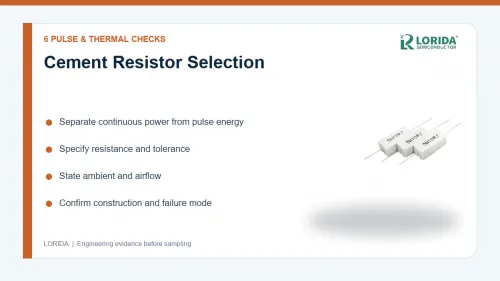
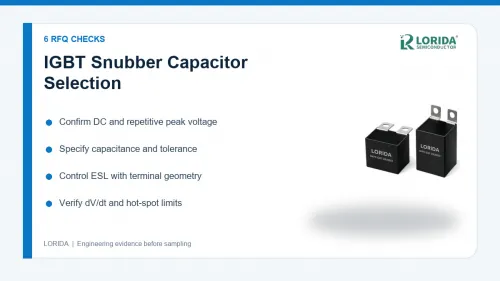
A CBB61 fan capacitor RFQ should identify the required capacitance, AC voltage rating, operating frequency, climatic category, termination and mechanical envelope before a sample is approved. A listed LORIDA product example is 1.2 µF at 450 V (LORIDA product page); a separate manufacturer’s marking example shows ±5%, 50/60 Hz and 40/70/21 (Anhui Safe Electronics explanation). These are examples, not a blanket specification for every CBB61 part. This guide explains how to turn an old label and motor drawing into a testable buyer specification without treating wire colors, a plastic case or a printed approval symbol as proof of compatibility.
Key Takeaways
“CBB61” identifies a product family, not a single interchangeable value or lead arrangement.
Record each electrical marking and the actual motor circuit requirement separately.
A higher VAC marking does not correct the wrong capacitance, termination or case fit.
Photograph the original part and document the mating connector before quoting.
Ask for a current datasheet and sample inspection plan for the exact offered construction.
Last Updated: September 15, 2026.
1. Decode the markings before you choose a replacement
Capacitance, tolerance and AC rating are separate requirements
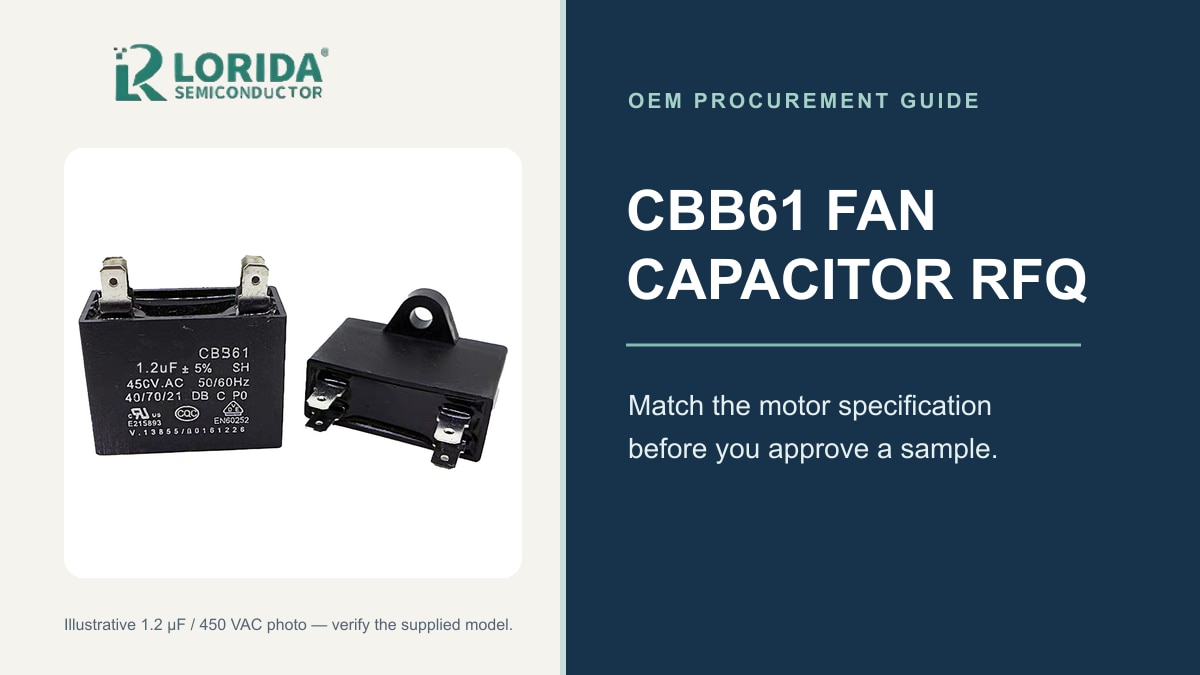
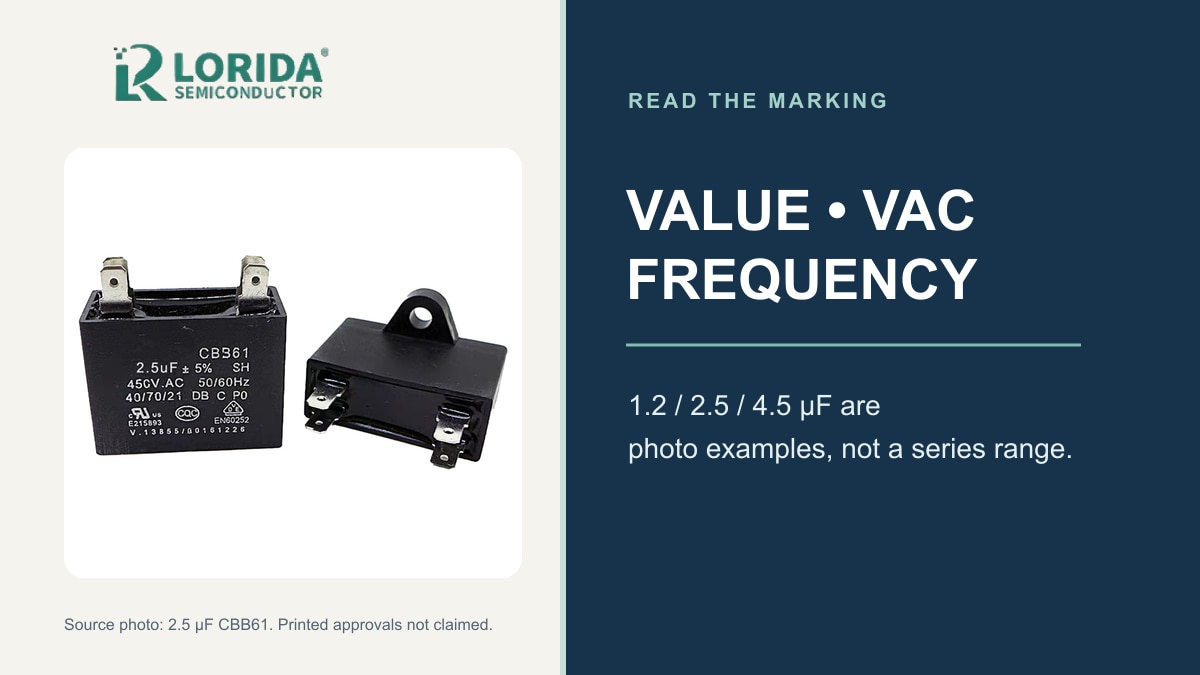
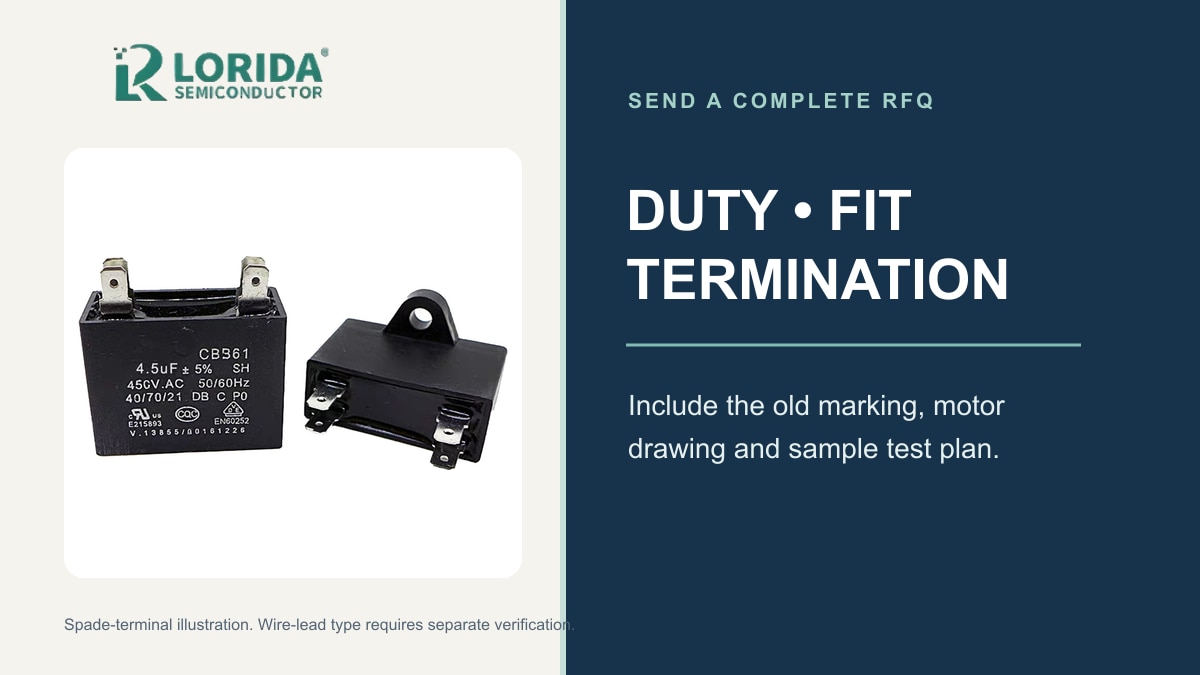
The old capacitor’s nominal microfarad value is the starting point. The LORIDA public product listing identifies a 1.2 µF, 450 V CBB61 fan-capacitor example; it does not establish the tolerance or terminal style of every possible quotation (LORIDA product page). In the independent Anhui Safe Electronics example, 1.2 µF is the nominal value and ±5% is the stated production tolerance, with 450 VAC as the AC rating (manufacturer explanation). The shared spade-terminal source photo used here also visibly carries these example markings; they must be checked against the actual offered model’s datasheet.
Do not mix a VAC marking with a DC voltage label merely because the numerical value looks similar. If an older OEM drawing calls for a different capacitance, the supplier should identify an exact compatible candidate rather than silently change the motor’s design target. Equally, tolerance is not permission to choose a different nominal value. Ask the motor engineer to specify the acceptable measured range and how it will be measured. A procurement sheet that says only “CBB61, 450 V” leaves too much room for a wrong sample.
Frequency and climatic category describe different conditions
The same manufacturer’s example states 50/60 Hz and 40/70/21 (Anhui Safe Electronics). The latter is a climatic category marking, not a “21-year life” promise. Anhui Safe explains its example as a −40°C lower category temperature, +70°C upper category temperature and 21-day damp-heat test designation. An independent RS reference sheet also lists 40/70/21 and 40/85/21 as example climatic categories for its own motor-capacitor family (RS datasheet, pp. 2 and 6). None of those ranges may be copied into a LORIDA model-level claim unless the offered LORIDA datasheet confirms them.
For the RFQ, identify the fan’s electrical supply and the measured or specified temperature in the capacitor location. A switch housing, motor enclosure or exhaust-fan cabinet can be warmer than the room, so “ambient temperature” without a measurement point is ambiguous. If the original component has a climatic code, preserve it in the comparison record and ask for a direct datasheet comparison. Treat the code as one design condition among several, not as a substitute for thermal evaluation.
2. Separate electrical fit from physical fit
Two terminals, lead wires and multi-section packs are not the same thing
CBB61 describes a family of fan/motor capacitors; the termination can differ. The published LORIDA CBB61 category covers the fan application, while the shared source photo in this article illustrates a two-tab/spade construction. The RS technical sheet independently lists wire and tab constructions in its reference family, and its test-method table distinguishes 20 N for wire terminals and 40 N for tabs during terminal-strength testing (RS datasheet, p. 4). Those are RS reference test loads, not LORIDA test results or promises. They illustrate why termination is an engineering field rather than a cosmetic preference.
Many real replacement questions ask whether a different number of wires or new wire colors can be mapped to an old fan capacitor (example buyer question, recent question). These posts are evidence of the question, not an authority for wiring. A two-terminal single-section part must not be assumed equivalent to a multi-section fan pack. Lead color alone does not specify the internal circuit, and an RFQ should never supply a guessed color-to-color substitution. Have a qualified motor or appliance engineer check the original circuit drawing and the proposed datasheet before any installation or energized test.
Case, mount and connector form one mechanical specification
The offered component must fit the envelope and the mating connection without forcing a cable, tab or case against adjacent parts. Record the original case’s length, width and height from the OEM drawing or controlled measurement; note the mounting tab or hole, the position and orientation of each terminal, insulation clearance and connector style. A photo from the top and another from the side can expose differences a single catalog image hides. Do not take dimensions from an unrelated manufacturer’s generic drawing and present them as LORIDA dimensions.
The RS reference datasheet demonstrates why dimensions vary by nominal value and construction: its 1.2 µF, 450 VAC tinned-wire reference has a 36.0 × 22.0 × 13.0 mm listed body envelope (RS datasheet, p. 3). This is an RS part only, not a LORIDA size. In the buyer comparison table below, any size is therefore “confirm from exact drawing” until a current offered-model document exists. The practical decision is not “which CBB61 photo looks closest?” but “which sampled candidate satisfies the controlled electrical, thermal and fit requirements?”
| RFQ field | What the buyer should provide | What the supplier should return |
|---|---|---|
| Nominal capacitance and tolerance | Original label plus motor-design requirement | Exact offered value, measured acceptance band and current datasheet |
| AC rating and frequency | Required VAC rating, supply and motor duty | Offered VAC/frequency marking and applicable operating conditions |
| Climatic category | Old code and temperature location | Exact model’s declared category, with document reference |
| Circuit/termination | Original schematic, connector and lead count | Exact lead/tab layout and termination drawing |
| Mechanical envelope | Controlled drawing and available space | Offered body and mount dimensions with tolerances |
| Sample plan | Expected quantity and test conditions | Traceable sample identification and agreed checks |
3. Build an RFQ that can be checked on a sample
Keep source evidence and offered claims in different columns
A good cross-reference sheet has four columns: old-part observation, OEM requirement, offered-model claim and verification result. The old label may be weathered or incomplete; in that case record “unreadable” rather than fill a guessed value. The OEM design drawing should prevail over an isolated color or unverified seller listing. The offered-model column should cite a current datasheet revision, not a marketing page copied from another product family. The result column remains open until the buyer measures or tests a real sample.
Ask for the exact product designation, bill-of-materials reference, case/termination drawing, nominal capacitance, tolerance, VAC rating, frequency, climatic category and any safety-protection classification applicable to that part. A mark printed on a source-image example does not establish that all LORIDA parts carry the same approval or protection class. If the buyer has an approval requirement, request a certificate or controlled approval list linked to the exact offered model. Likewise, do not translate “self-healing” marketing text into a quantified failure rate or lifetime claim.
Use a conservative first-article sample review
Before sample approval, compare the received sample label against the quotation and datasheet, then verify connector fit and the controlled envelope. Agree on a capacitance measurement method and the motor’s acceptance limits; check the actual thermal and electrical duty under supervision by qualified personnel. Keep the sample’s batch identifier and the datasheet revision with the test record so a later production shipment can be checked against the same construction. The reference values above are teaching examples, not acceptance limits for the specific LORIDA item.
If any offered value is different from the OEM requirement, request a written engineering disposition rather than letting purchasing silently accept a “near enough” substitute. An AC capacitor is not a harmless drop-in part simply because the case is black and the connector fits. This article is for specification and procurement planning; mains wiring and energized testing belong to qualified technicians following the appliance manufacturer’s instructions and applicable safety procedures.
4. Buyer FAQs from real replacement questions
Can a CBB61 with the same VAC but different µF replace the old part?
No: the same AC voltage rating does not make a different nominal capacitance an automatic substitute. Real replacement questions often compare parts with “slightly different ratings” when an exact CBB61 cannot be found (question example). Capacitance is part of the motor circuit design, while VAC is the capacitor’s electrical rating; neither field cancels the other. Write the original µF value, tolerance and section arrangement into the RFQ, then ask for the exact offered-model datasheet. If a supplier proposes a different value, require the motor or appliance engineer to approve the change and define the sample test. A ±5% tolerance on one cited manufacturer’s example is a band around that example’s nominal value, not permission to replace the design value with an arbitrary nearby component. Qualified personnel should make the final compatibility and safety decision.
Can different wire colors be matched by appearance alone?
No: wire colors alone are not a reliable map of a fan capacitor’s internal sections or motor connections. Users explicitly ask how to align different colors and different wire counts when an older CBB61 is unavailable (recent question). Photograph the old connection before removal, obtain the OEM schematic and request a diagram for the exact proposed part. A single two-terminal capacitor and a multi-section pack may perform different roles even if both carry the CBB61 family name. Neither this article nor a product photograph supplies a wiring instruction. If the proposed diagram cannot be reconciled with the appliance design, classify the sample as pending engineering review rather than inventing a color-to-color pairing. Actual mains wiring must be performed by a qualified technician under the relevant appliance instructions.
Is a higher 450 VAC marking always a safer replacement choice?
No: a higher VAC rating may satisfy one electrical constraint, but it does not prove overall compatibility. The LORIDA public page lists a 1.2 µF / 450 V example (product listing); other manufacturers offer different values and constructions. Compare the exact µF, tolerance, frequency, climatic category, size, lead or tab style, and the motor’s intended duty before approving any substitute. A physically larger higher-rated case may not fit the original housing, and a different lead arrangement may not match the controlled connector. Do not infer that every 450 VAC part runs cooler, has longer life or carries the same approval as another part. Record any changed field in the RFQ and have the OEM engineer define the qualification checks. The offered-model datasheet and first-article inspection are the decision evidence.
What information should an OEM send for a CBB61 quotation?
Send the old marking, OEM motor requirement, mechanical drawing and termination details together. A buyer who supplies only “CBB61 450 V” leaves the supplier guessing the capacitance and connector. Include the old part’s clear front and side photographs, each µF section if the capacitor is multi-section, VAC and frequency markings, climatic code, case dimensions, mounting and connector details, annual use or operating duty if known, and the target sample inspection method. Mark unreadable or unknown fields as such. Ask the supplier to return a current datasheet revision, exact part designation, drawing, declaration for the model and traceable sample identity; separately identify any proposed deviations. This gives the engineer a comparison they can approve, and it gives purchasing a precise basis for the request. It does not imply an unverified MOQ, delivery time or performance guarantee.
5. Next step for a traceable quote
Compare the exact offered candidate, not a product-family label
Review the LORIDA CBB61 category and the listed 1.2 µF / 450 V CBB61 product example to identify the relevant family. If you are comparing a cylindrical motor-run construction rather than a rectangular CBB61 case, read the separate CBB60 replacement guide without assuming either family is drop-in interchangeable. A supplier response should name the precise model and evidence for every changed field.
Send your CBB61 requirements
Share the old label, motor drawing, terminal or wire arrangement, case envelope, electrical duty and sample-check criteria through the LORIDA contact page. The review can then compare documented candidate parts rather than guess from a photograph.
Sources and attribution
LORIDA CBB61 product listing: listed 1.2 µF / 450 V example only.
LORIDA CBB61 category: CBB61 fan/motor application.
Anhui Safe Electronics CBB61 explanation: third-party marking example, not LORIDA specification.
RS motor-capacitor datasheet: independent reference markings, dimensions and test-method examples; not LORIDA specifications.
Buyer question about a three-wire replacement and buyer question about differing wire colors: wording evidence only, not technical authority.