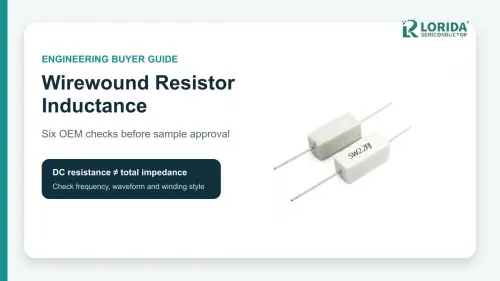
A cement resistor should be selected by resistance, continuous power, pulse energy, repetition rate, temperature and required failure behavior—not by wattage alone. LORIDA's RX27 product page lists 0.1 Ω to 100 kΩ, nominal power options of 5 W, 10 W, 20 W, 50 W and 100 W, and an operating-temperature entry of -55 °C to +250 °C. Those catalogue entries define a search range; an RFQ still needs the exact waveform and mounting condition before a sample can be approved. This guide provides six checks and clearly labels third-party examples.
Last Updated: 2026-09-07
Need an RFQ-ready RX27 shortlist? Send resistance, continuous voltage/current, pulse waveform, pulse energy, repetition rate, ambient temperature, mounting space and required failure behavior. LORIDA can review candidate options against the duty you provide.
Key Takeaways
Information that belongs in every cement-resistor RFQ
State continuous power and pulse energy separately.
Provide pulse shape, duration, repetition rate and cool-down time.
Define ambient temperature, airflow, board spacing and nearby heat sources.
Request an exact-series overload curve and failure-mode statement.
Why the wattage label is not enough
Continuous heating and short pulses are different loads
Continuous power determines steady heating, while a short surge may deposit substantial energy before heat can leave the resistive element. The same average power can therefore produce very different peak temperatures when pulse duration and repetition change. A buyer should send both the normal operating load and every exceptional event: startup, capacitor discharge, precharge, braking, fault clearing or surge. If only “20 W” appears on the RFQ, the supplier cannot know whether it means continuous dissipation, a brief pulse or a mechanical size preference.
Construction changes inductance and failure behavior
“Cement resistor” describes an enclosure or coating style, not one universal electrical construction. A wirewound element may have inductance unless a non-inductive winding is specified; a ceramic-composition element behaves differently under pulse energy. Some series are designed to fuse safely under overload, but that must be stated by the exact datasheet. Vishay's AC..CS is a specific fusible wirewound safety series recognized to UL 1412; its published behavior must not be transferred to an unrelated LORIDA RX27 part without evidence.
Six checks for a purchasing specification
Turn the circuit duty into supplier-verifiable inputs
| Check | Buyer input | Evidence to request |
|---|---|---|
| 1. Resistance | Nominal value and circuit function | Available value and tolerance |
| 2. Continuous load | Voltage/current and duty duration | Rated-power conditions and derating curve |
| 3. Pulse load | Pulse shape, duration, energy and repetition | Pulse-overload curve for exact series |
| 4. Thermal environment | Ambient, airflow, board spacing | Surface-temperature or clearance guidance |
| 5. Electrical behavior | Frequency and inductance sensitivity | Construction and non-inductive option |
| 6. Safety response | Fault voltage and desired failure mode | Applicable recognition and overload test |
Use public catalogue values only as a candidate filter
The LORIDA RX27 page lists a resistance range from 0.1 Ω to 100 kΩ and five power options: 5 W, 10 W, 20 W, 50 W and 100 W. It also lists tolerance codes corresponding to ±0.5%, ±1%, ±2%, ±5% and ±10%. These entries are useful for initial filtering, but the page does not provide a pulse-overload curve for every value and package. Buyers should therefore request a controlled datasheet and drawing for the exact proposed part before treating any pulse or thermal limit as approved.
How to evaluate pulse and surge evidence
Compare only tests with matching waveforms
Surge capability is meaningful only with the test waveform, resistance range and series stated. Vishay's Z300-Cxx page specifies impulse capability up to 12 kV using the IEC 61000-4-5 1.2/50 µs voltage pulse shape. Its AC03..CS example lists up to 2 kV for 4.7–91 Ω and 4 kV at 100 Ω, while AC05..CS lists 4 kV for 10–20 Ω and 6 kV for 22–100 Ω. These values are third-party, series-specific examples. They show why “surge resistant” without waveform and part number is not an auditable requirement.
Validate temperature and spacing on the real board
Mount the sample with production lead length, board spacing and airflow. Measure the resistor surface temperature at the highest repetitive duty after temperatures stabilize, then run the specified startup or fault pulses. Inspect solder joints, coating and nearby materials. If the resistor is intended to open safely during a fault, the acceptance test must define the source voltage, current limitation, clearing time and permitted damage. For related options, review LORIDA's RX27 cement resistor, DC-link precharge resistor guide, and product center.
Frequently Asked Questions
Can I replace a cement resistor with the same resistance and wattage?
Not safely without checking pulse, construction and dimensions. Two parts with the same resistance and nominal wattage can have different overload curves, thermal derating, inductance, lead spacing and failure behavior. Start with the circuit function and provide continuous current, pulse waveform, pulse energy, repetition rate, ambient temperature and board drawing. Ask the supplier to identify the exact series and the datasheet limits used for the replacement. Validate the candidate on the production layout, especially if it handles startup, discharge, surge or fault energy.
How do I calculate pulse energy for a resistor?
Calculate pulse energy by integrating instantaneous power over the pulse. For a rectangular approximation, energy equals power multiplied by pulse duration; power may be expressed as current squared times resistance or voltage squared divided by resistance. Real startup and discharge waveforms are often not rectangular, so use measured data or the circuit's analytical waveform. Send the supplier the waveform, not only the calculated joule value, because peak power and duration affect internal temperature differently. Also state repetition rate and cool-down time so cumulative heating can be checked.
When is a non-inductive resistor needed?
A non-inductive construction is important when circuit performance is sensitive to fast current changes or high frequency. Conventional wirewound elements can add inductance, which may change a snubber, discharge or measurement circuit during rapid transients. The required limit should come from circuit analysis or measurement, not from a generic label. State the frequency range, edge rate or allowable inductance in the RFQ, and request construction details or measured impedance data for the exact part. Do not assume every white ceramic or cement package is non-inductive.
Does an operating-temperature range equal the allowed surface temperature?
No; an operating-temperature range does not by itself define the allowable resistor surface temperature at full load. The published range may describe ambient or component capability under specified derating conditions. Request the exact derating curve, rated-power reference condition and any maximum surface or hot-spot guidance. During sample validation, measure both ambient and component temperature with the intended board spacing and airflow. Check nearby wire insulation, PCB material and connectors as well, because their temperature limits may be lower than the resistor's.
How to compare supplier proposals
Build one normalized evidence table
List the exact part number, resistance, tolerance, rated-power condition, pulse curve, thermal derating, dimensions, lead spacing, construction and declared failure behavior for every proposal. Do not mix a family-level brochure with a part-level drawing. When a field is absent, record it as missing and request clarification. A quotation that repeats only resistance and wattage has not answered a pulse-duty RFQ. If the resistor is safety-related, separately record the applicable recognition, file number, approved resistance range and test condition; recognition of one series or factory cannot be silently transferred to another construction.
Keep sample and production evidence connected
The validation report should show the tested resistor marking, lot, board revision and waveform. Keep photographs of lead forming, clearance and heat discoloration together with temperature data. Define which changes require requalification, such as element construction, ceramic body, coating, lead diameter, resistance alloy or manufacturing location. This traceability makes later substitutions auditable and helps purchasing distinguish an equivalent proposal from one that merely fits the same footprint.
Ready to compare a candidate? Attach the six purchasing inputs and the board-space or lead-spacing drawing. A complete duty profile helps the supplier answer with an exact resistance, construction, drawing and validation plan instead of a wattage-only match.
Sources
Verified references used for exact data
LORIDA RX27 product page: https://www.loridacapacitor.com/Cement-resistor/rx27-cement-resistor.html
Vishay Z300-Cxx product information: https://www.vishay.com/en/product/21027/
Vishay AC..CS datasheet: https://www.vishay.com/docs/48004/_ac-cs_fusible_wirewound_safety_resistor.pdf
Ohmite A Series: https://www.ohmite.com/res-a/