Procurement Decision Guide · Aluminum Electrolytic Capacitors
ESR and impedance are related but not interchangeable RFQ values. ESR is the resistive loss term, while impedance |Z| combines ESR with capacitive and inductive reactance at a stated frequency and temperature. A usable quotation must identify the required parameter, test frequency, temperature, voltage, capacitance and mechanical format.
Key Takeaways
Never compare an ESR value with an impedance limit unless the test conditions and definition match.
Request frequency and temperature beside every ESR or |Z| figure.
Use the exact series datasheet; construction and case size materially change the result.
Link the electrical request to ripple current, thermal conditions and validation evidence.
What Is the Buyer Actually Comparing?
ESR is the resistive part of the equivalent circuit
TDK defines equivalent series resistance as the resistive component of the capacitor equivalent circuit and gives the relationship ESR = tanδ/(ωC). The equation immediately shows why a dissipation-factor result cannot be converted into one universal ESR number without capacitance and frequency. It also explains why a value measured at 120 Hz is not directly comparable with one specified at 100 kHz.
ESR represents power loss and contributes to self-heating under ripple current. It includes losses associated with electrolyte, foils, contacts and terminals. The value is not a fixed property independent of operating condition: TDK and Nichicon both show strong changes with frequency and temperature.
Impedance includes reactive terms
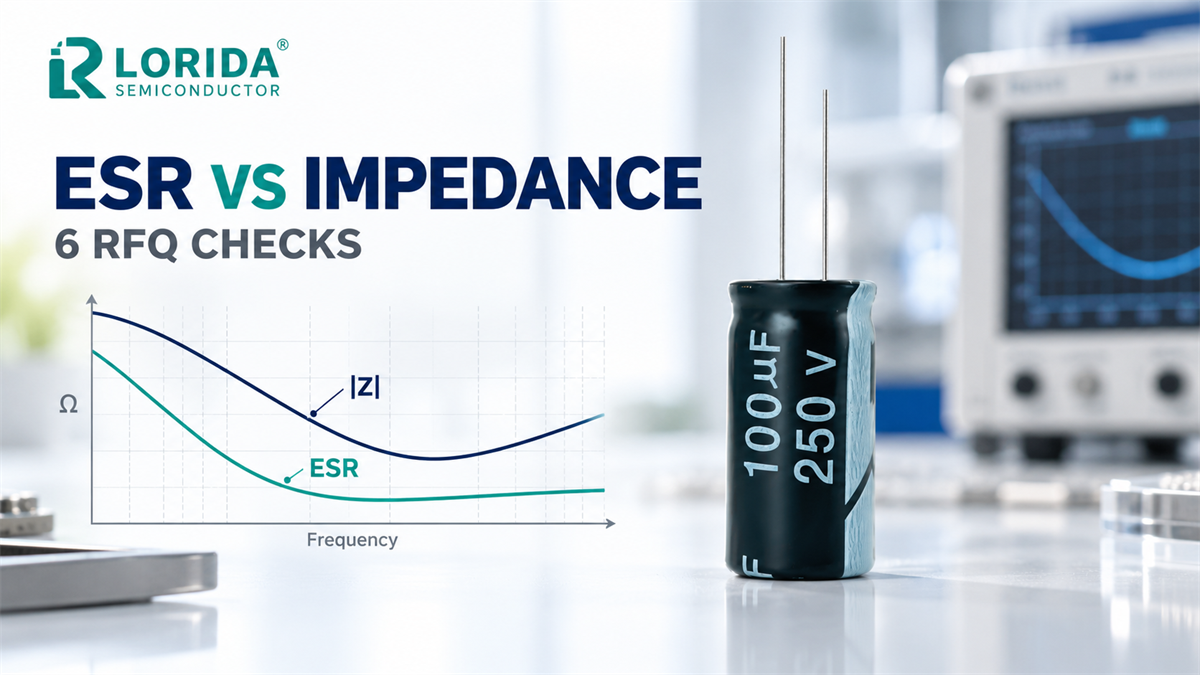
Total impedance |Z| combines capacitive reactance 1/(ωC), ESR and inductive reactance ωESL. TDK explains that capacitive reactance dominates at low frequency, electrolyte resistance becomes important as frequency rises, and inductive reactance dominates above self-resonance. Therefore the same capacitor can show a falling |Z| curve, a minimum near resonance and a rising curve at higher frequency.
Six RFQ Checks Before Comparing Quotes
Lock the measurement conditions first
| RFQ field | Minimum useful detail | Why it matters |
|---|---|---|
| Parameter | ESR, |Z| or tanδ | Prevents comparison of different electrical quantities |
| Frequency | For example 120 Hz, 10 kHz or 100 kHz | Reactance and losses change with frequency |
| Temperature | Measured value such as 20°C or −25°C | Electrolyte conductivity changes strongly with temperature |
| Electrical rating | Capacitance, tolerance, rated and operating voltage | Defines the intended part and calculation basis |
| Mechanical format | Case diameter, height, lead spacing and mounting | Construction changes terminal and winding losses |
| Validation | Series document, method, instrument and sample plan | Makes supplier claims reproducible |
How Do Frequency and Temperature Change the Decision?
Low frequency can be dominated by capacitance
At low frequency, capacitive reactance may be much larger than ESR, so the measured impedance mainly reflects capacitance. As frequency increases, 1/(ωC) falls. Near the impedance minimum, ESR often becomes the main term. Above self-resonance, lead and winding inductance increase impedance again. A single low-frequency impedance value therefore cannot predict high-frequency filtering performance.
Nippon Chemi-Con gives application examples in which conventional aluminum electrolytic capacitor behavior becomes ESR-dominated at kilohertz frequencies. Those examples are circuit-specific, not universal limits, but they demonstrate the procurement risk of copying one number without the associated curve and test condition.
Cold conditions can expose a hidden mismatch
Nichicon states that aluminum electrolytic electrolyte conductivity decreases as temperature falls, raising ESR and impedance. Its technical plots use 50 V 1000 µF and 200 V 470 µF examples across temperature and frequency; the figures are illustrations, not LORIDA model specifications. TDK further notes that IEC 60384-4 measurements are taken after thermal equilibrium. A cold-start requirement should therefore request cold impedance or ESR evidence, not only a room-temperature line item.
How Should an OEM Validate a Sample?
Use the same definition on both sides
Before measurement, confirm the exact series, capacitance, voltage, case size and polarity. Stabilize the part at the agreed temperature. Use a four-terminal fixture where lead and contact resistance would be material, and set the LCR meter to the specified frequency and measurement mode. Record calibration state, fixture compensation and test signal. Do not subtract an unexplained “fixture correction” after seeing the result.
Compare supplier evidence and incoming results under equivalent conditions. If the design needs high-frequency filtering, record a frequency sweep rather than one point. If the design is ripple-limited, combine electrical measurement with temperature-rise testing in the actual circuit. Never convert a generic ESR marketing claim into an approved model specification without documented evidence.
Translate the requirement into a complete inquiry
For a radial part, send capacitance, rated and operating voltage, ripple spectrum, ambient range, ESR or impedance test point, case envelope, lead spacing, polarity and life target. Review the radial electrolytic capacitor range, the broader capacitor portfolio and LORIDA's leakage-current test guide when building the validation plan.
Frequently Asked Questions
Is ESR the same as capacitor impedance?
No, ESR is only the resistive component of capacitor impedance. Total impedance also contains capacitive reactance and inductive reactance, so |Z| changes across frequency even when a simple ESR model appears nearly flat. At low frequency, capacitance can dominate; near resonance, ESR can dominate; above resonance, inductance raises impedance. State the required quantity, frequency and temperature in the RFQ. Comparing an ESR value from one datasheet with a |Z| value from another can select the wrong part even when both numbers are reported in ohms.
Why is ESR often specified at 100 kHz?
100 kHz is commonly used because many switching-power applications operate where resistive losses are important, but it is not a universal requirement. A 100 kHz ESR value may help compare parts for high-frequency ripple, while rectified mains and low-frequency ripple involve different conditions. Use the frequency required by the circuit or reference design. If the ripple spectrum has several components, request a curve or multiple points and evaluate heating from the complete spectrum rather than one convenient catalog value.
Does lower ESR always mean a better capacitor?
No, lower ESR is beneficial only when the circuit, thermal design and control loop support it. The part must still meet voltage, capacitance, ripple, temperature, life, surge and mechanical requirements. In some power supplies, a control loop expects a particular output-capacitor ESR range; moving far below it can alter stability. Procurement should therefore avoid ranking quotations by ESR alone. Ask engineering to define the acceptable window and the exact test condition, then compare complete series evidence.
What should be included in an ESR validation report?
Record part identity, series, capacitance, voltage, case size, temperature, frequency, instrument, fixture, compensation method, sample count and each result. Add the applicable datasheet revision and pass/fail limit. For a frequency sweep, preserve the raw curve and test settings. For cold testing, document stabilization time and actual component temperature. If ripple heating is critical, report circuit waveform and capacitor temperature rise separately; an LCR-meter ESR result alone does not prove safe operation under the final load.
Sources and Verification Notes
TDK: Aluminum Electrolytic Capacitors, General Technical Information.
Nichicon: General Descriptions of Aluminum Electrolytic Capacitors.
Nippon Chemi-Con: Judicious Use of Aluminum Electrolytic Capacitors.
Last Updated: October 30, 2026. Manufacturer examples explain measurement principles and are not presented as unverified LORIDA model specifications.
Need an ESR or impedance requirement checked before sampling?
Send the reference part, capacitance, voltage, frequency, temperature, ripple spectrum, case envelope and validation method. LORIDA can identify missing RFQ inputs before a sample configuration is proposed.
Send Your RFQ Conditions