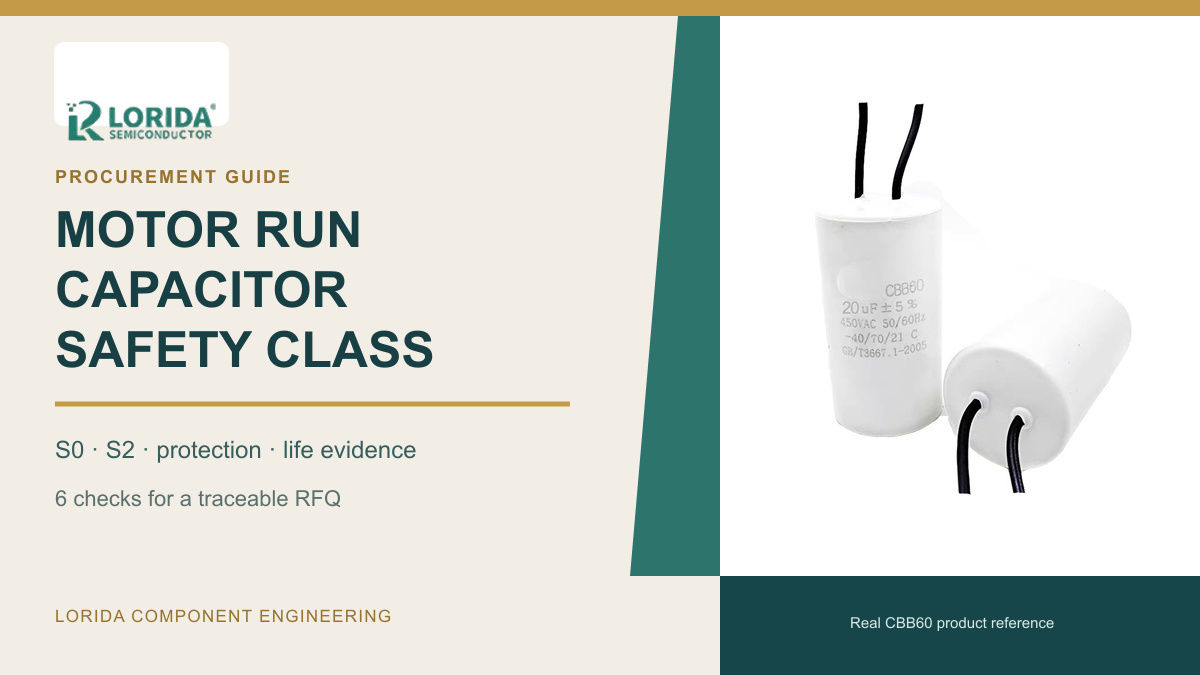
A motor run capacitor safety class must be verified from the exact series data because the class describes the protection behavior and test basis, not just capacitance or voltage. For a traceable RFQ, buyers should identify continuous motor-run duty, the required IEC 60252-1 safety class, the protection device, service life, temperature category and installation clearance. IEC 60252-1 covers motor capacitors for asynchronous motors at frequencies up to 100 Hz and rated voltages up to 660 V. Those scope limits are not ratings for every part.
Key Takeaways
What procurement should confirm
State the required IEC 60252-1 safety class and ask how the quoted series achieves it.
Do not treat P0, P2, S0 or S2 as interchangeable labels without the exact standard and series document.
Request rated voltage, frequency, capacitance tolerance, life class and temperature category together.
Leave the clearance required for an overpressure disconnector to operate.
Freeze the tested part number, case, terminals, protection construction and marking.
Why safety class belongs in the RFQ
The label describes a protection concept
A motor run capacitor remains energized while the motor operates. Its protection construction therefore matters when internal gas generation, heating or dielectric damage creates pressure. Some series use an overpressure breakaway device that opens the internal connection when the can deforms. Other constructions may rely on different protection concepts. A purchasing description such as “20 µF, 450 VAC” does not identify that behavior. The quotation should name the safety class, applicable standard, protection method and installation restrictions for the exact order code.
Standard scope is not a product rating
The official IEC page states that IEC 60252-1 applies to motor capacitors for single-phase asynchronous motors and to certain three-phase motors operated from a single-phase system. It covers frequencies up to 100 Hz and rated voltages up to 660 V. It also states that operation above rated voltage reduces life expectancy. Use these facts to define the standard framework, then use the supplier’s series sheet for the actual voltage, frequency, temperature and life values.
Six checks for motor run capacitor safety class
Normalize every quotation to the same evidence
| Check | Evidence required | Approval question |
|---|---|---|
| 1. Duty | Continuous motor-run circuit and waveform | Is this series intended for continuous run duty? |
| 2. Safety class | Declared class and standard edition | What protection test and class apply? |
| 3. Protection | Section drawing or construction statement | How does the disconnect device operate? |
| 4. Electrical | µF, tolerance, VAC and 50/60 Hz data | Does the exact part cover the measured duty? |
| 5. Life and heat | Life class, temperature category and test basis | What evidence supports the target service life? |
| 6. Installation | Case, terminals, mounting and clearance drawing | Can protection operate without obstruction? |
Third-party examples show why exact-series data matters
TDK’s public product search gives one concrete series example: ordering code B32330I6905J060 is listed as 9 µF, ±5%, 450 VAC, 30,000 hours and safety class S2. KEMET’s C87 data sheet provides another example: the series covers 420 VAC and 470 VAC options, 50/60 Hz operation, and capacitance tolerance codes of ±5%, ±10% or 0 to +10%, depending on the order code. KEMET also lists life options including 30,000 hours at 420 VAC or 10,000 hours at 470 VAC for one series variant. These are manufacturer-specific examples, not universal LORIDA ratings.
Include harmonics and current in the operating profile
Cornell Dubilier's AC capacitor application guide notes that AC capacitors used in power-supply circuits can be exposed to higher-order harmonics and that the sum of fundamental and harmonic currents must stay within the capacitor's maximum current rating. A motor drive or electronically controlled appliance can therefore require more evidence than a 50/60 Hz nameplate entry. Ask the responsible engineer whether the capacitor sees a clean sine-wave duty or a distorted waveform, and include measured current or waveform data when harmonics are significant.
Installation and sample validation
Keep the pressure-disconnect path clear
If the approved capacitor uses an overpressure disconnector, the case must be able to extend or deform as designed. Do not restrain the top, pull the leads tight, or place a rigid cover against the active end of the can unless the series drawing explicitly allows it. Confirm the clamp position, stud torque, lead bend radius and distance from hot or moving parts. The final equipment drawing should show the installed orientation and the free space reserved for protective operation.
Validate electrical and thermal behavior together
Run the first sample in the production motor and enclosure. Record supply frequency, voltage across the capacitor, motor current, ambient temperature, capacitor surface temperature, run time, load state and cycling pattern. Check starting behavior, steady speed, noise and connection heating. After the test, inspect the case, seal, terminals and mounting hardware, then measure capacitance and dissipation factor using the agreed method. A motor that starts once is not enough evidence for continuous-duty approval.
Frequently Asked Questions
Are P0 and S0 the same as P2 and S2?
No. Buyers should not assume those designations are interchangeable. The label must be read together with the cited standard, edition, series data sheet and declared protection construction. A supplier may use different designation systems for different markets or documents. Ask for the exact series evidence and confirm whether the quoted part includes an overpressure disconnector or another protection method. Record the approved class and standard in the drawing rather than writing only “safety capacitor.” If the required class changes, repeat the technical and installation review.
Can a higher VAC rating replace the original motor run capacitor?
A higher VAC rating can be acceptable only after all other requirements are checked. Keep the motor designer’s capacitance and tolerance, then confirm frequency, continuous-duty construction, safety class, life class, temperature category, case dimensions and terminals. A higher-voltage part may be larger and may require different mounting clearance. Measure the real capacitor voltage because it can differ from the line voltage in a phase-shift circuit. Approve the exact part number after testing it in the production motor and enclosure.
What should a motor run capacitor RFQ include?
Send the motor nameplate, circuit duty, old-capacitor label and installation evidence. Include nominal capacitance and tolerance, measured capacitor voltage, supply frequency, ambient temperature, run cycle, case dimensions, terminal or lead drawing, mounting method and destination market. State the required IEC 60252-1 safety class and ask the supplier to identify the protection device, life class and temperature category for the exact order code. Add photos of the wiring and available clearance so the quotation addresses installation rather than only electrical markings.
Build a traceable motor capacitor RFQ
Use one evidence package for every supplier
For related options, review LORIDA’s CBB60 capacitor page, the broader film capacitor range, and the earlier CBB60 replacement checklist. When the operating data and installation drawing are ready, send them through the LORIDA RFQ contact page. The quotation should return one exact part number, declared safety evidence and a sample-validation plan.
Primary sources
Verified references for exact data
Send the motor duty, measured voltage, thermal environment and installation drawing for exact-series review.
Last Updated: November 17, 2026. Third-party numerical examples are cited engineering references and are not blanket LORIDA product specifications. Verify the exact order code and final equipment requirements before approval.