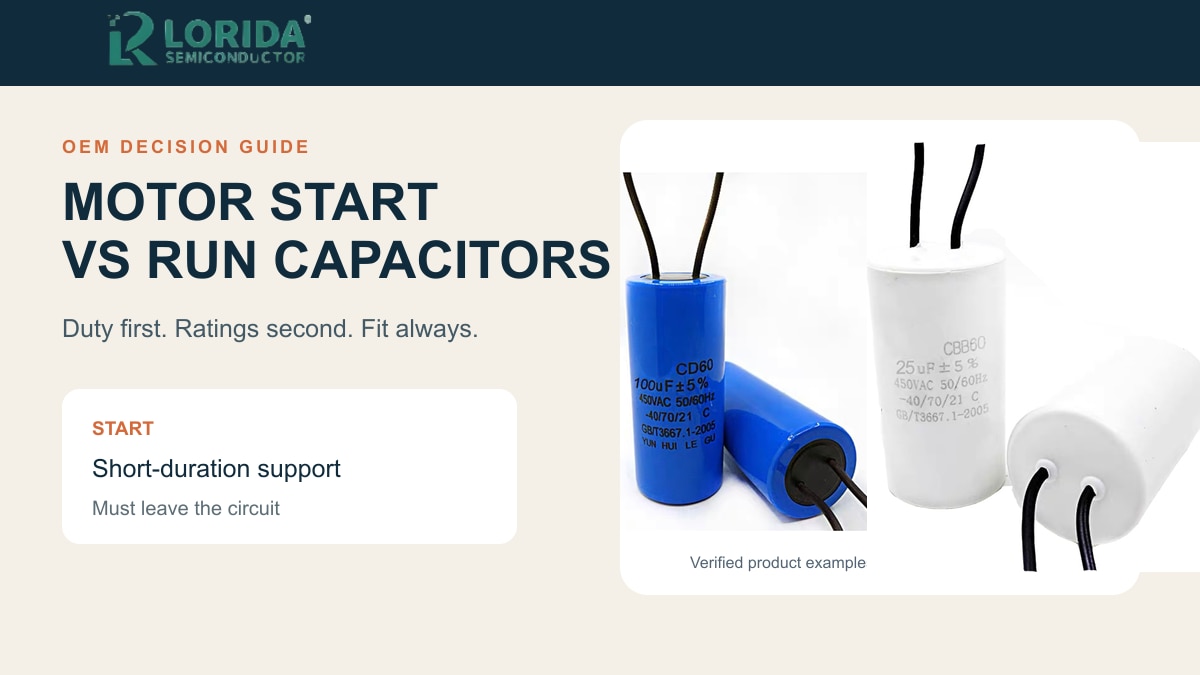
A motor start capacitor supplies short-duration starting support and must leave the circuit after acceleration, while a motor run capacitor is designed to remain energized during operation. IEC 60252-2 covers motor-start capacitors up to 660 V; IEC 60252-1 covers motor capacitors for asynchronous motors at frequencies up to 100 Hz and rated voltages up to 660 V (IEC). Those are standard scopes, not ratings for every part. The practical buying rule is simple: never approve a capacitor from µF and VAC alone. Confirm duty, circuit position, switching method, tolerance, temperature, safety construction, terminals, and mechanical fit for the exact offered model.
Last Updated: September 17, 2026
Key Takeaways
The short answer for buyers
A start capacitor is intermittent-duty and must be removed from the circuit by the motor's approved switching system.
A run capacitor stays in the energized circuit, so continuous electrical and thermal duty matters.
Similar shape or ratings do not prove interchangeability.
Require an exact-series data sheet, drawing, duty declaration, and switching requirements.
Validate the first article on the real motor and freeze the approved construction.
Why start and run capacitors are not interchangeable
The circuit duty is different
A start capacitor helps create starting torque for a single-phase induction motor. It is normally connected only during acceleration, then removed by a centrifugal switch, potential relay, electronic control, or another motor-approved device. A run capacitor remains connected while the motor operates and continuously influences the auxiliary-winding current and phase relationship. Capacitor Industries describes run capacitors as continuous-duty components energized for the full motor run time, while start capacitors are used for the starting interval (manufacturer technical note).
That difference changes the validation plan. Start duty requires defined start events and off-time; run duty requires continuous electrical and thermal control. The supplier's current data sheet and the motor manufacturer's circuit requirement are the controlling evidence.
Standards separate the two applications
IEC 60252-1 applies to motor capacitors connected to asynchronous-motor windings at frequencies up to and including 100 Hz and covers rated voltages up to and including 660 V. IEC 60252-2 separately applies to motor-start capacitors and includes metallized-film constructions as well as electrolytic start capacitors with non-solid electrolyte, again up to 660 V (IEC official publication pages). The existence of two parts is a useful procurement signal: “motor capacitor” is not one universal duty class.
IEC 60252-1 also warns that operation above rated voltage reduces capacitor life expectancy. The motor supply voltage is not automatically the capacitor voltage; a qualified engineer should determine the actual circuit stress.
Compare the required evidence before requesting a quote
Use one RFQ table for every supplier
| RFQ field | Motor start capacitor | Motor run capacitor | Evidence to request |
|---|---|---|---|
| Duty | Short-duration starting duty | Continuous energized duty | Exact-series data sheet and circuit diagram |
| Circuit control | Approved switch, relay, or controller removes it | Remains connected during normal operation | Motor schematic and switching sequence |
| Capacitance | Motor/OEM start requirement | Motor/OEM run requirement | Nominal µF plus tolerance |
| Voltage | Must meet the actual start-circuit stress | Must meet continuous and transient stress | Rated VAC and measured/design voltage |
| Thermal input | Start frequency, on-time, and off-time | Ambient, airflow, run time, and surface temperature | Duty-cycle statement and validation plan |
| Mechanical interface | Case, leads/terminals, mount, clearance | Case, leads/terminals, mount, clearance | Controlled drawing and sample photographs |
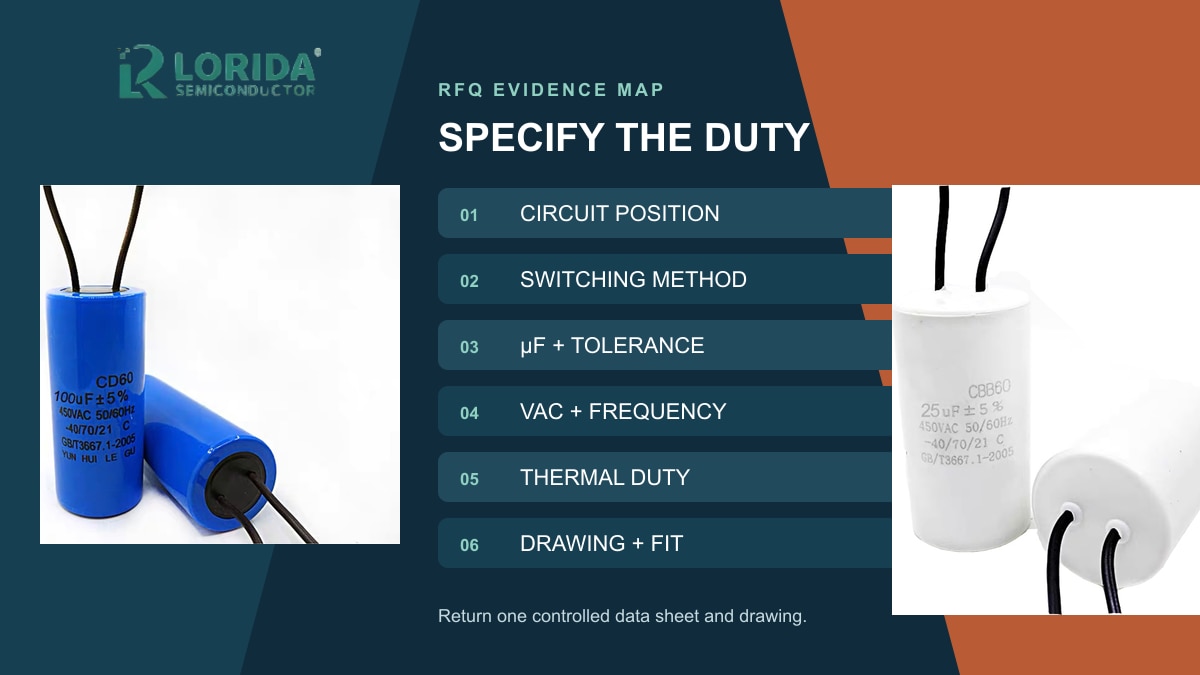
The photographed internal examples show why label reading must be disciplined. One CBB60 example is marked 25 µF ±5%, 450 VAC, 50/60 Hz, and 40/70/21; one CD60 example is marked 100 µF ±5%, 450 VAC, 50/60 Hz, and 40/70/21. These are two specific photographed items, not universal CBB60 or CD60 ranges. Their shared voltage and environmental markings still do not make their duty interchangeable.
Interpret operating-class numbers correctly
IEC 60252-1 defines Class A at 30,000 h, B at 10,000 h, C at 3,000 h, and D at 1,000 h. It associates them with a probable failure rate not exceeding 3% under rated duty, voltage, temperature, and frequency (IEC preview). This is statistical, not a product warranty.
Build an RFQ that prevents duty confusion
Freeze the exact electrical and mechanical interface
Start with the motor nameplate, wiring diagram, old label, and connection photographs. Specify capacitance, tolerance, VAC, frequency, duty, switching device, temperature category, dimensions, mount, terminal, lead length, connector, and marking. For start duty, add energized time, starts per hour, and minimum off-time. Ask for a controlled drawing, not a generic photo.
LORIDA's public CBB60 capacitor range describes a polypropylene-film family and shows a 25 µF, 450 V catalogue example. Use it for discovery, then require a model-specific drawing and data sheet. Related references include the capacitor product center and CBB60 replacement guide.
Validate the first article on the actual motor
Test the switching sequence before extended operation
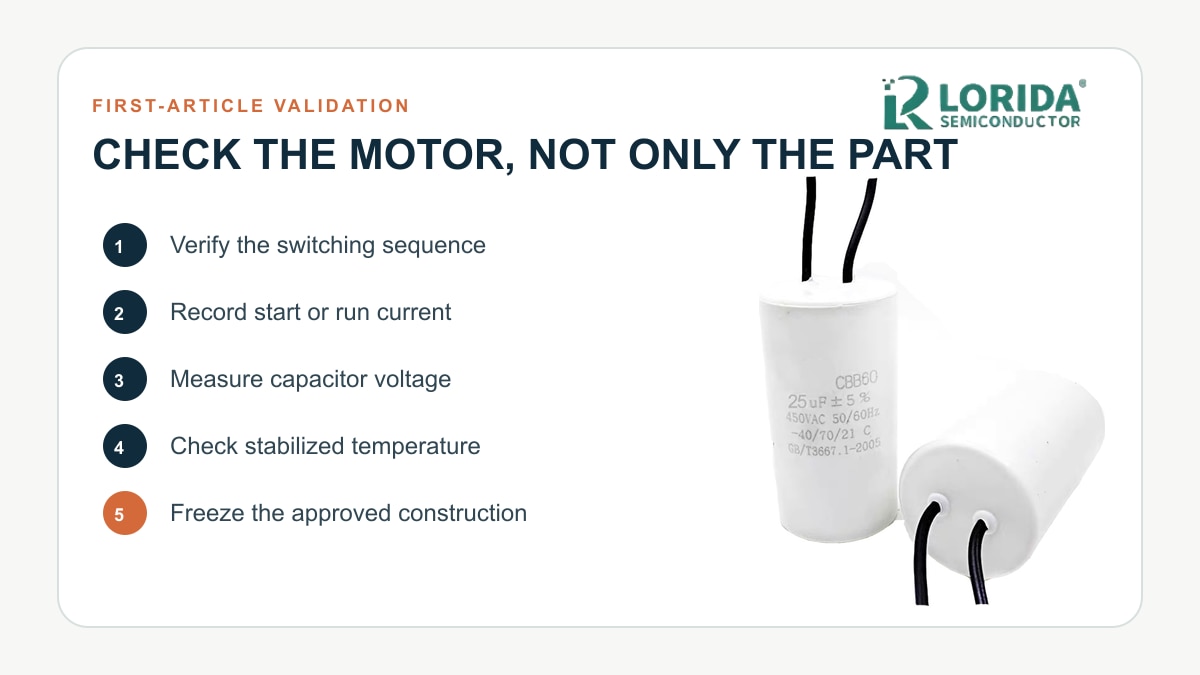
Use a qualified technician and rated instruments. Confirm that the start capacitor disconnects at the intended point. Record start time, current, switching, and restart behavior. For a run capacitor, record capacitor voltage, motor current, load behavior, and stabilized surface temperature.
Compare the sample with an approved baseline under the required load, supply, ambient, and cycling conditions. Stop if the case swells, vents, leaks, overheats, or a terminal discolors or loosens.
Frequently Asked Questions
Can I use a start capacitor as a run capacitor if the µF matches?
No. A matching capacitance does not make a start capacitor suitable for continuous run duty. Start capacitors are selected for short-duration starting service and are normally removed from the circuit after acceleration. A run capacitor remains energized and must control heating and electrical stress throughout normal operation. Using the wrong duty can damage the capacitor, motor, switching device, or wiring. Check the motor manufacturer's schematic and required capacitor type, then obtain the exact offered part's data sheet and drawing. Validate the sample on the real motor with a qualified technician before approving production.
Can I replace a capacitor with the same µF and a higher VAC rating?
A higher VAC rating may be acceptable, but it is not sufficient evidence of compatibility. Keep the required capacitance and tolerance, then confirm start or run duty, frequency, temperature category, safety construction, body size, mounting, terminal arrangement, and switching requirements. A higher-voltage part may be larger or use a different construction. Never replace the required part with a lower voltage rating, and do not assume the motor's line voltage equals the capacitor voltage. Use the motor documentation and measured or calculated circuit stress to approve the rating.
Why did the replacement start capacitor fail again?
Repeated failure can result from a circuit or load problem as well as the capacitor itself. Check whether the centrifugal switch, potential relay, or electronic controller removes the start capacitor at the intended time. Inspect for excessive start duration, too many starts per hour, insufficient off-time, low supply voltage, mechanical overload, seized bearings, incorrect capacitance, loose terminals, or excessive ambient temperature. Preserve the failed part and record the motor current, switching time, and operating conditions. Do not keep installing new capacitors until the root cause is identified by a qualified technician.
What should an OEM send for a motor-capacitor quotation?
Send the motor nameplate, wiring diagram, original capacitor label, body dimensions, mounting details, and clear photographs of every terminal or lead. State whether the part is for start duty, run duty, or a dual arrangement. Include nominal capacitance, tolerance, required VAC rating, frequency, ambient temperature, enclosure, load, and destination-market requirements. For start duty, add energized time, starts per hour, minimum off-time, and switching device. For run duty, add continuous run time and expected capacitor voltage. Request an exact part number, current data sheet, controlled drawing, and first-article validation plan.
Send a controlled specification
Turn the evidence into a quotation package
Use the table as the cover sheet and ask every supplier to complete the same missing fields. This prevents a similar-looking part from being approved for the wrong duty.
Send your motor capacitor requirements
with the label photos, circuit duty, switching method, dimensions, and validation targets.
Sources
Verified references for exact figures
IEC 60252-1:2010 official publication page: https://webstore.iec.ch/en/publication/1153
IEC 60252-2:2010+A1:2013 official publication page: https://webstore.iec.ch/en/publication/1157
IEC 60252-1 definitions preview: https://cdn.standards.iteh.ai/samples/17748/bb99a5d87a74417b9371488c3e29d390/IEC-60252-1-2010.pdf
Capacitor Industries technical note: https://capacitorindustries.com/wp-content/uploads/Run-and-Start-Capacitors.pdf
LORIDA CBB60 category: https://www.loridacapacitor.com/cbb60-capacitor/