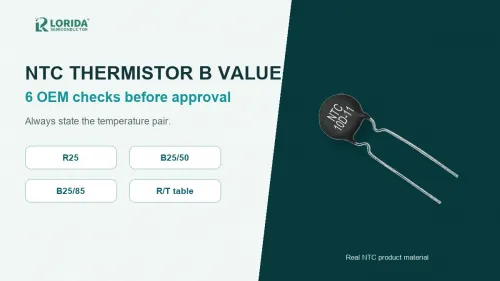
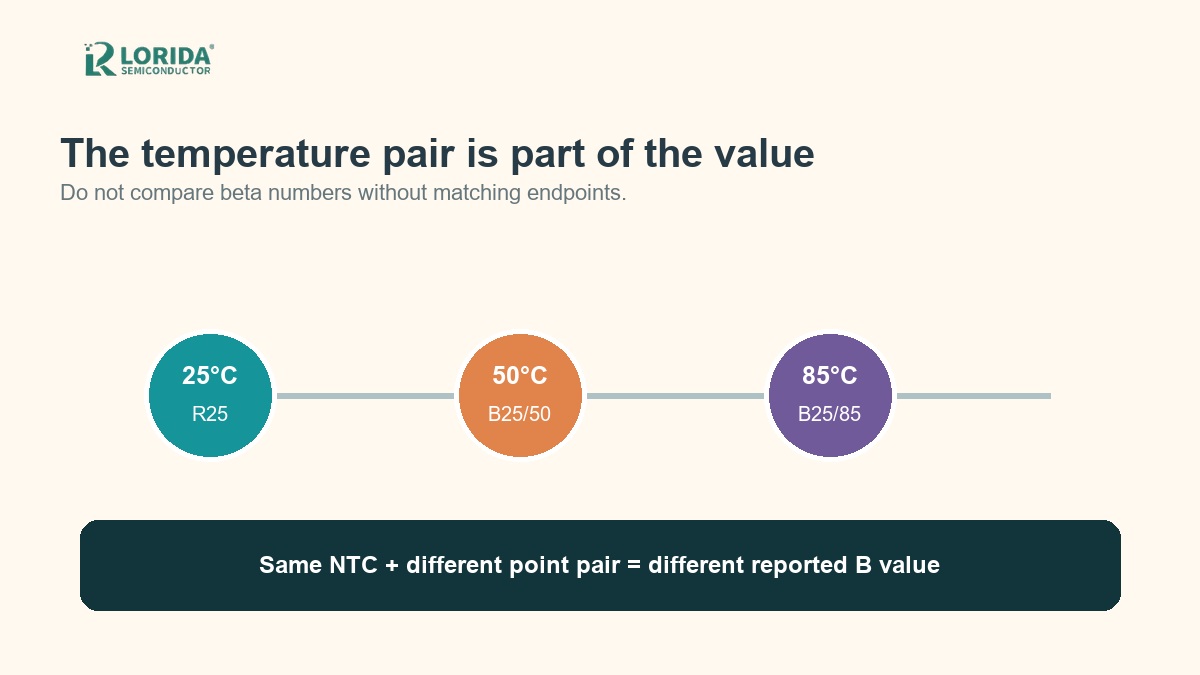
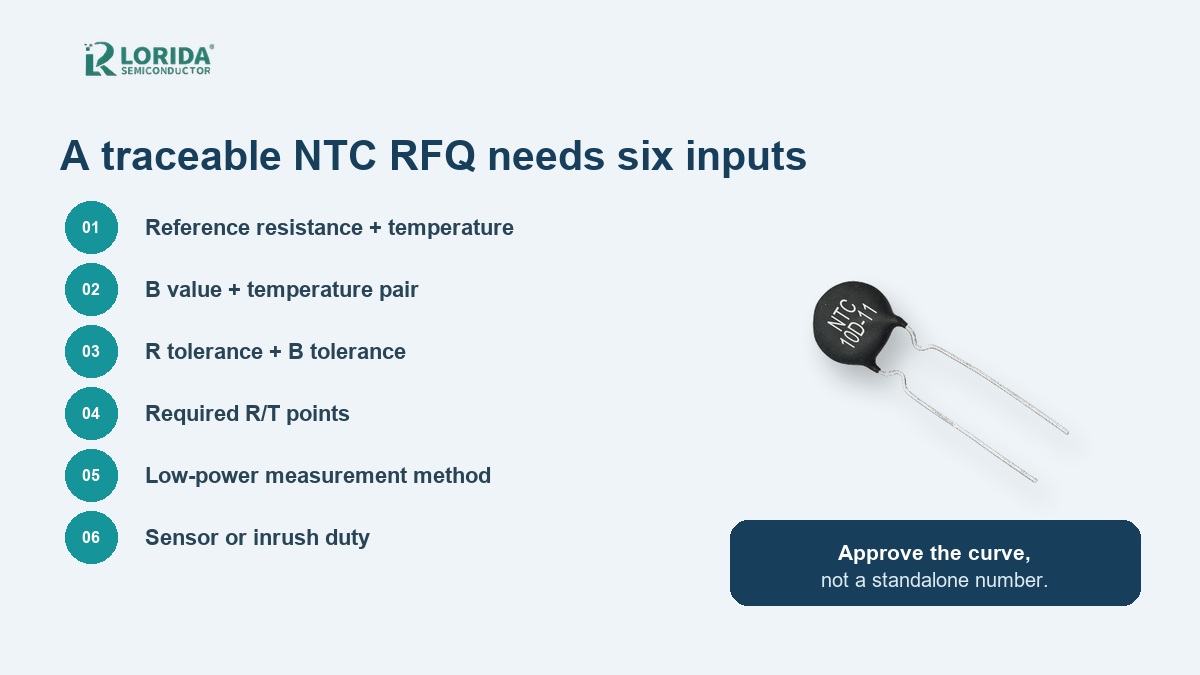
NTC thermistor B value describes the slope of the resistance-temperature curve between two stated temperatures, so an OEM buyer must never compare beta numbers without the same temperature pair. A B25/50 value and a B25/85 value are not interchangeable. The RFQ should state R25, the B-value temperature pair, B tolerance, required R/T points, measuring power, operating range, and whether the device is a temperature sensor or an inrush-current limiter.
Last Updated: 2026-10-22
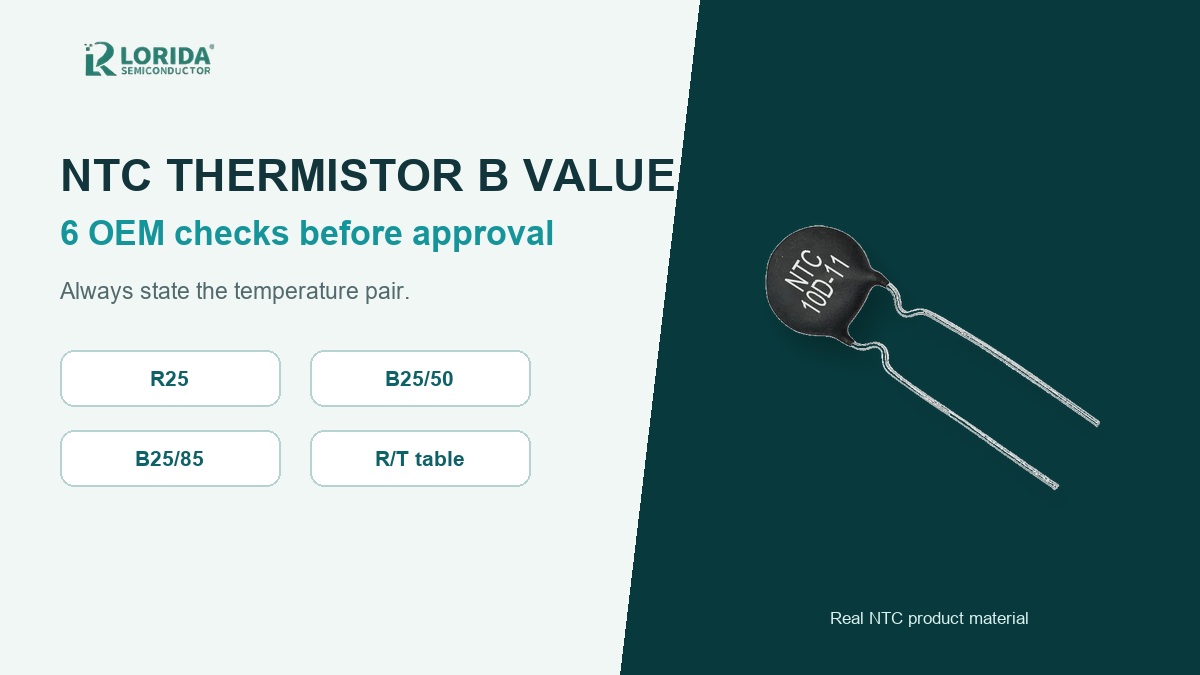
Always write the temperature pair: B25/50 and B25/85 can produce different values for the same thermistor.
R25 tolerance and B-value tolerance create different parts of the resistance error away from 25 deg C.
Use kelvin, not degrees Celsius, in the exponential equation.
Keep measuring power low enough to prevent self-heating from corrupting the R/T result.
Approve the exact R/T table or controlled coefficients, not a standalone beta number.
What Does NTC Thermistor B Value Mean?
Beta is a two-point slope, not a complete curve
The resistance of an NTC thermistor decreases as temperature rises. A common approximation is R(T)=R0 exp[B(1/T-1/T0)], where both temperatures are in kelvin. TDK defines B from resistance measured at two specified temperatures and notes that common NTC materials are typically in the 3000 K to 5000 K range. TDK also warns that B changes slightly with the selected temperature interval, which is why B25/50 and B25/85 must be written explicitly.
Murata uses B25/50 in its basic explanation, while Vishay commonly publishes B25/85 for cited products. That difference is not a contradiction; it is evidence that the temperature pair belongs in every comparison. A buyer who copies only “B=3950 K” into an RFQ has not yet defined a reproducible requirement.
Sources: TDK NTC Thermistor General Technical Information; Murata NTC basic characteristics.
Higher beta means a steeper resistance change
At a given temperature, the local temperature coefficient can be estimated as alpha=-B/T squared. Murata gives an example in which B=3380 K at 50 deg C produces about -3.2% per degree C. TDK's commercial chip-NTC catalog gives another example: B=3400 K at 20 deg C corresponds to approximately -4% per degree C. These examples show why beta influences sensitivity, but they remain series-specific calculations rather than LORIDA product specifications.
Six OEM Checks Before Approving an NTC B Value
1. State the exact reference resistance and temperature
Begin with R25 or another explicitly agreed reference point. TDK says resistance tolerance is normally specified at one temperature and that 25 deg C is the usual reference. Do not accept “10 k ohm NTC” without the reference temperature, tolerance, package, and intended function. For a replacement, provide the original code, measured R/T points, circuit, mounting, and operating temperature window.
2. Write the beta temperature pair
Record B25/50, B25/85, B0/100, or the exact pair stated in the controlled specification. Murata notes that different point selections produce different B constants. Vishay explains that its published B25/85 value comes from resistance measurements at 25 deg C and 85 deg C. Therefore, a supplier comparison is valid only when both products use the same pair or when full R/T tables are compared.
3. Separate R25 tolerance from B-value tolerance
Initial resistance tolerance shifts the curve at the reference temperature. B-value tolerance changes the slope and therefore contributes increasing resistance uncertainty as the operating temperature moves away from the reference point. TDK illustrates this with a 10 k ohm, B=3400 K example comparing R25 tolerances of 1%, 3%, and 5%, and separate B tolerances of 1% and 2%. Build the error budget from both terms instead of treating one tolerance as the whole sensor accuracy.
4. Request an R/T table over the real operating range
The beta equation is an approximation. Vishay says the simple beta formula is useful over narrower ranges and that the Steinhart-Hart equation uses three coefficients derived from at least three calibration points. For procurement, request the manufacturer's R/T table or approved coefficients at the temperatures that matter to the equipment. Use interpolation and controller linearization rules agreed by engineering; do not extrapolate a two-point beta far beyond its validated interval.
5. Control measuring power and self-heating
Resistance must be measured under zero-power or sufficiently low-power conditions. TDK defines zero-power resistance as the value measured with electrical load small enough that a further reduction causes no noticeable change. Vishay recommends measuring power below 5% of the dissipation factor in the used medium, corresponding to self-heating below 0.05 deg C for its stated method. State test current, medium, stabilization time, fixture, and temperature accuracy in the validation plan.
6. Match beta to the thermistor's actual job
A temperature-sensing NTC is chosen for accuracy, response, packaging, thermal coupling, and the controller's working resistance range. An inrush-current limiter is selected primarily from cold resistance, surge energy, steady current, hot resistance, cooling time, and restart duty. Beta can help model its R/T behavior, but it cannot replace those power-duty checks. Use the LORIDA NTC thermal resistor category as a sourcing entry point, then confirm the exact intended function and controlled series data.
| RFQ field | Why it matters | Required evidence |
|---|---|---|
| Reference resistance | Defines the curve anchor | R25 or other stated R at temperature |
| B value and pair | Defines two-point slope | B25/50, B25/85, or stated alternative |
| R and B tolerances | Builds the resistance error band | Separate guaranteed limits |
| Operating range | Prevents unsafe extrapolation | Required R/T points and environment |
| Measuring power | Limits self-heating error | Current, medium, fixture, stabilization |
| Application duty | Separates sensor and inrush requirements | Circuit, waveform, thermal and restart profile |
How to Validate a Replacement Thermistor
Compare the whole curve and physical assembly
Prepare a common table of resistance at minimum operating temperature, reference temperature, key controller thresholds, and maximum operating temperature. Add the guaranteed tolerance at each point, not only nominal resistance. For sensing applications, include ADC range, divider resistance, excitation current, calibration method, connector and lead resistance, thermal coupling, response time, and environmental protection. For inrush applications, include line range, input capacitance, surge waveform, steady current, ambient temperature, cooling interval, disc diameter, lead spacing, and enclosure airflow.
Two parts with identical R25 and nominal B can still differ in tolerance, coating, package, thermal time constant, dissipation factor, mounting stress, humidity resistance, or qualification. Review a specific record such as the LORIDA 33D-5 NTC product page only as product-family context; final limits must come from the ordered code and approved specification.
Use a controlled bath for precision checks
Vishay advises against precision thermistor measurements in air because errors can exceed 1 K. Its method calls for a stirred, non-conductive thermostatic bath with accuracy and repeatability better than 0.1 deg C, temperature measured close to the NTC, and sufficient time for equilibrium; some cited types may require more than one minute. Record the reference thermometer calibration, immersion depth, sample stabilization criterion, measurement current, and raw resistance data.
Frequently Asked Questions
Is B3950 the same as B25/50 or B25/85?
No; “B3950” is incomplete unless the two reference temperatures are also stated. The same thermistor material can produce slightly different beta values when calculated over different temperature intervals. Murata explicitly notes that the value changes when the two selected points change, and TDK labels values such as B25/85 for that reason. Ask for the full notation, nominal value, tolerance, and R/T table. If two suppliers use different pairs, compare their resistance at the actual application temperatures rather than ranking the standalone beta numbers.
Does a higher B value mean a better NTC thermistor?
No; a higher B value means a steeper resistance-temperature slope, not universally better performance. The useful choice depends on the controller input range, target temperatures, required sensitivity, R25, tolerances, package, response time, self-heating, and calibration method. A steep curve can improve sensitivity in one region while pushing resistance outside the measurable range elsewhere. Specify the required R/T window and total temperature error, then select a series that satisfies those conditions with sufficient manufacturing and qualification evidence.
Can I calculate the complete NTC curve from R25 and beta?
You can estimate resistance over a limited interval, but do not treat the two-parameter beta equation as a guaranteed full-range curve. Vishay describes the beta equation as useful over narrow ranges and recommends multi-coefficient approaches such as Steinhart-Hart when higher accuracy over a wider range is required. For production decisions, use the manufacturer's controlled R/T table, interpolation method, guaranteed tolerances, and exact part revision. Validate the assembled system at the important thresholds because thermal coupling and self-heating add errors beyond the nominal equation.
Does beta value select an NTC inrush current limiter?
No; beta value alone cannot select an NTC inrush current limiter. The inrush decision also requires cold resistance, allowed surge energy, maximum steady current, hot resistance or resistance-current behavior, ambient temperature, cooling time, restart duty, disc size, lead spacing, and installation airflow. Beta may support thermal modeling, but the power duty remains the acceptance driver. Review the earlier NTC inrush limiter RFQ guide and provide the real waveform before approving a sample.
Send LORIDA the intended function, R25, beta pair, tolerances, R/T points, measuring method, package, waveform, and thermal conditions through the contact page. Final limits remain subject to the ordered series specification and approved sample.