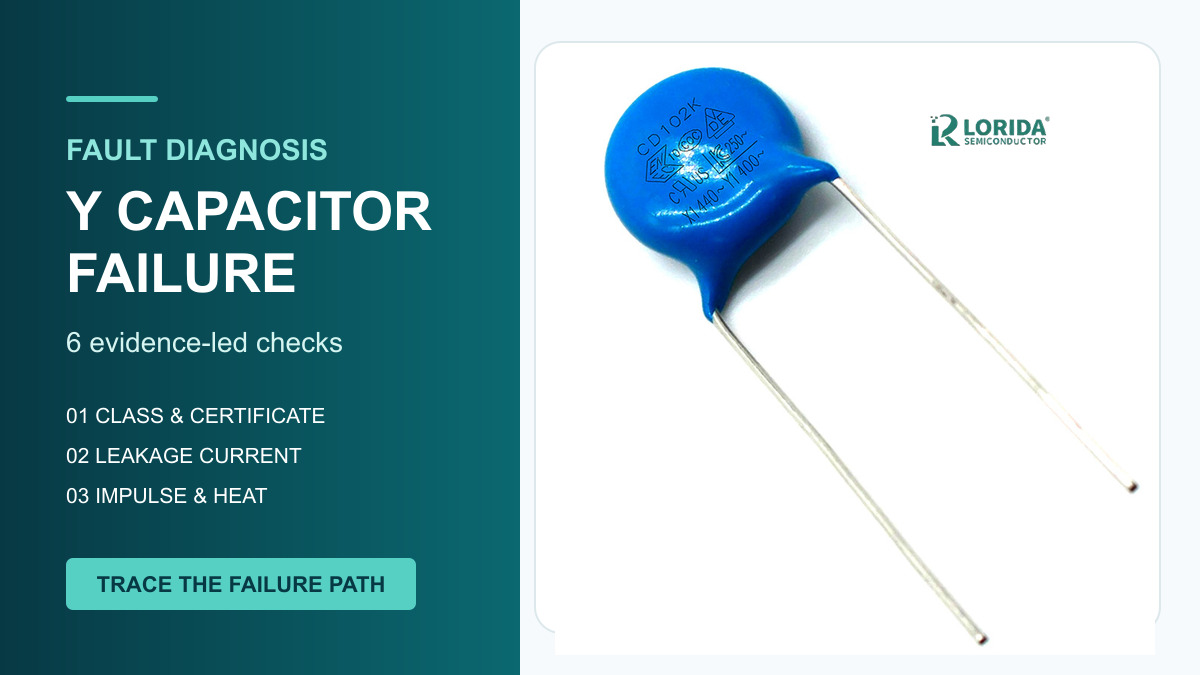
Investigate a suspected Y capacitor failure by checking its safety class, certificate, leakage path, impulse exposure, temperature and installation. Capacitance alone cannot show whether the part still provides the required protection. Because a Y capacitor bridges insulation where failure could expose a person to shock, preserve the circuit position, rated class and approval evidence.
Key Takeaways
Y capacitors are safety components, not ordinary capacitors with a blue coating.
Y1 and Y2 are not interchangeable in both directions: a Y2 part must not replace Y1.
Leakage current, insulation position and the equipment standard belong in the failure record.
Heat, humidity, surge events and lead stress can change the diagnosis even when capacitance appears normal.
Approve a replacement only against the exact certificate and datasheet for its ordering code.
What a Y capacitor failure means
Start with the safety function
TDK describes Y capacitors as components used to bridge operational insulation where capacitor failure could create a dangerous electric shock. Their capacitance is limited to restrict AC current and stored energy. This makes the circuit role more important than the visible package. Record whether the part is line-to-protective-earth, primary-to-secondary, or in another certified insulation path before removing it.
Class determines the allowed position
Under the EN 60384-14 table published by TDK, Y1 is associated with double or reinforced insulation, a rated AC voltage up to 250 V in that reference table, and an 8.0 kV peak surge test before endurance. Y2 is associated with basic or supplementary insulation, 150-250 V AC, and a 5.0 kV peak surge test. KEMET states the practical substitution rule directly: Y2 cannot replace Y1, although Y1 may replace Y2 when the complete design and approvals permit it.
Six diagnostic checks
1. Verify marking, class and certificate
Photograph every marking. Capture the capacitance code, tolerance, AC rating, Y class, approval marks, lot code and manufacturer. Locate the certificate for the exact series and ordering code. A body logo is not enough: certificates can be series-specific and voltage-specific. If the identity is unreadable, treat the sample as unidentified rather than guessing from color or diameter.
2. Measure the leakage-current path
With power isolated and stored energy discharged, compare capacitance, dissipation factor and insulation behavior with the approved specification and a known-good control. In the operating equipment, leakage current must be assessed with the applicable safety method, line voltage and frequency. Do not infer touch current from capacitance alone. Wiring, parallel filters, protective-earth continuity and measurement-network tolerances all affect the system result.
3. Reconstruct impulse exposure
Review lightning, switching and hipot records, not only the final failed unit. TDK's general table lists 8.0 kV for Y1 and 5.0 kV for Y2 before endurance, while Y4 is listed at 2.5 kV; these are class reference values, not permission to apply the same pulse to every part. Check the exact component standard, waveform, source impedance, polarity, repetition count and test sequence. A surge outside the documented test can damage insulation without producing an obvious crack.
4. Check temperature and humidity history
Look for hot resistors, transformers, restricted airflow and moisture paths around the capacitor. Murata publishes a current Y1 surface-mount example with an operating range of -40 to +125 C; that range belongs to the cited DK1 example, not to every Y capacitor. TDK also lists qualified EMI families with different damp-heat conditions, including 85 C/85% RH under applied AC voltage for selected products. Use the failed part's own endurance and humidity data for acceptance.
5. Inspect leads, coating and clearance
Examine the epoxy for radial cracks, pinholes, discoloration and separation around each lead. Inspect lead bends under magnification and compare the hole pitch with the approved drawing. Board depaneling, forced insertion and bending too close to the body can transfer stress into the ceramic or internal joint. Murata's automotive safety-capacitor overview shows that creepage requirements can differ by structure: cited examples list 10 mm minimum for EVA, 4 mm for KCA and 7.5 mm for DE6. Never copy one geometry to another family.
6. Confirm the replacement under real duty
Repeat the relevant dielectric, leakage, thermal and EMC tests in the finished assembly at worst credible line, frequency, ambient and humidity. Use a controlled lot and preserve the certificate revision, drawing, test report and sample photographs. A replacement that suppresses noise on the bench may still be unacceptable if its class, rated voltage, creepage, approval scope or failure mode differs from the original.
Evidence table for the failure review
Keep reference data separate from product limits
| Evidence | What to record | Decision risk |
|---|---|---|
| Safety identity | Exact Y class, AC rating, series, certificate | Wrong insulation class |
| Electrical result | Capacitance, loss, insulation and system leakage | Hidden insulation damage |
| Stress history | Surge, hipot, heat, humidity and hours | False root cause |
| Mechanical state | Pitch, bend, coating, clearance and board strain | Repeat field damage |
How buyers should write the corrective RFQ
Ask for evidence that closes the failure path
Provide the circuit position, mains range, frequency, nominal capacitance, original class, required approvals, lead pitch, available clearance and photos of both sides of the board. Add the failure symptoms, test conditions, service environment and lot history. Request the proposed part number, current datasheet, certificate, dimensional drawing and change-control statement. The LORIDA product categories illustrate why a category name is only a starting point; approval must follow exact evidence. For broader selection context, review the component RFQ checklist and contact LORIDA with the complete application record.
Frequently asked questions
Can a Y2 capacitor replace a failed Y1 capacitor?
No, a Y2 capacitor should not replace a Y1 capacitor. KEMET's safety-capacitor guidance states that Y2 cannot be used in place of Y1, while Y1 may replace Y2 when the rest of the design permits it. The reason is not simply rated voltage: the classes correspond to different insulation functions and impulse requirements. Confirm the circuit position, equipment standard, exact certificate and mechanical fit before any substitution. A purchasing cross-reference based only on capacitance, color and lead spacing is incomplete.
Why does the capacitor look normal but fail a safety test?
Internal insulation damage can exist without visible burning or cracking. A surge, damp-heat exposure, lead stress or manufacturing defect may change leakage or dielectric behavior while the outer coating remains intact. Preserve the sample, photograph it, and compare its electrical results with the exact specification and a controlled reference. The system test must use the required network, voltage, frequency and environmental condition. Do not return the unit to service because a handheld capacitance meter shows the nominal value.
What evidence should accompany a replacement request?
Send the exact original identity and the complete electrical, safety, mechanical and environmental duty. Include readable marking photos, PCB location, circuit role, line range, frequency, class, approvals, capacitance, lead pitch, clearance, ambient, humidity, surge and hipot history, symptoms, failure rate and lot code. Ask the supplier to return the precise ordering code, datasheet, certificate and drawing. Qualification should then reproduce the relevant leakage, dielectric, thermal, EMC and mechanical conditions in the finished equipment.
Primary sources
Documents used for verified reference data
TDK, EMI suppression capacitors - general standard.
KEMET, Ceramic Capacitor FAQ and Application Guide.
Murata, Y1 safety-certified capacitor specifications.
Murata, safety capacitor structures and clearance examples.
Retain the source revision or official snapshot. Record its date, document number and the table supporting each value. If a page or certificate changes, the approved file should still show the evidence used. Repeat verification when the ordering code, factory, construction or approval scope changes.
Last Updated: November 12, 2026. Third-party values are identified as reference examples; verify the exact component documentation and applicable equipment standard before approval.