

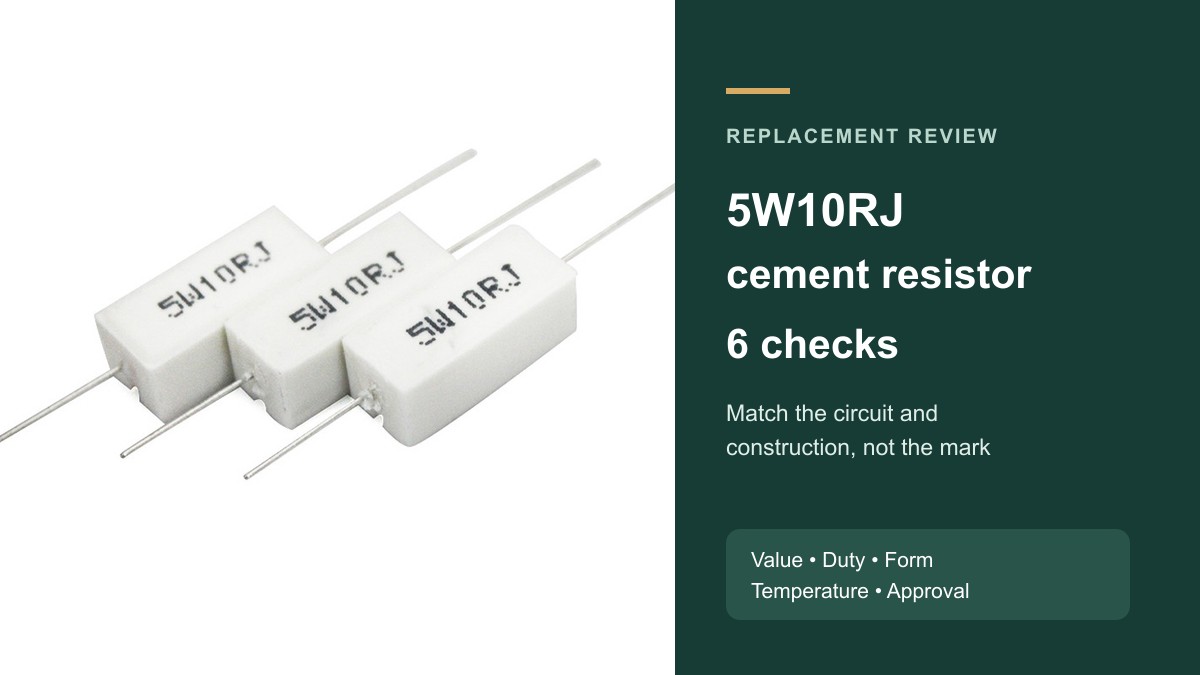
A 5W10RJ cement resistor replacement should match more than the visible 5 W, 10 ohm and J marking. Check its actual circuit power, pulse waveform, lead form, body dimensions, thermal environment and required failure behavior before accepting a substitute. The real shared product photograph shows the marking on three ceramic-housed parts; it does not identify a controlled LORIDA order code or prove the installed part's construction [1].
Key Takeaways
What a buyer should confirm first
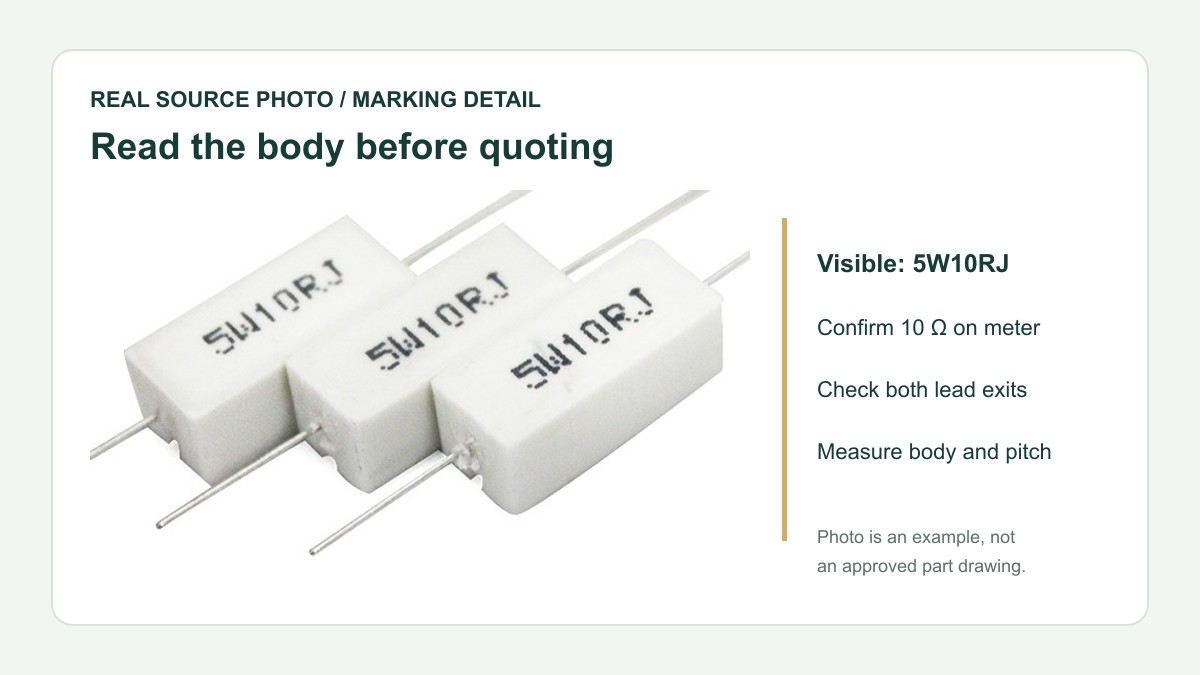
The shared photo visibly reads 5W10RJ. Treat 5 W, 10 ohms and J as fields to verify on the exact ordered part, not as a complete substitute specification [1][2].
A 10 ohm resistor dissipates 5 W at about 7.07 V RMS or 0.707 A RMS under a purely resistive steady-state calculation. Those derived values do not establish pulse or temperature capability [5].
Two named Ohmite examples both specify 5 W, 10 ohms and 5% yet use different radial and axial lead forms; their ratings are not LORIDA ratings [3][4].
Record the original part, board footprint, enclosure temperature and waveform, then ask for a current exact-series drawing and test limits.
1. Decode the mark, then verify the exact series
Separate visible text from an approved part number
The photographed parts show “5W10RJ” on a white ceramic housing [1]. The common resistor notation suggests a 5 W rating, 10 ohm nominal resistance and a J tolerance code. LORIDA's RX27 listing includes 5 W among its offered power levels and lists J as 5% in its tolerance field [2]. These two sources support a cautious reading of the photo, but they do not prove that this photographed unit is the RX27 construction or that every 5W10RJ package is electrically identical. Ask the supplier for the exact series, order code, revision and a drawing tied to the sample lot.
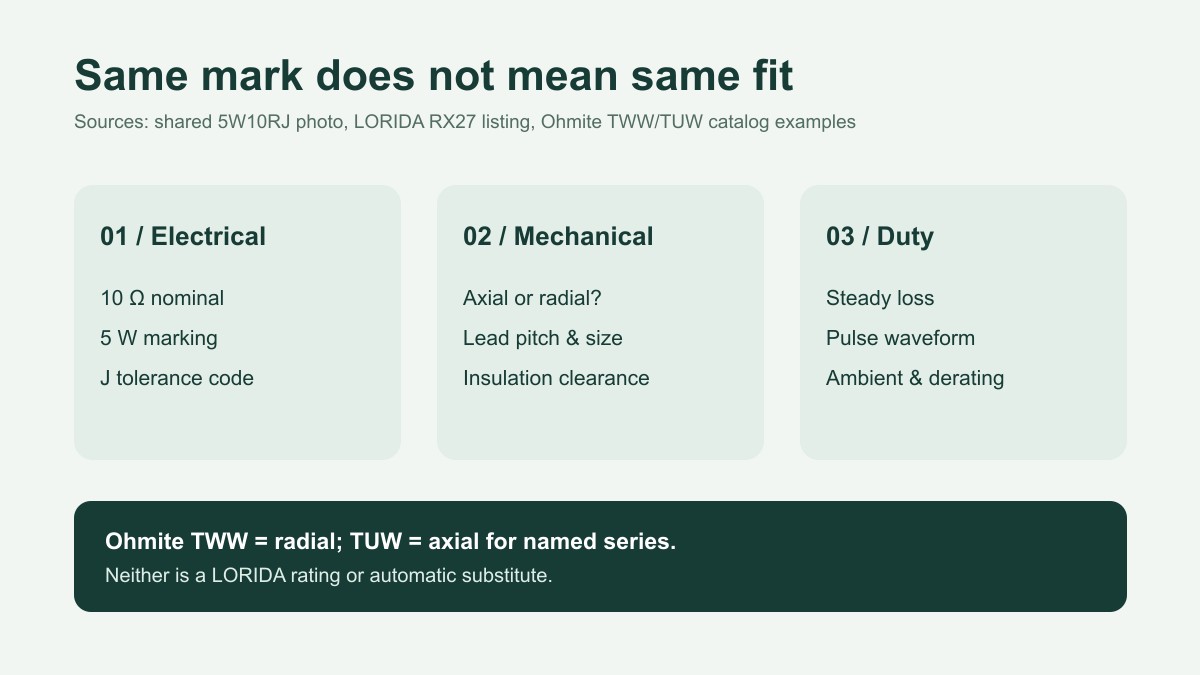
To illustrate why the marking is incomplete, Ohmite lists a TWW5J10RE ceramic radial wirewound example at 5 W, 10 ohms and 5%, while its TUW5J10RE example is axial leaded [3][4]. The numerical trio can match while the lead orientation differs. These are named Ohmite comparison examples, never claims about LORIDA parts. Do not translate a competitor's pulse curve, working voltage, coating or safety designation into a LORIDA offer without a signed exact-model specification.
2. Prove steady power and pulse duty separately
Use the measured waveform, not wattage alone
For a 10 ohm purely resistive load, P = I squared times R and P = V squared divided by R. At 5 W, the ideal steady-state values are approximately 0.707 A RMS and 7.07 V RMS [5]. This calculation is a screening example, not permission to operate at 5 W in a hot enclosure. Real resistance tolerance, applied waveform, ambient temperature and mounting change the result. Capture voltage and current with appropriate bandwidth at the actual circuit position, and calculate average dissipation from the measured trace.
A brief startup or discharge pulse needs another check. Specify peak voltage or current, pulse width, repetition interval, number of events and energy integration method. A 5 W continuous body marking cannot be turned into a universal joule rating by multiplying it by one second. Request the offered series' permissible pulse curve and test conditions; then validate the installed board at high line, maximum load and the shortest credible restart interval. If the resistor is intended to open under fault, ask for the exact safety construction and approved fault test rather than assuming all ceramic-housed resistors are fusible.
3. Check the package and board interface
Lead form changes the assembly even when ohms match
Photograph the original part from above and both sides, then measure body length, width, height, lead diameter, lead pitch and stand-off. Record whether it is mounted flat, raised, vertical, radial or axial. The Ohmite TWW and TUW examples demonstrate that a common electrical marking does not settle lead arrangement [3][4]. A bent lead forced into an unsuitable footprint can stress the ceramic body or solder joint. Request the proposed part's controlled drawing before authorizing automatic insertion, bending or rework.
4. Make the RFQ testable
Six fields with an acceptance record
| Check | Buyer evidence | Supplier or test evidence |
|---|---|---|
| 1 / Identity | Full old marking, maker, lot, photos | Exact offered series, code, revision |
| 2 / Electrical | Nominal ohms, tolerance and measured range | Exact-series resistance, tolerance and voltage limits |
| 3 / Steady duty | Measured RMS voltage/current and local ambient | Derating curve and installed temperature result |
| 4 / Pulse duty | Waveform, width, repetition and event count | Permissible pulse data and circuit test |
| 5 / Mechanical | Board drawing, lead pitch, height and clearance | Controlled drawing and first-article fit |
| 6 / Safety | Fault mode and applicable equipment requirement | Exact safety behavior, approval evidence and test method |
The public LORIDA RX27 page lists a broad 0.1 ohm to 100 kilohm range and power options of 5, 10, 20, 50 and 100 W [2]. Those are category-level catalog fields, not a declaration that every combination is available or approved. The same page contains unrelated capacitor-style marketing text, so this guide uses only its clearly labeled product-parameter fields and still requires the current offered-model data sheet. No claim of a production quantity, lead time, yield, certificate or customer result is made from that page.
5. Compare samples under one controlled setup
Keep circuit and component evidence linked
Acceptance should include the circuit's required voltage behavior and temperature limits, the part's exact data sheet and the OEM's safety evaluation. If the old part failed, investigate the upstream cause as well: an unexpected voltage, stalled load, repeated startup or a damaged joint can destroy a correctly specified resistor.
Frequently Asked Questions
Can any 5 W, 10 ohm resistor replace a 5W10RJ part?
No. The common numerical marking is only a starting comparison. The real photograph shows 5W10RJ, and the LORIDA RX27 listing includes a 5 W option and J tolerance field, but the photo does not prove an exact RX27 order code [1][2]. Ohmite's named 5 W, 10 ohm, 5% TWW and TUW examples have different lead forms [3][4]. A replacement must also match the circuit's continuous and pulse duty, package, lead pitch, operating temperature, voltage limits and required failure behavior. Request the old and proposed drawings and current data sheets, then test the assembled board under its real worst-case condition. Any changed field needs OEM engineering approval.
Does the J on this resistor always prove a 5% tolerance?
J is a common 5% resistor tolerance code, and the LORIDA RX27 product-parameter field lists J as 5% [2]. That supports the reading of the photographed 5W10RJ example, but a photograph alone is not a controlled datasheet for a particular lot [1]. Confirm the exact maker, series and order code, then measure sample resistance at a defined temperature using a suitable meter and lead compensation. Compare the result with the offered-model specification and the circuit's own error budget. A 5% initial tolerance does not describe temperature coefficient, load-life drift, pulse behavior or insulation. Those properties require separate evidence before a purchasing approval.
What should an OEM send when requesting a substitute?
Send the old component's complete markings and photographs, circuit schematic, nominal resistance and allowed range, measured steady voltage/current, startup or fault pulse waveform, ambient and enclosure conditions, board drawing, lead form, package dimensions and required safety behavior. Mark every missing item as unknown. Ask the supplier to return the exact offered series and order code, current datasheet revision, drawing, derating and pulse evidence, sample identity and any deviations. Then specify a first-article plan for resistance, fit, temperature and pulse verification on the real assembly. A request that says only “5W10RJ” leaves construction and duty ambiguous, even if a photo appears visually similar.
Sources and next step
Named references and engineering boundary
[1] Genuine shared product photograph: 5W10RJ ceramic-housed resistors, source path and SHA-256 recorded in the publication archive. [2] LORIDA RX27 product-parameter listing. [3] Ohmite TWW5J10RE radial example. [4] Ohmite TUW5J10RE axial example. [5] Ohm's law and resistive power equations, calculated from the photographed nominal 10 ohms and 5 W marking. Ohmite values apply only to the named Ohmite parts.
For broader procurement context, compare the cement resistor selection guide and the overheating diagnosis guide. They cover selection and fault investigation; this article focuses on decoding a 5W10RJ replacement request into a controlled equivalence decision.
Last Updated: November 28, 2026. Technical review used the cited product and manufacturer references. No individual author or reviewer name is shown because a confirmed public byline identity was unavailable. Electrical and fault testing belong to qualified personnel.


