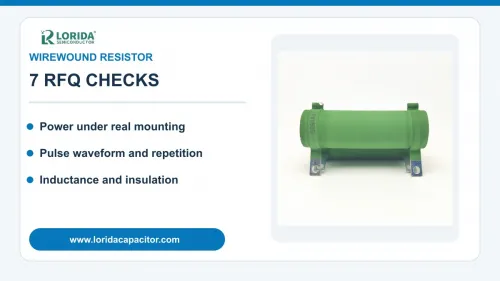
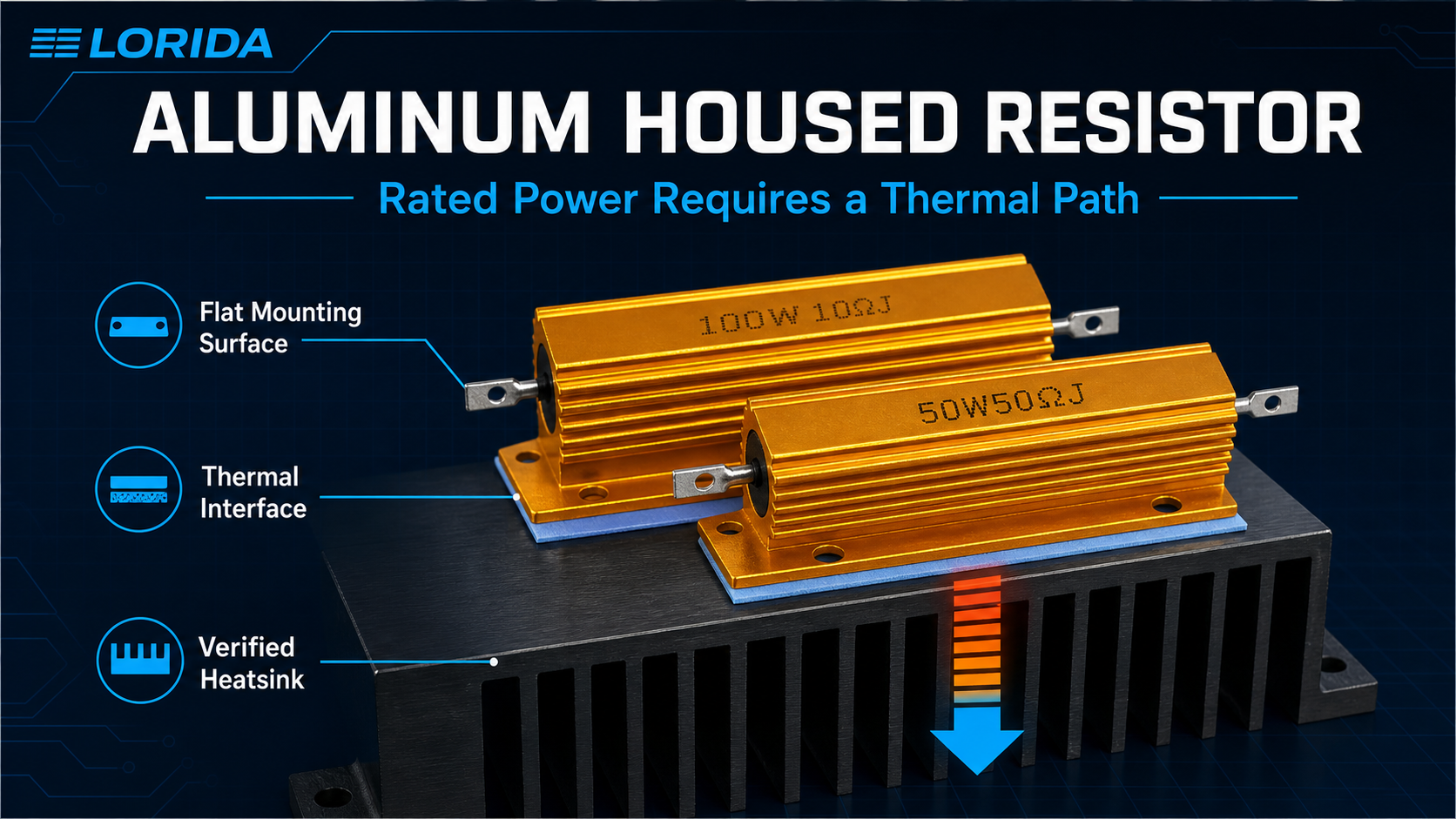
An aluminum housed resistor reaches its published power rating only under the thermal conditions stated for that exact series. A metal case does not automatically make the nameplate wattage a free-air rating. Vishay rates its RH050 on a specified 12 × 12 × 0.059 inch aluminum panel, while the same physical size is rated at only 20 W in free air at 25 °C. Ohmite/ARCOL likewise lists its HS100 at 100 W on the standard heatsink but 30 W without one. These are manufacturer-specific examples—not LORIDA product claims—and they show why mounting details belong in every RFQ.
Last Updated: 2026-08-25
Key Takeaways
What buyers should decide before requesting a sample
Treat mounted power and free-air power as different operating conditions.
Request the exact heatsink assumption, derating curve, and case or hot-spot limit for the proposed series.
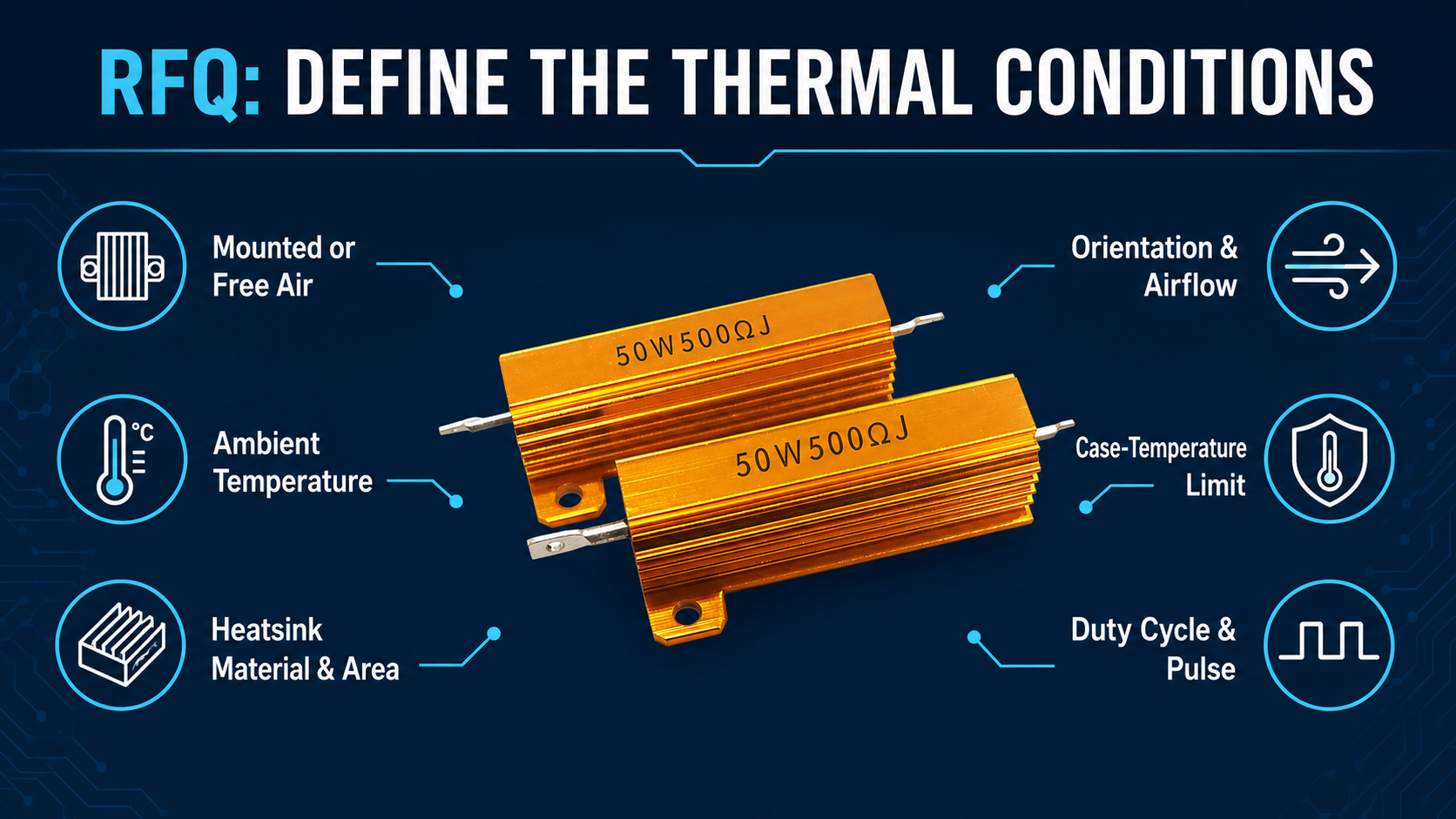
Define the mounting surface, interface material, screw method, orientation, airflow, ambient temperature, and duty cycle.
Do not transfer a wattage, torque, pulse, or temperature figure from another manufacturer to a LORIDA part.
Validate case temperature and resistance stability in the real assembly before volume approval.
Why the Printed Wattage Is Not a Standalone Thermal Rating
Mounted and free-air figures can differ sharply
A resistor converts electrical energy into heat. The aluminum extrusion spreads that heat and creates a low-resistance route toward the mounting surface, but the final temperature still depends on the complete path: internal element to case, case to interface, interface to chassis or heatsink, and heatsink to ambient air. If any part of that path changes, the allowable continuous power can change.
Vishay's February 2026 RH/NH datasheet makes the mounting assumption explicit. The RH050 mounted rating uses a 12 × 12 × 0.059 inch aluminum panel with 291 square inches of total surface area. Its free-air table gives the RH050/NH050 a 20 W rating at 25 °C. The same document requires derating above 25 °C and additional derating when the recommended heatsink area is reduced. These values apply only to the cited Vishay series, but the engineering lesson is general: ask what physical installation supports the catalog wattage.
A heatsink statement must identify the test condition
The Ohmite/ARCOL HS data provides another concrete comparison. Its HS100 is listed at 100 W on the standard heatsink at 25 °C and 30 W without a heatsink at 25 °C. The same source states that dissipation derates linearly to zero at 200 °C and that the 200 °C maximum hot-spot temperature must not be exceeded. Buyers should not copy those limits to another series. They should use them as a model for the evidence an RFQ needs: mounted rating, free-air rating, reference heatsink, ambient derating, and maximum allowed case or hot-spot temperature.
Six Thermal Checks Before Sampling
1. Confirm whether the proposed wattage is mounted or free air
Ask the supplier to label every quoted power value as free-air, chassis-mounted, or mounted to a defined heatsink. A phrase such as “aluminum housed” is not enough. Request the applicable datasheet page and record the ambient temperature, orientation, and steady-state or intermittent duty behind the number. For a replacement, compare the old part's verified installation rather than only the printing on its case.
2. Define the mounting surface and available heat-spreading area
Provide the chassis material, thickness, usable surface area, nearby heat sources, finish, and whether the panel is shared with other dissipating components. A thin bracket and a large aluminum panel are not thermally equivalent. Vishay's RH examples use different reference chassis sizes for different packages: RH025 uses a 5 × 7 × 2 × 0.040 inch chassis, while RH050 uses the much larger panel described above. The supplier needs comparable installation data to judge derating.
3. Specify the thermal interface and surface preparation
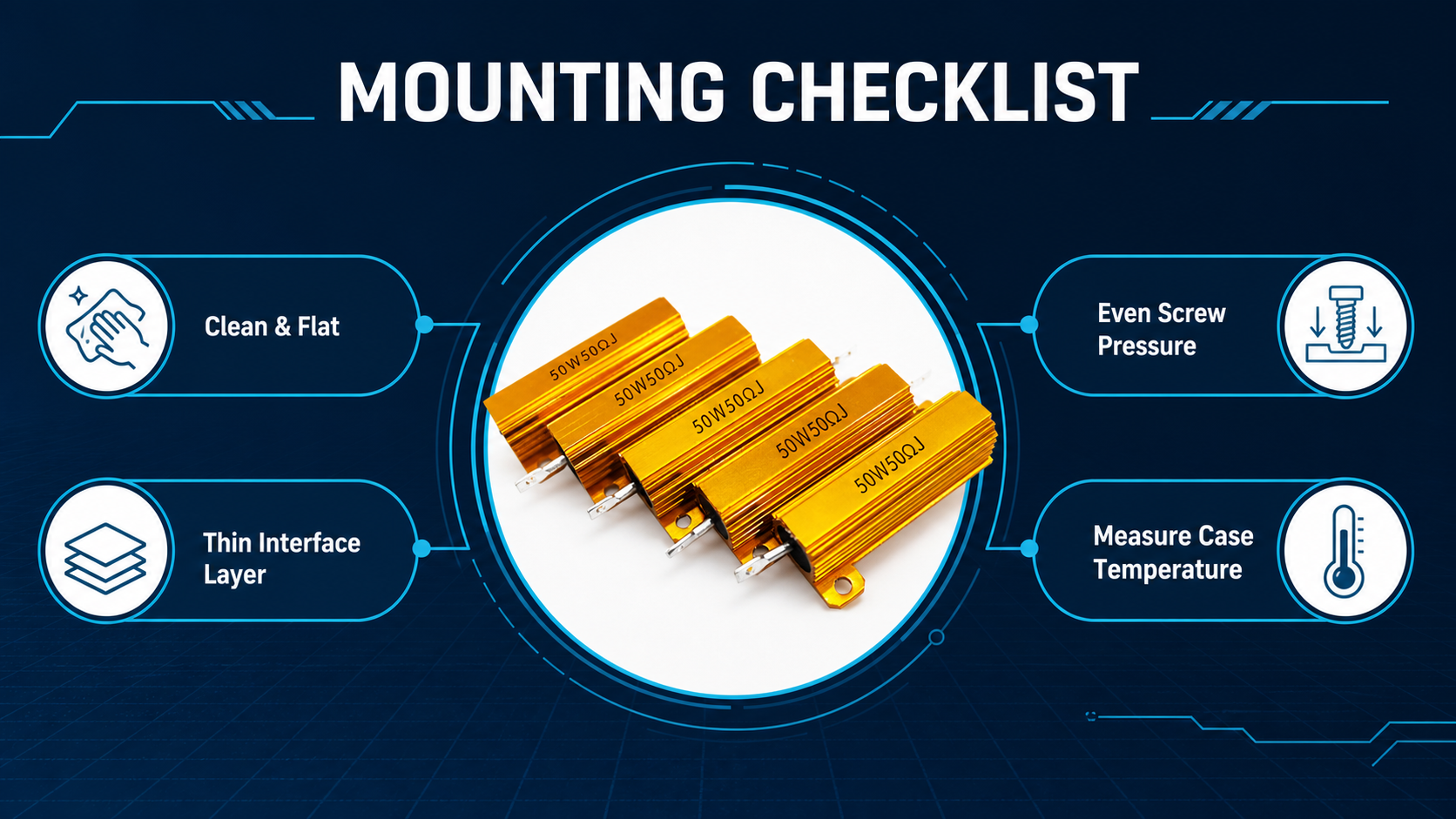
Ohmite/ARCOL recommends a heatsink compound between the resistor base and the chassis surface for maximum heat transfer. The practical purpose is to fill microscopic air gaps, not to create a thick insulating layer. State whether the design uses grease, a pad, or another approved interface; identify its thickness and thermal data when known. The mounting surface should be clean, flat, free of burrs, and compatible with the interface material. Do not assume that the same interface works for every housing finish or environment.
4. Use the series-specific fastening method
Mounting pressure should be even enough to support thermal contact without twisting the housing or stressing the tabs. Follow the proposed manufacturer's drawing for screw size, washer arrangement, sequence, and torque. This article intentionally gives no universal torque value because the correct figure depends on the housing, hole geometry, chassis, and fastener. After assembly, inspect for rocking, gaps, housing damage, terminal stress, and conflict between the electrical leads and mounting screws.
5. Include orientation, airflow, and ambient temperature
Heatsink orientation changes natural convection. Ohmite's HS heatsink sheet states that its thermal-resistance values assume vertical orientation; horizontal mounting with fins upward is acceptable with approximately 20% performance degradation. Again, that percentage belongs to the cited heatsink family, not to every installation. For an RFQ, describe fin direction, forced-air speed if available, cabinet inlet temperature, altitude, dust loading, and the worst credible ambient near the resistor.
6. Separate continuous heating from pulse duty
Continuous power, braking pulses, precharge events, and discharge cycles stress the resistor differently. A pulse-overload number does not replace a thermal model for repeated operation. Ohmite's BA series, for example, publishes a series-specific overload of 10 times rated wattage for 5 seconds and labels its catalog power as free air, greater with a heatsink. That does not authorize using 10× for another part. Send the voltage or current waveform, pulse duration, repetition rate, cooling interval, maximum event count, and fault-retry behavior so the supplier can check both energy and accumulated temperature.
Evidence to Request in the RFQ
A comparison table for supplier responses
| RFQ item | Evidence to request | Why it matters |
|---|---|---|
| Power condition | Free-air and mounted ratings with ambient | Prevents nameplate-wattage assumptions |
| Reference thermal path | Heatsink material, area, thickness, thermal resistance, orientation | Makes catalog conditions reproducible |
| Interface | Approved compound or pad and application method | Controls case-to-sink resistance |
| Fastening | Drawing, screw size, sequence, and torque for the exact housing | Avoids poor contact and mechanical damage |
| Temperature limit | Case/hot-spot limit, measurement location, derating curve | Defines the pass/fail boundary |
| Electrical duty | Continuous power plus pulse-energy or overload curve | Separates steady heating from short events |
| Sample validation | Test conditions and allowed resistance change | Supports production approval |
For related electrical checks, see LORIDA's gold aluminum housed resistor selection guide, VFD braking resistor RFQ guide, and DC-link precharge resistor sizing guide.
How to Validate the First Article
Measure the real assembly, not an isolated component
Install the sample using the intended chassis, interface, fasteners, wiring, orientation, and enclosure. Record ambient temperature close to the resistor and case temperature at the manufacturer's specified measurement point. Run the worst repeatable continuous load and the representative pulse sequence, including the shortest permitted cooling interval. Also inspect lead temperature, nearby material temperatures, discoloration, odor, interface migration, loose fasteners, and any change in resistance after cooling.
Approval criteria should come from the exact part specification and the equipment's safety analysis. If the case temperature exceeds the agreed limit, investigate power, waveform, interface coverage, mounting flatness, heatsink area, airflow, and ambient before changing the resistor wattage. A larger nameplate alone may not solve a poor thermal path.
Frequently Asked Questions
Can I operate a 100 W aluminum housed resistor at 100 W in free air?
Not unless the exact datasheet explicitly gives a 100 W free-air rating under your ambient and orientation. Many compact aluminum housed resistors achieve their headline rating only when attached to a specified chassis or heatsink. One Ohmite/ARCOL example lists HS100 at 100 W on its standard heatsink at 25 °C but 30 W without a heatsink. Treat that only as an example of the difference. Obtain the proposed series' mounted and unmounted curves, then verify case temperature in your real enclosure.
Is the aluminum case itself a sufficient heatsink?
No; the case is part of the heat path, not necessarily the final heat rejecter. It spreads heat from the resistive element and provides a surface for chassis mounting, but its equilibrium temperature depends on contact resistance, chassis area, airflow, ambient temperature, and nearby losses. If the rating assumes a panel or heatsink, operating the loose component changes the thermal boundary condition. Ask the supplier to identify the required mounting condition and temperature measurement point.
How much thermal compound should be applied?
Use the thinnest complete layer that follows the interface-material and resistor manufacturer's instructions. The compound is intended to displace microscopic air gaps between clean mating surfaces. Excess material can increase mess, migration, and—in some systems—thermal resistance. Do not invent a universal thickness. Record the approved material, application method, coverage, mounting pressure, and inspection criterion in the assembly instruction so samples and production units use the same thermal interface.
Does a larger aluminum plate always eliminate derating?
No; area is only one part of heatsink performance. Material, thickness, fin geometry, orientation, airflow, enclosure temperature, contact quality, and heat from adjacent parts all affect temperature. Vishay explicitly requires reduced-heatsink derating when its recommended area is reduced, while Ohmite publishes different thermal resistances for specific HS heatsinks. Use the proposed series' thermal data or a validated equipment thermal model, and confirm the result with case-temperature measurements.
What should I send LORIDA for a thermal review?
Send electrical duty and the complete mechanical thermal context. Include resistance, tolerance, continuous voltage/current or power, pulse waveform, duration and repetition, ambient range, airflow, chassis material and dimensions, mounting drawing, interface material, orientation, allowable case temperature, sample quantity, and expected annual demand. For a replacement, add clear photographs, markings, the original datasheet, failure symptoms, and measured temperatures. LORIDA can use that package to discuss a sample; final acceptance still requires validation in your equipment.
Technical Sources
Manufacturer documents used for numerical examples
Vishay Dale, RH/NH Aluminum Housed Resistors, revision 09-Feb-2026.
Ohmite/ARCOL, HS Aluminum Housed Resistors datasheet.
Ohmite, HS Series Heatsinks for ARCOL Resistors.
Ohmite, BA Series Aluminum Cased Resistor datasheet.