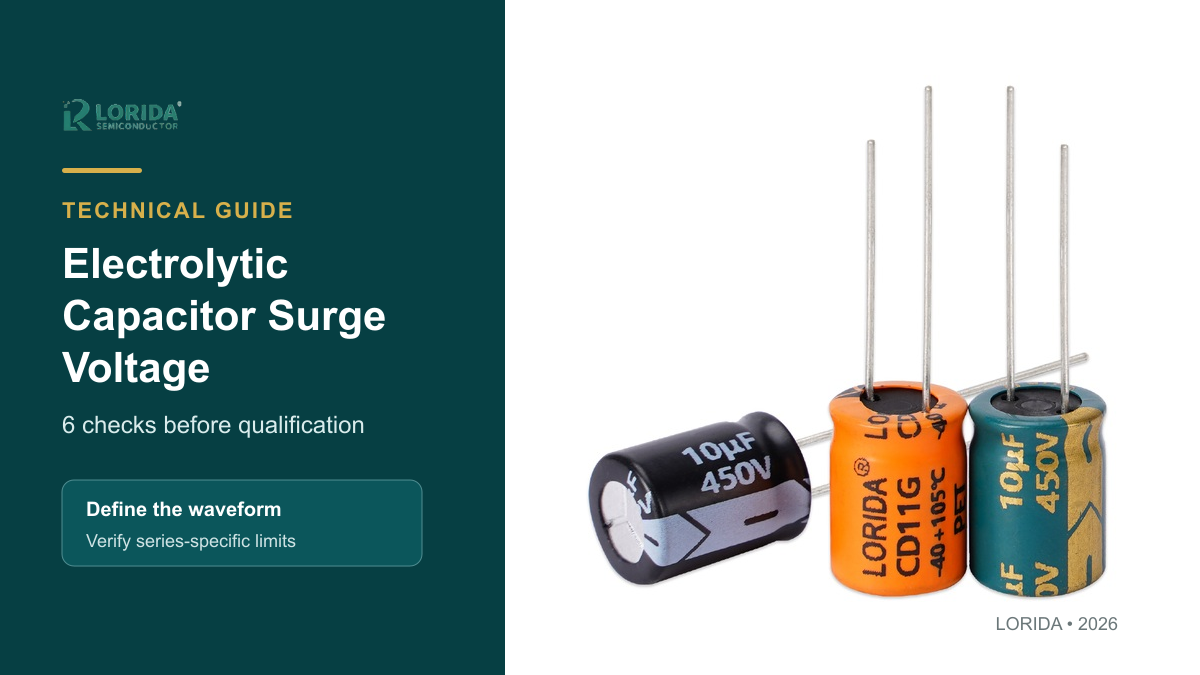
Electrolytic capacitor surge voltage is a short-duration overvoltage allowance, not a continuous operating rating. A buyer should approve it only against the exact series definition, waveform, repetition, temperature, polarity, ripple and post-test limits. TDK permits surge voltage for short periods defined as up to five applications of one minute per hour in its general guidance, while Nippon Chemi-Con describes a different 1,000-cycle JIS test. These are source-specific examples, not universal LORIDA limits.
Keep normal DC plus ripple within the selected series' rated-voltage rule.
Do not treat a surge rating as permission for repeated switching spikes.
Specify peak voltage, duration, repetition, source impedance and polarity.
Use the exact series test method and acceptance limits.
Validate the real assembly before production approval.
What Surge Voltage Means
Rated, surge and transient voltage are different
Rated voltage is the continuous design value under the stated temperature and ripple conditions. TDK defines surge voltage as a short-period maximum and states that its series limits follow IEC 60384-4. TDK separately describes transient capability because application pulses can differ too widely for one general rating. That distinction matters: a data-sheet surge value does not automatically cover repetitive regenerative peaks, inductive kickback or poorly clamped startup overshoot.
Overvoltage raises leakage, heat and internal pressure
Nichicon explains that leakage current rises sharply above rated voltage. The resulting dielectric formation, heat and gas can increase internal pressure and operate the pressure-relief vent. Its technical note also says energy stored in a capacitor follows one-half C times V squared, so voltage error raises stored energy quadratically. A surge check must therefore address both the capacitor limit and the system energy available during an abnormal event.
Six Qualification Checks
1. Identify the exact voltage category
Record normal DC, highest steady DC, ripple peak, startup overshoot, shutdown behavior and fault clamp level separately. TDK states that continuous DC plus superimposed AC must not exceed rated voltage and must not cause polarity reversal. Ask the supplier to label every quoted number as rated, surge or transient and attach it to an exact part number or controlled series sheet.
2. Capture the complete waveform
A single peak number is incomplete. Provide pulse width, rise time, repetition rate, source impedance, duty cycle and the operating mode that creates the event. A 500 V peak lasting microseconds is not equivalent to 500 V for 30 seconds. Export an oscilloscope capture with probe type, bandwidth, grounding method and trigger condition so the supplier can judge whether a surge, repetitive pulse or separate transient qualification applies.
3. Check temperature and ripple together
Surge capability does not cancel thermal limits. Record ambient, case temperature, airflow, neighboring heat sources and RMS ripple by significant frequency. TDK requires both the voltage and ripple-current limits to be respected. When ripple is already heating the capacitor, an overvoltage event begins from a higher internal temperature. Test the worst repeatable mission-profile mode, not only a room-temperature no-load startup.
4. Confirm repetition and recovery time
Manufacturer methods are not interchangeable. Nippon Chemi-Con summarizes a JIS example with 1,000 cycles at 15 to 35 degrees C, 30 seconds of surge-voltage charging, 5 minutes 30 seconds open, and a protective resistance selected for an RC time constant of 0.1 plus or minus 0.05 seconds. TDK's general definition instead allows up to five one-minute applications per hour. Use the rule for the offered series, not the more convenient test.
5. Protect polarity and discharge paths
Aluminum electrolytic capacitors are polarized. Nichicon notes that the natural oxide on the cathode foil withstands only about 1 V in its general explanation; higher reverse stress can increase current, gas and pressure. Include every startup, brownout and shutdown interval in the waveform review. Define the discharge resistor, bleed path, series protection and safe verification method. Never infer that a surge allowance also permits reverse voltage.
6. Define post-test acceptance
Qualification must say what is measured before and after the sequence. Include capacitance, dissipation factor, leakage current, ESR or impedance when applicable, appearance, vent condition and insulation checks. One LORIDA approving-sheet example uses 1,000 charge-discharge cycles, 30 plus or minus 5 seconds charging, about 5 minutes 30 seconds discharging, a 1 kΩ protective resistor and 1 to 2 hours of stabilization before measurement. Treat that as a document-specific example and request the controlled specification for the proposed part.
| RFQ field | Required evidence | Approval question |
|---|---|---|
| Voltage categories | Rated, highest steady, surge and transient values | Which exact limit applies? |
| Waveform | Peak, width, rise time, repetition and impedance | Is the event repetitive? |
| Thermal state | Ambient, case temperature, airflow and ripple spectrum | What is the hottest starting condition? |
| Test method | Series document, cycle timing and protection | Does it match the offered part? |
| Acceptance | Electrical and visual limits before and after test | Who owns the pass/fail criteria? |
How to Build the RFQ and Sample Plan
Send electrical and mechanical context together
Provide capacitance, tolerance, rated voltage, polarity, terminal style, dimensions, mounting orientation, vent clearance and application. Add the measured waveform for normal, startup, shutdown and fault modes. Buyers can review the LORIDA capacitor product center and a representative screw-terminal capacitor page, but final limits require the exact series file and approved sample.
Separate screening from qualification
A bench screening run can expose wrong assumptions, but it is not automatically a qualification test. First verify probe setup and worst-case waveform. Then agree the cycle count, temperature, protection, recovery time and measurements. Link every sample to its lot, position and instrument record. For related checks, use the ripple-current RFQ guide and the leakage-current test guide.
Frequently Asked Questions
Can I operate continuously at the surge-voltage value?
No. Surge voltage is a short-duration allowance under a defined series test, while rated voltage is the continuous operating limit. TDK's general guidance allows surge exposure only for short periods and places continuous DC plus ripple under the rated-voltage rule. If the circuit repeatedly reaches the surge value, classify it as a repetitive operating condition and obtain a series-specific assessment. Measure the actual waveform, repetition, temperature and ripple, then redesign the clamp or select a suitable part rather than treating the surge number as extra continuous margin.
Is 1.15 times rated voltage a universal surge rule?
No. Nippon Chemi-Con says surge voltage is generally 1.15 times rated voltage at or below 315 V and 1.1 times above 315 V, with a different note above 500 V, but it also warns that some series differ. Other manufacturers define their own tables and exposure methods. Use these values only to understand why the rating is conditional. The offered capacitor's controlled data sheet, operating temperature, waveform and test method must determine the actual limit.
Does a brief startup spike count as surge voltage?
Only if the exact series documentation and supplier review classify that waveform within the surge allowance. Startup spikes can have different rise times, durations, source impedances and repetition from a catalog surge test. Capture the event at worst line, load and temperature, including any ringing and polarity reversal. Provide the trace and circuit context. If the pulse exceeds the published surge definition, treat it as transient qualification or redesign the suppression network instead of assuming the capacitor will tolerate it.
What should sample testing record?
Record the complete electrical, thermal and traceability package. Include part number, lot, capacitance, voltage, polarity, test temperature, waveform, cycle timing, protection resistance, current, case temperature and instrument IDs. Measure the agreed electrical parameters before and after testing and inspect the sleeve, seal and vent. Photograph the setup and sample orientation. Do not approve a lot from capacitance alone; leakage, dissipation factor, ESR or impedance and visual acceptance may reveal damage that a single capacitance reading misses.
Primary Sources
Documents used for the numerical examples
Last Updated: 2026-11-10
Send LORIDA the waveform, thermal conditions, dimensions, series requirements and acceptance plan. Final limits remain subject to the controlled specification and approved sample.